FARM STORE EVENTS · VISITOR INFORMATION
Approve where guests may arrive, check in and take part before printing event materials. Make the boundary between a public activity and farm production explicit.
Start with an approved visitor journey
Before designing a farm-event invitation, confirm the activity, arrival point, check-in location and route guests are allowed to use. Then describe which areas the invitation includes and where visitors should ask for help.
An event at a farm store does not automatically include a field visit, greenhouse tour, harvest activity or access to a packing room. Make those distinctions in the invitation and staff brief. A welcoming photograph of crops cannot establish permission to enter them.
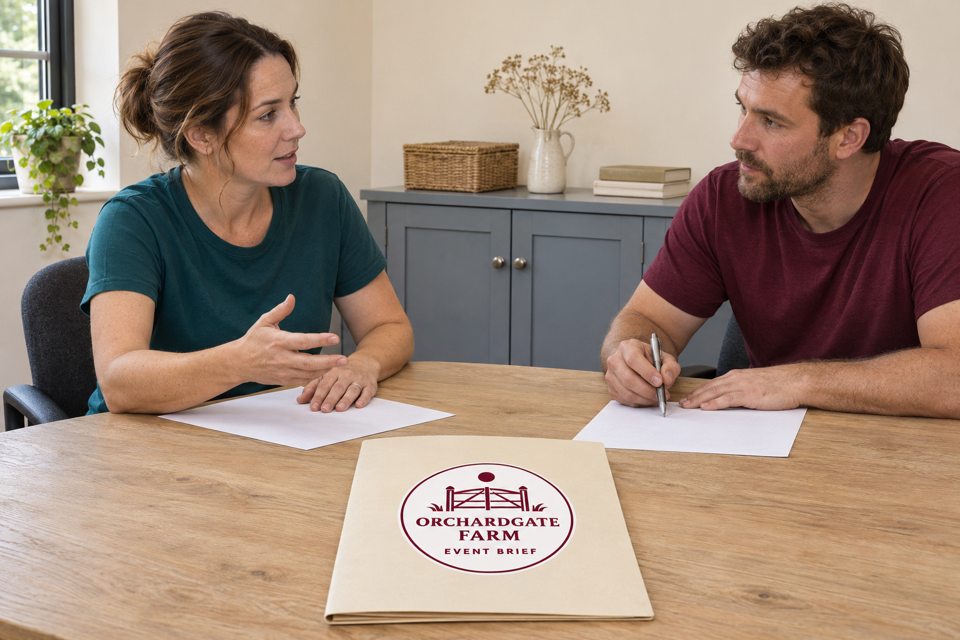
Use the actual farm’s rules rather than a generic open-day promise
Granor’s farm-store FAQ distinguishes a visitor walking path from fields, hoophouses, greenhouses and chicken coops. Its parking instructions are also specific to that property.
Lansing’s visitor rules describe a working farm with designated parking and limits around equipment, the house and barn. An advertised activity should follow the operator’s particular permission, rather than imply that everything visible is open.
The UW Farm CSA page describes community events within an educational program. It is an example of a particular program, not evidence that another farm offers the same activities or has authorized an outside organizer.
Ask the responsible operator to resolve the event’s scope before selecting the message and materials. Record the approved activity area, the route between named points, the areas outside that permission and who can approve a change. Obtain the actual property and activity permissions; a design brief does not grant them.
A completed brief for a fictional indoor workshop
Suppose Orchardgate Farm has approved a registered paper-collage workshop in its west meeting room. The following names, arrangement and approval are fictional teaching details. They describe no real property or bookable event.
Workshop visitor brief · version A
- Activity and time
- Paper-collage workshop, Sunday, November 15, 2026, 2–3 p.m. Eastern Time. Check-in begins at 1:45 p.m.
- Approved arrival
- Guests use the designated visitor lot, then the main visitor entrance and courtyard path to the reception desk. The host meets checked-in participants and takes them to the west meeting room.
- Included area
- The approved arrival route, reception point and meeting room. This workshop includes no field tour, picking activity or production-area visit.
- Outside the event
- Growing fields, greenhouses, packing rooms, equipment areas and staff-only doors remain outside the workshop invitation. Guests ask the reception team if they are unsure where to go.
- Responsibilities
- The farm operator approves the area and route. The event editor maintains the current guest message. The reception team uses that version to direct arrivals; the host handles the meeting-room activity.
The role names indicate responsibilities, not a staffing ratio or evidence that any real site can accommodate the event. For an actual property, confirm names, locations and conditions through its authorized team.
If CSA collection happens on the same day, keep its instructions separate. An event reception desk does not become a member pickup point merely because both activities use the farm store. Link the correct separate CSA pickup instructions where members need them.
Turn the approved brief into a readable arrival message
For the fictional version-A arrangement, the message sent with a participant’s confirmed event details could say:
No message was sent for this article. Real communications must include the confirmed address, actual contact route and any operator-approved arrival details needed by that audience. A visitor should not have to identify an unfamiliar building from a decorative farm photograph.
Resolve access questions with the responsible team before promising a route or arrangement. Do not describe an unassessed path as accessible or invent parking capacity, walking times or site-specific emergency instructions. These need the property’s actual assessment and plans.
Walk a closed-route problem through to a corrected message
Continue the fictional example. Before guest arrival, the operator closes the courtyard route. The editor has not yet received approval for another entrance. The next step is to obtain the operator’s decision; it is not to draw a shortcut beside a greenhouse or direct visitors through a staff door.
In the completed teaching outcome, the operator confirms a different visitor route through the west visitor entrance and moves reception just inside that door. The workshop remains in the west meeting room at the same time. This is an assumed approval within the example, not an assessment of a real alternative route.
The correction identifies exactly what changed, what stayed the same and which earlier instruction it replaces. If the actual operator cannot approve a workable arrangement, the event team must communicate the resulting decision, including any change or cancellation, under the event’s real terms. Do not publish a hopeful replacement route as confirmed.
Complete the change in the places visitors actually use
- Replace the current event-page instructions and read the public version after saving.
- Send the correction through the event’s authorized participant channel. Already-sent messages remain in inboxes, so identify the superseded version clearly.
- Replace or cover the obsolete arrival information where the operator permits it, and brief reception and the host from the same current version.
- Have the responsible team check the actual arrival arrangement before directing guests there. Record unresolved locations or instructions and who must resolve them.
This communication sequence does not replace site management, traffic planning, emergency arrangements or activity-specific requirements. Those remain with the appropriate authorized people and plans.
Give each material one job at its intended location
A pre-visit email explains arrival. An approved on-site notice supports a particular decision point. A staff brief records the current route, responsibilities and exceptions. A logo header identifies the document; it does not perform all those jobs.
Before buying new materials, check whether the existing web page, reusable notices and plain briefing folder already serve the task. If a stable indoor header is useful, compare custom labels and stickers for that limited role.
An indoor briefing-folder identity
The linked custom product labels page offers material, shape, size and finish options. Its white-paper option is described for indoor use and dry products. The Orchardgate artwork is a paper folder-header concept in that dry setting.
The listed package is 1 × (N) sheet. Ordering quantity 1 does not establish the finished label count; confirm the configuration, yield, artwork and surface first.
No outdoor durability, attachment strength, removability or safety-sign performance was established. Evaluate outdoor directional materials separately for their actual location and purpose.
Approve the journey, then release matching information
Read the invitation alongside the staff brief: do they name the same arrival point, check-in desk, activity area and current version? Can a guest tell what the event includes and where to ask when unsure? Correct conflicting instructions before calling the materials complete.
Explore suitable printed identification at DecentCustom when the approved brief identifies a need. A clearer existing notice and a shared current version may be the better choice.
Prepared by DecentCustom from the linked operators’ pages, original industry research and current catalog, reviewed November 7, 2026. Orchardgate Farm, the workshop, roles, permissions, times and route change are fictional. No event was booked, message sent, site inspected or visitor route approved for a real property.