Farmers market purchasing guide
A shopping carrier, a staff shirt and a souvenir for sale are different proposals. Confirm the exact use before paying for branded stock.
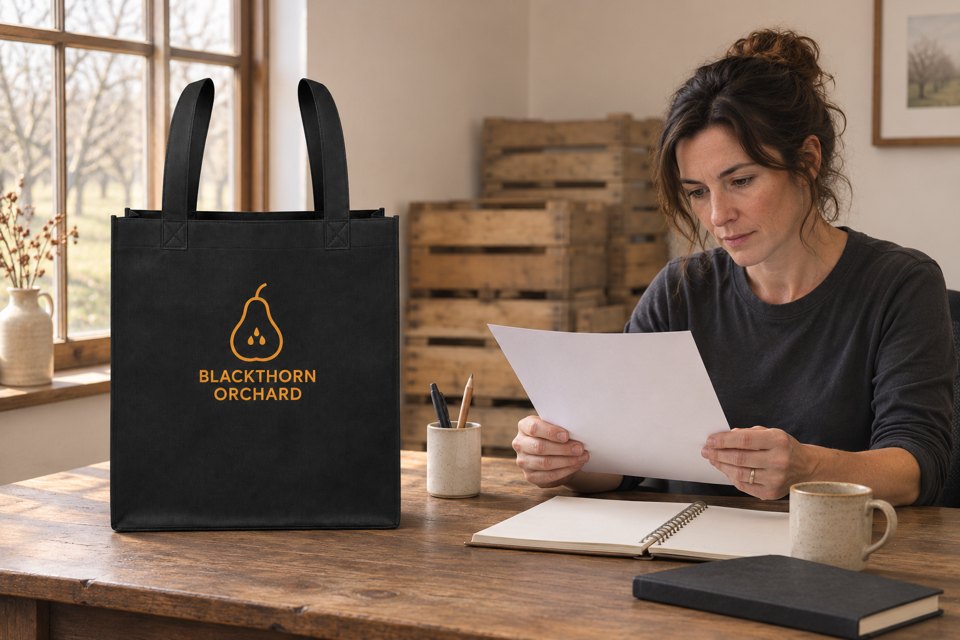
Define what you plan to do with the item
Before ordering farmers market bags or branded merchandise, write down the item’s intended use. A carrier supplied with a purchase, a reusable bag offered for sale, a shirt worn by staff and a shirt sold as a souvenir are different activities. Permission for one does not establish permission for the others.
Start with the market you actually attend and your approved vendor arrangement. The market organizer and the individual farm or food business are different decision-makers. A supplier’s product description cannot grant permission to display or sell an item at that market.
Use four short descriptions to keep the proposal precise:
- Checkout carrier: what the bag will carry, whether it is supplied or sold, and the exact material.
- Reusable shopping bag for sale: the proposed price, display arrangement and product specification.
- Staff use: who will wear or use the item, with no offer of that item for sale.
- Branded merchandise for sale: each proposed product, rather than the broad phrase “farm merchandise.”
Keep essential market identity and price displays separate from a proposed merchandise range. A business can still identify its stall without committing to an unapproved batch of souvenirs.
A real handbook shows why the distinction matters
Portland Farmers Market’s 2026 vendor handbook, pages 8 and 18, excludes branded merchandise such as shirts and stickers from sale, while allowing reusable shopping bags priced at $10 or less. Page 18 also says those bags must be sturdy and occupy only a small part of the booth display. This is that operator’s stated policy, not a rule for every US farmers market.
The exception does not establish that every product advertised as a “reusable tote” qualifies. Confirm the proposed material, construction, use and display with the actual organizer. Also check the current rules that apply to the place and transaction. This guide does not classify a particular bag under local law.
For a different market, use its current handbook and vendor contact process. Record the document or response, its date, the market and the exact item/use covered. An approval for a different stall, an earlier season or another material leaves a gap in the purchasing brief.
A completed request before artwork becomes stock
Fictional example: Blackthorn Orchard is an approved produce vendor considering an additional shopping bag. Its owner, Nora, has not ordered the bags and has not obtained permission for this proposal. She prepares the following message for the market’s actual vendor contact route:
Subject: Confirming a proposed reusable shopping bag at our stall
We would like to confirm whether the following use is permitted at our approved Blackthorn Orchard produce stall before ordering.
The proposed item is a black non-woven polypropylene shopping bag with our orchard name and a pear graphic. The listing states 80 GSM material, a bottom board and two carrying straps. We intend to offer it as a shopping carrier for sale at $8 per bag, rather than introduce a separate souvenir range. The proposed display is one example bag beside checkout; the remaining stock would stay with our stall supplies.
Could you confirm whether this exact bag type, proposed sale and display arrangement are permitted, and whether you need a sample or further specification before deciding? The supplier’s product link and an artwork concept would accompany our request. We are not treating this message as permission to order or sell the bags.
We are also considering staff shirts for staff wear only. Please let us know whether that use has separate requirements. We will not offer shirts or stickers for sale on the basis of a shopping-bag response.
This is complete example wording, not an actual message sent to an organizer. The $8 price and display plan are fictional choices, not a recommended margin, a quotation or evidence that the bag satisfies a market’s requirements.
Turn the answer into a clear purchasing decision
If the answer is pending or does not cover the material
Nora marks the proposed bag order “on hold.” The team continues using packaging already permitted for its actual produce sales. It does not announce the new bags, take payment for them or assume that a logo makes them an approved extension of the produce business.
A reply saying “shopping bags are allowed” still needs to cover the proposed use and relevant conditions. If a requested sample or material detail remains unresolved, keep that part of the order unresolved too. Do not replace the proposed polypropylene bag with canvas, paper or another construction and carry the earlier answer across without checking.
If the exact proposal is confirmed
In a separate, hypothetical branch, the organizer confirms the specific bag, sale and display arrangement. Nora keeps that response with the brief and checks that the final supplier configuration matches it. She then reviews the actual packing task, intended quantity, artwork position and complete quotation before deciding whether to buy.
Approval to sell does not establish demand. Existing permitted packaging may still be enough. A large carton, an attractive starting price or a free artwork concept is not a reason to order stock without a practical use and a person responsible for it.
If the proposed item is not permitted
Remove that item from the market purchasing plan. For example, permission for a shopping carrier would not reverse a refusal to sell branded shirts. Keep any separate staff-use question separate, and use the market’s actual process for a revised proposal.
Check the bag specification after the use is established
Compare custom non-woven bags only after defining the relevant material and use. A product category is a selection aid; it does not confirm market eligibility.
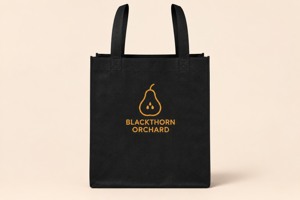
13W × 15H non-woven grocery bag
The current listing specifies 80 GSM non-woven polypropylene, a bottom board and a 5W × 8H inch imprint area. Its dimensions are written as 13W × 15H × 10 inches; the third axis is not named. Confirm the finished dimensions needed for the actual packing task.
The current minimum/default quantity is 12 bags. “Case pack: 100” is a separate listing detail, not that minimum. Neither the material name nor the word “reusable” proves approval, food-contact suitability, a carrying-load rating or an environmental benefit.
AI artwork concept of a black Blackthorn Orchard bag, with the same fictional identity as the preparation scene. Click the small image for the exact product. No market operator has approved this artwork or product through this guide.
Give the supplier a settled brief
Once the use and relevant permissions are clear, take the exact configuration, intended quantity and artwork to DecentCustom for current options and a complete quote. Keep the approval record attached to that brief so a change of material, use or display does not disappear during ordering.
Prepared by DecentCustom, reviewed November 7, 2026. The handbook example is specific to Portland Farmers Market. Blackthorn Orchard, Nora, the request and both decision branches are fictional editorial examples. No actual approval, message, order, legal assessment or physical performance test has been completed. Source organizations do not endorse the product.