Grocery store buying guide
Choose bags around the purchases leaving your store, the person packing them and the space available for the next order.
A bag can look right on a product page and still be awkward at your register. A box may sit across the base instead of inside it. A tall package may leave too little room to grip the handles. A bulk order may fit the budget but take over the shelf you use for back stock.
Start with three checks: measure representative purchases after they are wrapped, try the bag through your packing routine, then choose a quantity and reorder point from actual use and available storage.
For an independent food shop, that may mean one everyday carrier and a smaller bag for wrapped snacks. A store offering pickup may need a separate arrangement. The useful mix depends on the services you actually provide.
Start with the way your store works
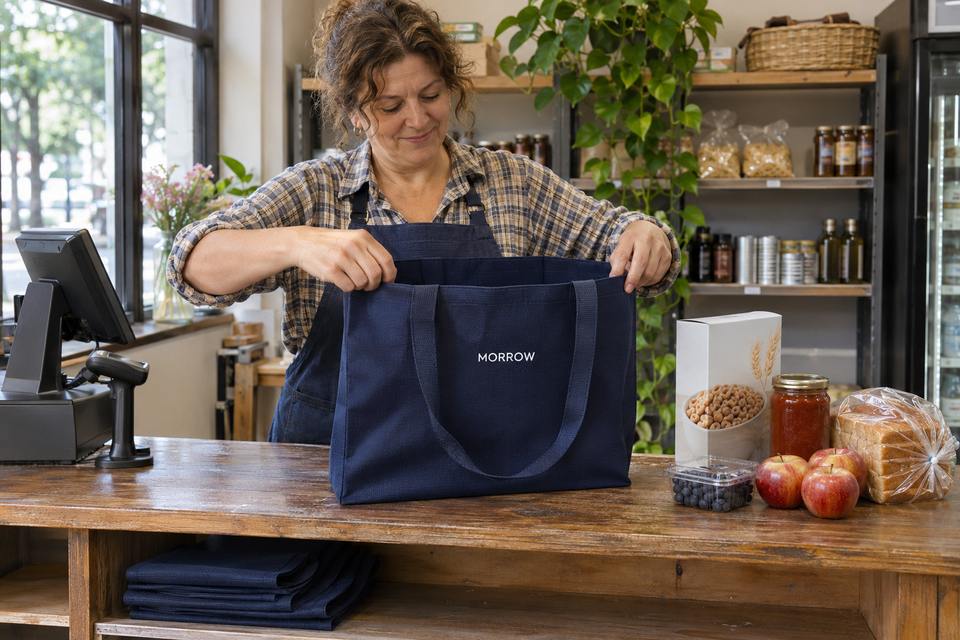
Space and service make a practical difference. In an owner-written account from Henderson, Nebraska, a 900-square-foot mercantile describes keeping back stock in a small refrigerator and on a bottom shelf. Its food-supply choices reflect that limited space. For a shop with similar constraints, bag cartons also need a planned home.
Other stores have different handoffs. Weaver Street Market describes online pickup and delivery, with orders shopped by its staff or Instacart shoppers depending on demand and staffing. GreenStar’s bulk-shopping instructions include customers bringing containers, recording tare weight and then checking out. Those operations should not all be given the same packaging plan.
| Your operating situation | Check before ordering bags |
|---|---|
| Compact walk-in grocery Limited back stock and a small checkout area | Where opened bags sit, how much a delivery occupies and whether two useful sizes cover normal purchases. |
| Store with pickup orders Purchases may be packed before the customer arrives | Who packs, where orders wait, how bags are identified and how the customer receives them. |
| Bulk or refill shopping Customers may already bring suitable containers | Which transactions still need an outer carrier. Count bags issued separately from transactions. |
These are separate public operating examples, not DecentCustom customer case studies. Your staffing, bag use and storage capacity need their own check.
Choose the size from a packed purchase
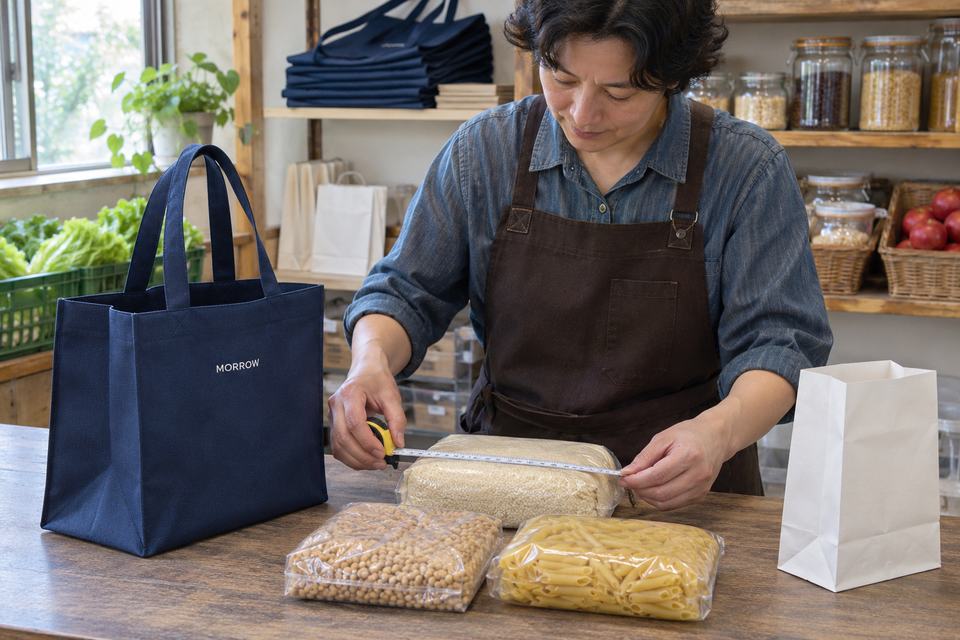
Set out three representative purchases: a small top-up, an ordinary mixed basket and a bulky order. Keep the packaging your customers will receive around each item. A jar in protective wrapping takes more space than the bare jar.
Check the bag’s usable base, opening and height. Width and height alone do not describe the footprint. A gusset is the fold that lets the side or base expand. Suppliers can list dimensions in different orders, so identify what each number means before comparing two products.
- Base: can the widest wrapped package sit the way you intend, without forcing the corners?
- Opening: can the packer lower items into the bag while using the checkout space normally?
- Height and closure: is there room to hold the handles or fold a paper top after packing?
- Mixed purchases: do fragile items need separate protection or a second bag?
A paper mock-up can help screen dimensions. A physical bag with representative contents is the better next check for handling and carrying. A printed size, fabric weight or AI scene does not establish a tested load capacity.
Try the bag at the register and through the handoff
If one employee scans and packs, watch what happens between those actions. Where does the empty bag sit? Does opening it require moving the next customer’s goods? Can the employee reach spare bags without leaving the checkout? Ask the employee where scanning, bagging and customer requests tend to overlap in your own routine.
For pickup, follow the order beyond the counter: packing, waiting area, identification and handoff. Confirm who controls the packaging when a third party shops the order. Keep any order identifier limited to the information staff need, rather than printing personal customer details on a reusable bag.
A short trial to run with your team
- Pack the same representative purchases in each candidate format.
- Ask the person who normally packs to open, fill and hand over each one.
- Record awkward movements, missing protection and whether a second bag was needed.
- Check the space for open bags and the space for an unopened delivery.
Keep a working alternative in the comparison. Your current plain bags, an appropriate sticker, or a customer’s own carrier may already do the job. Custom printing adds store identification; it does not replace a bag that fits or an orderly packing process.
Three product formats to compare against that routine
Browse custom grocery bags for wider format choices, then compare the examples below with your test basket and current order options. Click each small product image to open its product page.
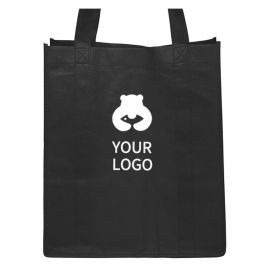
Non-woven grocery tote
An open carrier to compare for mixed, individually packaged purchases. The listing specifies 80 GSM polypropylene, an inner bottom board and a 13-inch width by 15-inch height. Confirm its opened base dimensions for your basket.
Order check: the current minimum is 12 bags; the listed case pack is 100. The stated imprint area is 5 W × 8 H inches.

Small white paper bag
Among custom paper bags, this is a separate format for suitable dry, wrapped snacks or small retail handoffs. Its listed size is 4.75 W × 8.75 H × 3 inches. It has no handles or laminated poly liner, so check the inner packaging and the way the customer will carry it.
Order check: 200 bags minimum; 500 is the case pack. Check the full wrapped item and leave room if you will fold the top.
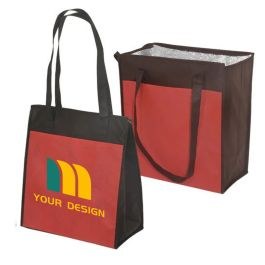
Foil-lined grocery tote
A candidate when your actual pickup or carrying routine calls for this structure. The listing gives 14.5 H × 11.5 W × 7 D inches, 80 GSM polypropylene and a maximum logo area of 8 H × 8 W inches.
Order check: 50 bags minimum. Establish suitability for your contents, route and cleaning process separately; this guide makes no temperature-hold or tested-load claim.
Product-page photos show sample artwork. Specifications and quantity limits were checked on November 2, 2026; review the selected options and final total before ordering.
Set a reorder point for each bag you actually use
Use your shop’s own bag-use and inventory records for this calculation. Count each format separately: small paper bags issued, everyday carriers issued and any pickup bags issued. A customer bringing a bag should not be counted as a store bag used.
Use representative weeks and note promotions or changes in service. Then confirm the time from artwork approval through production, transport and receipt. Keep the time units consistent.
Illustrative reorder calculation
Reorder point = average weekly use × (total lead time + buffer time)
- Assumed use for one bag format
- 80 bags per week
- Assumed approval-to-arrival time
- 3 weeks
- Chosen buffer
- 1 week
- Example reorder point
- 80 × (3 + 1) = 320 bags
All inputs above are hypothetical. They are not measured store demand, a DecentCustom delivery promise or a universal recommended buffer.
At a stock check, count usable bags across the checkout and back stock, and note bags already committed to prepared orders. Check confirmed incoming orders before placing another one. A shipment expected after you run out does not cover that earlier gap.
Use the reorder point to decide when to act. Choose how many from the minimum order, expected use, final order cost and storage space. For the compact shop in the Henderson example, a lower unit price alone would not answer where another carton could go.
As a sensitivity check, the same assumed 80 bags a week would give a 400-bag trigger if total lead time became four weeks and the one-week buffer stayed unchanged. Recheck the inputs when your supplier, artwork or operating routine changes.
Keep a short bag-order brief
Before approving the design or quantity, put these details in one place for the person ordering and the person packing:
- Use: walk-in purchases, wrapped snacks, pickup or another confirmed service.
- Fit: wrapped-item measurements, opened base, opening, handles or folded closure.
- Artwork: the correct store name, a readable contact detail if needed, print area and printed side.
- Stock: usable bags on hand, confirmed incoming quantity, weekly use, reorder point and delivery-storage space.
- Approval: who chooses, who checks the preview, who pays, the final total and the required arrival date.
Give recurring designs a final spelling and contact-information check before every reorder. Product options, print areas and quantities can differ between formats. Check the selected configuration rather than assuming the last order’s settings apply to a different bag.
If you are coordinating bags with other store materials, explore custom products from DecentCustom and carry the same spelling, artwork and approval checks into each order.
Questions before you order
What size grocery bag should a small store choose?
Measure representative purchases after wrapping, then compare the usable base, opening and height. Trial the candidate with the person who packs. A small snack handoff and a mixed grocery basket may need different formats.
Does a case pack tell me the minimum order?
No. They are separate specifications. For example, the white paper bag above has a 200-bag minimum and a 500-bag case pack. The non-woven tote has a 12-bag minimum and a listed case pack of 100.
Should every purchase leave in a custom bag?
Base that choice on your service and customers’ existing carriers. Bulk-container users and customers with their own bags may not need another carrier. Keep ordinary bags or suitable labels in the comparison if they meet your current needs.
When should I reorder grocery bags?
Track use by format and cover the full approval-to-arrival period plus a buffer suited to your operation. In the hypothetical example above, 80 bags a week over three weeks plus one buffer week gives a 320-bag trigger. Use your own figures.