An egg farm shop needs more printed materials when an actual information job remains unmet, existing supplies cannot serve it and the proposed item fits the setting and quantity required. Start with the job and usable stock. Updating a current notice or retaining an appropriate carrier can be the complete decision.
Different shop activities do not create the same purchasing need
The prepared research uses an egg ranch with a shop and an egg machine as its service example. The limited indexed Glaum Connect listing also describes local food and gifts in the shop. Selling gifts is not evidence that the owner needs a new bulk giveaway program. Its direct site reported an error during our review, so current services and stock remain unconfirmed.
Review each practical job separately:
- Helping a visitor choose the right service: first check whether existing information distinguishes shop and egg-vending hours. If the wording is inaccurate, correct the information before commissioning another design.
- Carrying an egg purchase: retain the original package and evaluate egg-tray and outer-bag fit. A new logo does not resolve an unsupported carrying arrangement.
- Explaining a service change: assign an owner to egg-shop service-information updates. A static printed item cannot substitute for a current machine-status or replenishment record.
- Identifying the shop: assess the actual missing identification and its permitted placement. Do not turn that limited job into assumptions about gift recipients, employee headcount, vehicles or events.
A single shop may need an information update, a carrier review and no new printed purchase. Keep those outcomes distinct rather than buying one item and claiming it solves every job.
Count what can serve the current job, not everything in storage
Inspect the materials intended for the actual location. Separate items with current approved wording from outdated versions, unsuitable formats and pieces already committed elsewhere. Keep a record of why an item is excluded; a storage count alone does not establish usable stock.
For information materials, check both physical condition and content. A clean sign with an obsolete schedule is not ready for display. A current notice hidden inside a closed shop does not necessarily serve someone choosing an outside self-service visit. Reading location is part of the job.
Consider whether the existing material can be updated appropriately or whether an ordinary low-quantity notice is sufficient. Do not assume that every printed paper product is rewritable, that a replacement insert fits an existing holder or that an adhesive can be removed without consequences. Verify the actual construction and surface before choosing a modification.
Check the format before comparing bulk quantities
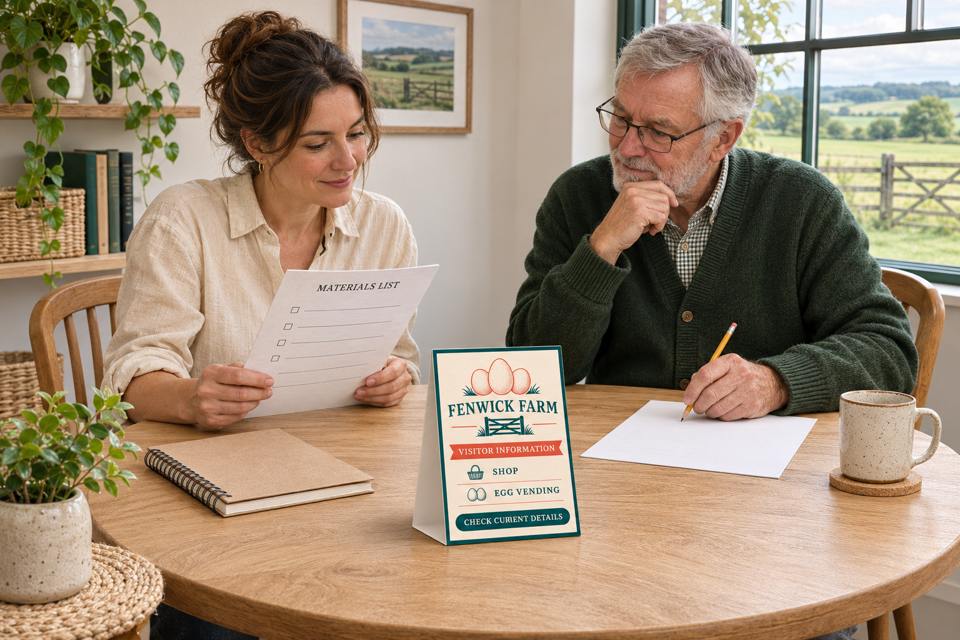
AI artwork concept only. The Fenwick service headings demonstrate a possible layout, not a complete operational notice, tested paper finish or approved print proof.
Work out the new requirement before accepting the minimum order
This Fenwick example is fictional. Assume the owner has approved two dry indoor positions, one current freestanding tent per position and no reserve requirement for this review. One existing tent is usable and current. Another has obsolete wording and is excluded from current display stock; it has not been destroyed.
Review M40 — one new unit needed, not twenty-five
Required display units: 2 positions × 1 unit = 2 units.
Usable existing units: 1.
Net new requirement: 2 − 1 = 1 unit.
Candidate’s observed minimum: 25 new units.
New units beyond the present requirement: 25 − 1 = 24 units. Combined with the retained current tent, that purchase would leave 26 units against two approved positions.
Decision: do not approve a production order from these inputs alone. Review a suitable ordinary low-quantity option or another appropriate way to supply the one remaining position. Do not invent future placements to justify the minimum.
The 24-unit difference is excess relative to this defined requirement, not proof that every extra piece would be wasted. Verified future uses could change the calculation. Record their actual quantity, timing, wording stability and storage implications before adding them to the requirement.
Compare complete quotations on the same basis: selected item and configuration, quantity, any applicable options, delivery and tax. Unknown charges are not zero. A lower advertised unit price at a larger quantity is not evidence that the larger total purchase serves the current job.
Write down a decision that another person can review
Nell and Fenwick Farm are fictional. The memo below uses only the example inputs above and does not authorize a real purchase.
Nell’s completed materials decision memo
Purpose: provide current service information at two approved dry indoor reading positions. This review does not cover outdoor machine instructions, egg packaging or a giveaway program.
Existing materials: retain the one current usable tent. Keep the obsolete version out of current display stock and preserve its record for review. No material is assumed reusable merely because it is present.
Remaining need: one appropriate display unit. The observed minimum of 25 for the candidate would exceed that present need by 24 units. We have no verified additional placements in this example.
Current decision: no production order approved. Assess a suitable ordinary low-quantity display for the remaining position. The service-information owner must check the wording and the responsible person must review actual placement and legibility.
Conditions for reconsidering the candidate: establish suitability, any genuine additional requirement, the actual selected configuration and complete quotation. Confirm the required-use date, preparation date and feasible order date separately. No delivery date or budget has been assumed.
Record owner: Nell, fictional materials-review coordinator. Update this decision if its verified inputs change; a design mockup is not purchasing approval.
That memo gives the next reviewer the purpose, arithmetic, unresolved conditions and current outcome. It is more useful than “order more farm-shop supplies,” because it shows why a purchase has not yet been justified.
Bring a defined requirement to the quotation stage
If a new printed item is justified, share the approved job, usable-stock count, quantity and artwork brief with DecentCustom. If updating existing information or using an ordinary material serves the need, record that outcome. The decision is complete when the actual job is addressed, even when no new custom order is placed.
Research scope: the prepared egg-and-farm-shop workbook, the limited indexed operator listing and the current DecentCustom product page. All Fenwick quantities, decisions, people and artwork are illustrative. No actual inventory inspection, quotation, purchase, print test or business result occurred.