The word volunteer does not tell a visitor who can answer which question. Confirm the actual assignment, training and receiving contact before putting a role on a card, sign or shirt.
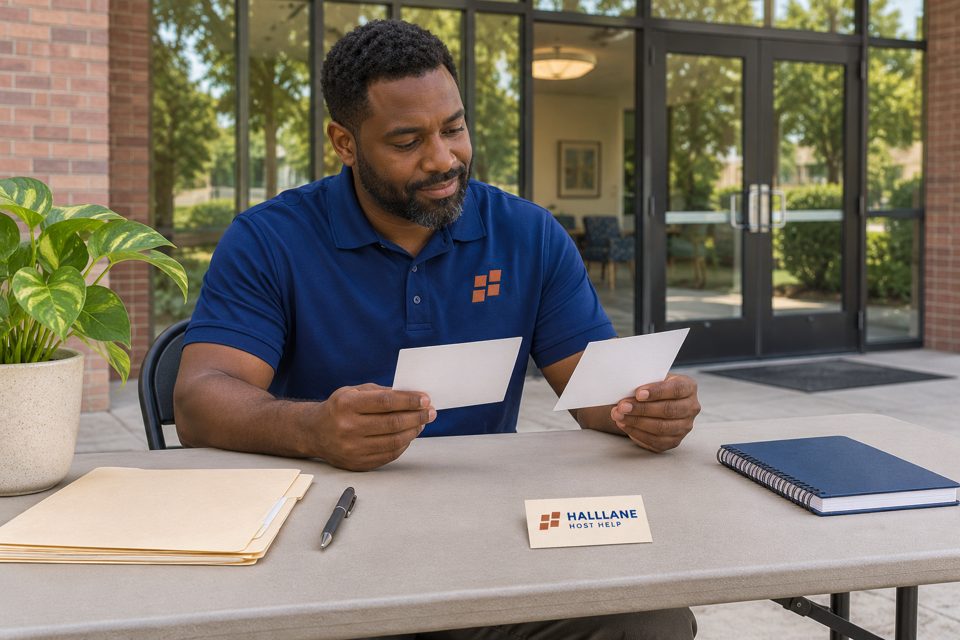
A host helper and a collector’s volunteer may have different assignments
When preparing a January blood-drive campaign, distinguish people supplied by the venue from people serving through the collecting organization’s own volunteer program. The same person might participate in either arrangement, but the assignment needs to be explicit. Willingness to help and a printed role label do not establish training or authorization.
The Red Cross hosting guide distinguishes the host’s location and volunteer support from the collector’s planning assistance and trained collection staff. Its day-of-drive section also identifies facility questions and volunteer scheduling as host coordination tasks. Treat that as one organization’s published model and confirm your own arrangement.
Separately, the Red Cross Blood Donor Ambassador page describes a specific volunteer role, training and variation by local need. It should not be used as a ready-made duty list for every person the venue recruits. Vitalant’s public volunteer overview likewise lists different opportunities, including blood-drive, transportation and administrative roles, with regional variation.
| Person or group | What the coordinator should establish | What a printed label cannot establish |
|---|---|---|
| Venue or host helper | The specific venue-help task, briefing owner and route for other questions | Assignment to the collector’s volunteer program |
| Collector-assigned volunteer | The collector’s actual role, onboarding requirements and instructions for this event | Completion of training merely because a role name appears on clothing |
| Collection staff | The collector’s designated event contact and approved way for host helpers to reach that contact | Professional status, access rights or responsibility based on matching colors or a logo |
Write a short host-help brief before ordering role materials
Start with an actual task, such as directing visitors to an approved entrance or finding the venue coordinator. Avoid “help with everything.” Ask the host and collector to resolve four practical questions:
- Whose team is this? Record whether the helper is assigned by the venue or by the collecting organization.
- What is the accepted task? Use the approved local description and identify any required briefing or training that remains pending.
- Who receives other questions? Agree a named event role and a way to find that person. Do not invent a public telephone number or publish an internal roster.
- Who covers the next shift? Confirm how the replacement accepts the assignment and receives updated instructions.
Keep personal donor questions within the collecting organization’s approved process. A host-help card should not summarize eligibility rules, invite someone to disclose screening answers at a venue desk or imply that a helper can make a donation decision. The host’s communication task is to identify the appropriate contact, not to create a clinical workflow.
Replace an unassigned title with an accurate host-help message
Fictional worked example. Halllane’s venue coordinator, Morgan, finds a draft card headed “Donor Ambassador—Ask Me Anything.” The venue has recruited two helpers to explain the entrance and locate the venue coordinator. Neither has been assigned that collector-program title. Morgan holds the proposed artwork rather than assuming a familiar title is harmless.
For this invented event, the collector and venue agree that the helpers provide venue directions only. The collector identifies its on-site lead as the receiving role for donation-related questions and explains to Morgan how that lead can be reached. The internal brief records the venue assignment, the limited help task, the receiving role and the relief arrangement. It does not record donor information.
Halllane — Host Help
We can help you find the approved entrance and the venue coordinator. For questions about donating, we will help connect you with the collecting team. Please use the collecting team’s own process for personal donation questions.
The reviewer asks the first helper two questions: “Where should I go?” and “Can you decide whether I can donate?” In the fictional rehearsal, the helper answers the first using the approved venue directions and routes the second to the collecting team. Morgan approves the narrower wording for the host’s materials after both parties confirm the local arrangement.
At the shift change, the second helper receives the current brief and confirms who is acting as the venue coordinator. The first helper does not simply leave the card on an unattended table and assume the title transfers the assignment. If the replacement has not arrived, Morgan handles the coverage through the agreed event plan.
A contact card should explain help, not impersonate identification
First ask whether existing collector-issued identification, venue signs and the briefing already make the distinction clear. Keep the collecting organization’s required identification intact. A new host contact card is optional and should solve a separate need, such as giving a visitor the venue’s approved help information to keep.
Ordinary paper host contact information
These custom business cards for host contact information list a 3.5 × 2-inch format, standard 14pt stock as the default and a current minimum of 50. That minimum is an ordering condition, not a count of volunteers or proof that new cards are needed.
Compare custom business cards for event contacts, then bring approved host wording and artwork to DecentCustom. Keep any organization name or logo within its owner’s permission. A paper card does not confer staff status, system access or a collector affiliation.
AI paper-card concept, not a staff badge, medical credential or sample of an actual collector’s materials.
Review the role again when people or instructions change
Before opening the help point, check that the expected helper has actually arrived and received the current instructions. A name on a planning sheet is not coverage. If the receiving contact changes, update the brief and tell the person currently giving directions; matching yesterday’s card does not make today’s route correct.
Keep appointment instructions separate from role identification. The blood-drive sign-up link review covers the public booking destination. Together, the checks tell visitors where to obtain current information and who can help without expanding anyone’s assigned duties.
Public organization descriptions and product fields reviewed November 15, 2026. The Halllane event, helpers and rehearsal are fictional. Actual duties, training, supervision and identification must be confirmed with the venue and collecting organization; no local staffing, clinical outcome or reader test was verified.