Buy for an unresolved information gap at an approved location. First check the resources already in use, then count only current, usable stock and compare the real shortfall with the supplier’s ordering rules.

Find the missing explanation before choosing a new product
A new branded item can repeat an old mistake if the underlying office instructions are wrong. Start with the question someone cannot answer: where to attend, how to contact the responsible team or what a message confirms. Find the existing resource that should answer it before adding another one.
Bayley Davis Associates’ FAQ describes preparer-issued upload links and an existing Tax Organizer. It also distinguishes its mailing address from an office visitors can attend. These are examples of resources and location boundaries to understand first, not invitations to replace a firm’s document process with a general printed handout.
Willmes Accounting’s process description includes shared folders and workflows during setup or cleanup before ongoing monthly work. An office may already have a usable system. Review what its actual owner maintains instead of assuming every communication problem requires another paper item.
For each relevant resource, record its purpose, owner, current version, actual users and whether it resolves the identified question. Possible resources include the approved service page, appointment confirmation, reception directory and existing general notice. Keep private forms, portals and professional documents within their established processes; an ordinary table tent is not a replacement for them.
Count approved placements and usable versions separately
A listed address does not establish a place to display merchandise. A mailing-only address is not a visitor desk. Shared, temporary and home offices need their own placement decision. Do not multiply a directory’s addresses by one sign each and call the result an order quantity.
At each genuinely approved, ordinary dry reception counter, check whether the existing information is sufficient. If a display still has a purpose, inspect stock by wording and condition. A physically present item with an old contact route is not usable stock for the current request.
| Review | Evidence to keep | Decision it supports |
|---|---|---|
| Existing explanation | Current page, template or notice and its responsible owner. | Fix or reuse it before adding another channel. |
| Placement | Named approved desk and permission from its operator. | Include that location in the display requirement. |
| Stock eligibility | Count, condition, approved wording version and existing allocation. | Separate usable stock from outdated or already reserved items. |
| Remaining requirement | Actual placements or uses, any explicitly chosen reserve and eligible stock. | Establish the shortfall before checking the supplier minimum. |
Leave unknown permission or inventory marked unresolved. Zero is appropriate only when someone has actually established none, or has explicitly chosen no reserve. Visits, service fees, assets under management and staff biographies do not establish a custom-print budget or quantity.
A completed decision: two replacements do not justify twenty-five
Fictional worked example; all counts and approvals are illustrative. Desktrace’s office owner confirms five reception desks may display the same general contact message. A sixth, shared location has not granted display permission, so it is not included as an approved placement.
The coordinator finds five physical paper desk signs. Three are in good condition with the current approved wording, version C3. Two show a retired contact route. Those two are kept out of use and recorded separately; their presence in storage does not make them available for the new requirement. The owner explicitly chooses no reserve for this small request.
New display shortfall = approved placements + chosen reserve − usable stock.
5 placements + 0 reserve − 3 usable signs = 2 new signs needed.
A 25-unit order for that two-sign shortfall would leave 25 − 2 = 23 units without an assigned use. The two outdated signs do not reduce the shortfall, and the unapproved shared location does not increase it.
The product listing’s current minimum is 25. The buyer has no confirmed future use for the additional 23, no approved reserve plan and no complete delivered quote. The owner therefore holds the custom order rather than inventing future demand to fit the minimum.
The completed action record reads:
Decision: retain the three usable C3 signs at their approved desks. Use the office owner’s approved temporary general notice at the other two desks. Keep the two retired-route signs out of use. Do not place a display at the shared location while permission remains unresolved. Do not order 25 custom signs for the present two-sign gap. The coordinator will revisit the record if approved placements, usable stock or a real replenishment plan changes.
The coordinator also checks that the existing service page and contact template use C3’s route. A colleague verifies all five approved desks have the intended current explanation. That is a completed local decision, not proof of cost savings, reduced calls or any supplier commitment.
Check the actual ordering rule after establishing need
When a custom run does have a supported use, keep separate counts for artwork versions that cannot be shared. Confirm the actual product, size, material, quantity control and current full quote. Do not treat a default quantity as a business recommendation.
A conditional option for approved desks
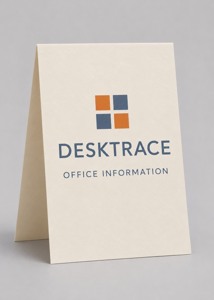
These custom table tents for approved office information are listed as 5 × 7 inches on 14pt card stock. The current quantity field starts at 25 and enforces a minimum of 25 for this listing. That is the ordering constraint used in the example; it does not establish an office’s need.
Compare custom table tents for ordinary office displays, and bring approved wording, artwork, allocation and required date to DecentCustom when the request is ready for a complete quote.
AI paper-product concept, not a physical proof or professional notice. Ordinary printed materials do not establish credentials, protect private files or replace professional review.
Keep the decision connected to the resource owner
Record the stock-count date, version, approved locations, content owner and purchasing decision. If ordering proceeds later, confirm the complete delivered cost, production and shipping plan, receiving location and allocation before committing funds. Unknown freight, tax or timing should remain pending rather than being entered as zero.
For the actual location information, use the office location and remote-options guide. For wording about work already in progress, see the document-status guide. Accurate content and a justified purchase solve related but separate problems.
Public resource descriptions and product fields reviewed November 15, 2026. Desktrace’s inventory and decision are fictional. This article concerns ordinary administrative materials, not financial, tax, legal or privacy-compliance advice.