A file arriving is not the same as a complete submission, an authorized review or a finished deliverable. Name the exact stage, what is still needed and who can confirm the next step.

Say what happened to the documents, not simply “done”
“We have your documents” can mean a successful upload, a checked package or work ready to begin. Those meanings lead to different expectations. An acknowledgment should describe only what the sender can verify. If completeness has not been assessed, do not imply that nothing else is needed.
Professional offices also have different starting points for substantive work. Seattle Divorce Services’ new-client page distinguishes documents supplied as consultation reference from formal document review, which it says begins after the attorney is hired. That is this firm’s stated process, not a rule to copy across every law, insurance or accounting office.
In a different service, Willmes Accounting’s monthly-process FAQ describes questions or clarifications before monthly statements and reports are delivered. A folder containing files therefore does not answer every question needed to produce a final output.
| Useful stage | What the message should establish | What it should not imply |
|---|---|---|
| Receipt acknowledged | The named items arrived through the agreed channel. | Everything required is present or formally reviewed. |
| Information still needed | The responsible team has identified a specific missing item or clarification. | A fixed completion date before that dependency is resolved. |
| Review underway | The authorized owner confirms that the relevant review has started. | Approval, acceptance by another organization or final delivery. |
| Defined output delivered | A named version or deliverable has been issued through the agreed route. | Every later filing, third-party decision or wider engagement is complete. |
These are wording distinctions, not a replacement workflow or mandatory software labels. Retain the office’s actual process. Where a portal already explains the stage clearly, avoid creating a parallel spreadsheet or paper status system that can fall out of step.
Give each statement a source and a responsible person
Reception may be able to acknowledge delivery without being authorized to judge completeness or professional review. Before staff use a status phrase, identify which owner can confirm it and what record supports it. An automatic upload notification and a professional’s review note carry different meanings.
Record the relevant service period or work item, the current document version, the confirmed stage, any dependency and the next action. Keep those details in the office’s approved working system. This article does not recommend moving private client information onto a public sign, general contact form or ordinary printed card.
A client also needs to know whether to act. “Waiting on you” is unhelpful if it does not identify the requested clarification through the agreed channel. Conversely, a receipt acknowledgment should not ask the client to resend everything merely because review has not started. Resolve uncertain or conflicting versions with the responsible team.
A worked sequence with one corrected clarification
Fictional administrative example, not accounting instructions or an actual client engagement. Stagewise’s monthly-service team receives four files for an October 2026 work package. The coordinator can verify receipt, but the assigned reviewer has not checked whether the package is complete. An old template says, “All received—your October work is done.” The coordinator holds that template.
The service owner approves the following sequence in the existing client-message system:
- Receipt: “We received the four files sent for your October work package. This confirms receipt only. Completeness and review are not yet confirmed. Please keep using the usual project channel for questions.”
- Clarification needed: “The reviewer needs an answer to the clarification listed in your project message, version 1, before this package can move forward. Please respond in that existing thread. We have not confirmed a delivery date.”
- Correction: “Please use clarification version 2 in the same project thread; it replaces version 1. No second response to version 1 is needed. The reviewer will confirm when the outstanding question is resolved.”
- Review: “The reviewer has confirmed the requested clarification is resolved and has started the October review. No additional item is currently requested from you. Final delivery is still pending.”
- Delivery: “The approved October summary, version 1, has been delivered through your existing project channel. This message confirms that named deliverable only; it does not confirm any separate filing or third-party decision. Please use the usual project thread for questions about this delivery.”
In this example, the reviewer confirms each change that requires review authority. The coordinator records version 2 as current, marks the earlier clarification superseded and stops its duplicate reminder. The final message names the output instead of declaring the client’s entire account or every later action “complete.”
A colleague checks the sequence from the client’s perspective: after receipt, completion is still unconfirmed; after the correction, only version 2 needs attention; after delivery, the named summary has been issued. The sequence does not infer a tax filing, legal approval or government outcome.
Keep a public desk pointer general
Fix the actual acknowledgment and reminder templates first. A desk display is optional and belongs only at an approved, ordinary dry reception counter where people need a stable contact pointer. It should not list client names, work stages, missing documents or private joining links.
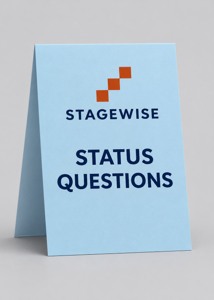
An optional contact-guidance table tent
These custom table tents for general office contact guidance are listed as 5 × 7 inches on 14pt card stock. The current quantity field starts at 25 and enforces a minimum of 25 for this listing. Confirm current configuration and ordering details before buying.
Compare custom table tents for office information, and bring approved wording to DecentCustom. A general instruction such as “For status questions, use your existing project contact” needs office approval and a real use; it is not a reason to create another intake channel.
AI paper-product concept. A table tent does not establish review status, protect private documents or replace the office’s professional records. If existing messages already solve the problem, no new print is necessary.
Test one acknowledgment, one dependency and one final message
Ask a colleague to identify what is confirmed, whether the client must act and who owns the next step. Check that a revised request replaces its earlier version and that “delivered” names the actual output. Match updates to the agreed milestones; do not add weekly messages when there is no useful change or the client prefers less frequent contact.
For a different question—where an in-person or remote meeting takes place—use the professional-office location and remote-options guide. Correct location instructions and accurate document status support separate parts of the same client experience.
Selected public process descriptions and product fields reviewed November 15, 2026. The Stagewise sequence is fictional. This is administrative communication guidance, not financial, tax, legal, privacy-compliance or filing advice.