Supermarket service guide
Evaluate a grocery bag with the complete packed order and the space that receives it. Opened dimensions alone cannot settle fit or storage.
There are three different space questions
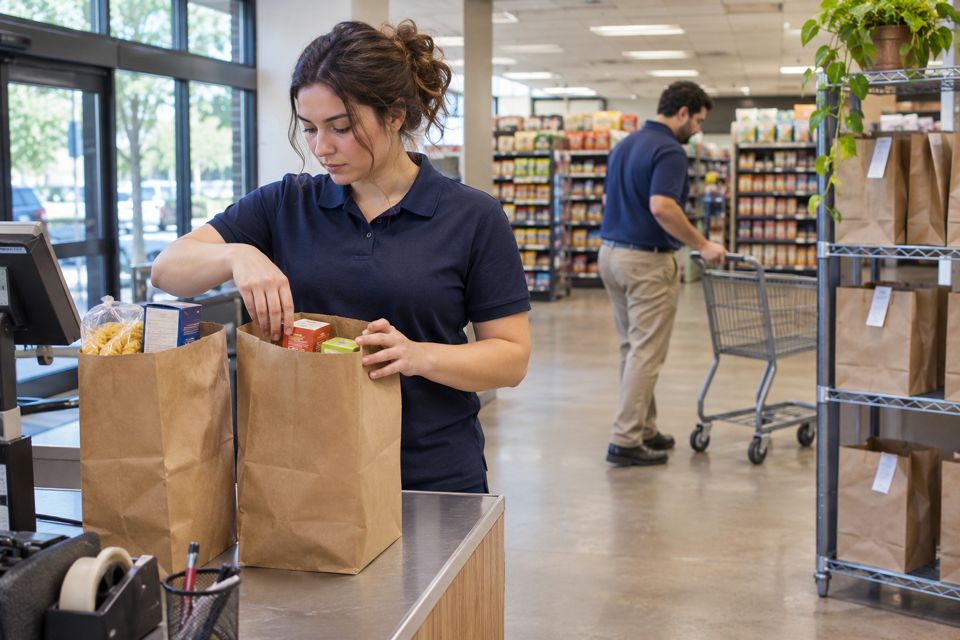
A supermarket needs room inside the bag, room to open and fill it at the packing station, and room for incoming unused bags. A carrier can suit one of those spaces and still fail another. Treat them as separate checks.
Publix’s customer-service information and its online-service FAQ describe distinct store and collection services. Use that distinction when selecting representative orders: a quick checkout purchase and a staged collection order may not produce the same packing task. These sources do not supply a bag size for your store.
Measure the packed shape, then observe the station
- Choose the order. Record which service and item combination you are assessing. Keep fragile, wet or temperature-controlled requirements separate from an ordinary carrier comparison.
- Measure the finished arrangement. Include original packaging, closures and the clearance needed to put items in and take them out.
- Check the opening. A narrow mouth or stiff corner may matter even when nominal outside dimensions look generous.
- Check the work surface. Try a suitable sample or full-size mockup at the actual station without blocking another task.
- Check incoming stock separately. Ask for packing quantities and incoming carton dimensions. Do not calculate carton storage from the bag’s opened dimensions.
A cardboard outline can reveal an obvious shape mismatch. It cannot prove handle strength, seam durability or carrying capacity. Where those properties matter, obtain suitable product evidence and evaluate the actual use before purchasing.
A fit review that identifies the real problem
Illustrative order: two factory-packed pantry boxes and a sealed jar. The chosen arrangement fits inside a carrier mockup, but the employee must move the mockup away from the scanner to open it fully.
Fit: packed shape has room; opening check still requires an actual suitable sample.
Station: current location conflicts with scanning; review another opening position.
Storage: incoming pack details not yet confirmed; leave the order quantity open.
Decision: revise the station arrangement before assuming a larger bag is needed.
Repeat the review for a genuinely different load rather than packing every order into the largest possible carrier. Record which format worked for which arrangement, and keep an ordinary alternative available where a custom bag has no established advantage.
Where printed supplies fit this decision
For this tote, the current page lists 13 W × 15 H × 10 inches and 80 GSM non-woven polypropylene. The third axis is unnamed. Confirm the opened shape and do not infer tested carrying capacity from the dimensions.
Compare custom grocery bags only when the format and information task are clear.
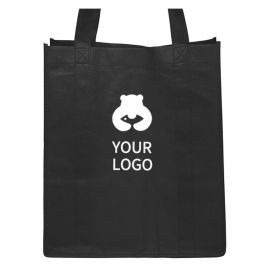
Non-woven grocery tote
Current page: 13 W × 15 H × 10 inches; 80 GSM non-woven polypropylene. The third dimension is not named, so confirm the opened shape. Minimum: 12 bags; listed case pack: 100. No tested carrying capacity is established here.
Catalog sample artwork is shown. Click the small image for the exact product. Product information reviewed November 3, 2026; confirm current options before purchase.
Turn the answer into your next decision
Give the buyer a short fit record: service, packed dimensions, opening result, station position, unresolved material requirements and incoming-stock space. Choose quantity only after those questions are settled.
If that decision calls for an approved custom item, compare the configuration and design preview among custom products from DecentCustom. Keep existing suitable materials when they already do the job.
A related question
Can we divide shelf volume by opened bag volume to plan stock?
No. Unused bags arrive folded or nested in a particular pack. Use the supplier’s actual incoming packing details and your usable storage arrangement.