Neighborhood grocery guide
For a small grocery stockroom, order quantity must work on delivery day as well as over the selling period. Count usable stock before considering a price tier.
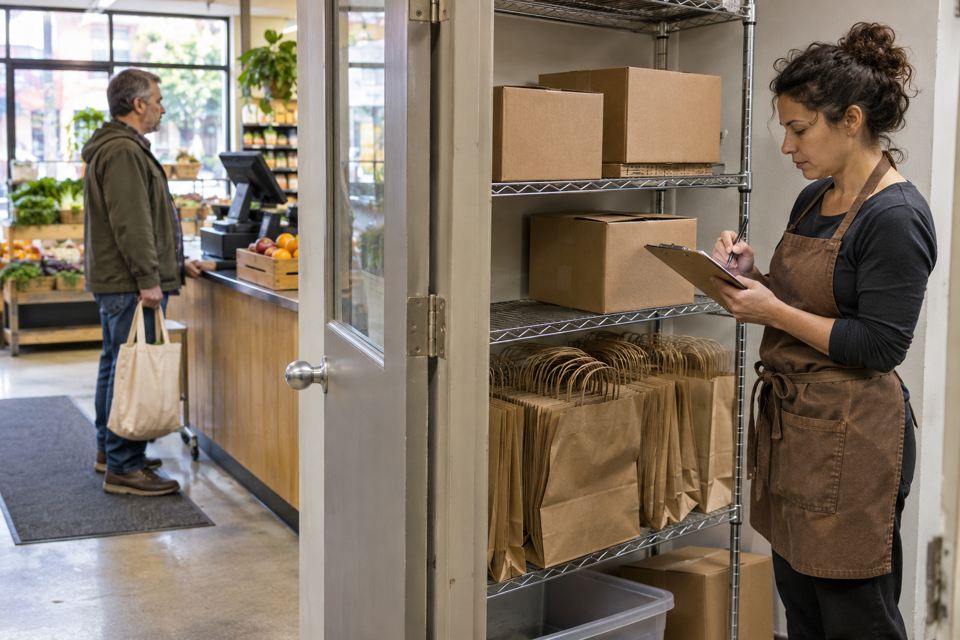
Start with the space you can actually use
A lower unit price does not make an extra carton disappear. In Sheree Goertzen’s account of opening a Nebraska mercantile, limited back-stock space is part of everyday purchasing. That is one owner’s experience, not a standard stockroom size or a forecast for your store.
Choose one bag format and a named planning period. Count only stock available to that service, after reservations and expected use before the new supplies are ready. List incoming deliveries separately so you do not count them twice.
Calculate need, then check the purchase constraint
Use this planning relationship: expected use during the period + chosen reserve − usable stock at the ready date − additional confirmed inbound. Keep each input in individual bags. A carton, sheet or bundle is not an interchangeable unit.
A negative result means the stated assumptions do not show an immediate uncovered need. It does not automatically mean all stock is usable or that a different format is unnecessary. Check condition and task fit before changing the plan.
Next compare the calculated need with the actual minimum order and available purchase options. Finally, check the complete arrival quantity in its real packaging. Ask for incoming-pack dimensions instead of estimating storage from an opened bag photograph.
A small-stockroom example that changes the order
All inputs below are hypothetical. They demonstrate a decision, not a store’s measured consumption or this product’s carton capacity.
Planned use: 30 bags/week × 4 weeks = 120 bags.
Reserve: 20 bags.
Usable stock at ready date: 50 bags.
Additional confirmed inbound: 0 bags.
Uncovered need: 120 + 20 − 50 = 90 bags.
The small white paper bag below currently has a 200-bag minimum, distinct from its listed case pack of 500. Buying 200 brings available stock to 50 + 200 = 250 bags, before use begins.
The period’s use and reserve total 140 bags, so 110 bags remain beyond that requirement. If an operator-checked storage arrangement accommodates only 220 bags in the actual incoming packs, the 250-bag arrival peak exceeds it by 30. That storage limit is an illustrative input, not a product-volume claim.
The useful next decision is to review timing, another suitable purchasing option or verified additional storage. Do not silently reduce the selected product’s minimum to 90. If weekly use were only 20 bags, the same formula would give 80 + 20 − 50 = 50 bags needed, making the minimum-order mismatch larger.
Where printed supplies fit this decision
The white paper example is an unlined small carrier for dry, protected items. Current minimum200 and case500 describe different things. Neither establishes demand, delivery timing or how many incoming packs your shelf can hold.
Compare custom paper bags only when the format and information task are clear.

Small white paper bag
Current page: 4.75 W × 8.75 H × 3 inches, unlined white paper for dry, protected items. Minimum: 200 bags; listed case pack: 500. This is not a verified liquid, grease-resistant or temperature-control package.
Catalog sample artwork is shown. Click the small image for the exact product. Product information reviewed November 3, 2026; confirm current options before purchase.
Turn the answer into your next decision
Record the ready date, inputs, order minimum, arrival peak and actual storage check together. Keep uncertain inbound separate and recalculate without it. Delay or use an existing suitable alternative when the custom order does not fit the service plan.
If that decision calls for an approved custom item, compare the configuration and design preview among custom products from DecentCustom. Keep existing suitable materials when they already do the job.
A related question
Should we buy more just to reach the next price tier?
Only after the full configuration total, expected use, artwork life and receiving space justify it. A unit-price reduction alone is not a complete purchasing reason.