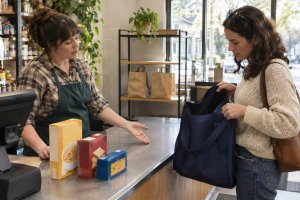
Grocery store operating guide
Map who picks, checks, packs and hands over the order before you buy labels, bags or vehicle signs.
The bag is only one part of a grocery pickup order. Someone still needs to select the right items, resolve changes, check what has been packed, keep the order in its assigned place and hand all of it to the right person. A printed label cannot fill a gap in that chain.
Plan the handoffs first, then choose supplies for the steps your store actually controls. Separate collection at the shop from store-operated delivery and delivery handled through a platform. That distinction changes who chooses the packaging, who updates the customer and whether your store has any vehicle to identify.
Start with the pickup or delivery service you really provide
Weaver Street Market's online-shopping page offers a useful example of why responsibilities need checking. It describes an Instacart partnership in which shopping can be assigned to store staff or platform shoppers according to demand and staffing. A store advertising online shopping therefore does not automatically control every shopping or delivery step.
Write down your own arrangement. If it changes by order type or time of day, record those branches. Do not buy a full set of materials around a process that only happens occasionally or belongs to another operator.
| Your service | Confirm before buying supplies | What may already be enough |
|---|---|---|
| Store-prepared pickup | Who picks, checks, stages and hands over the order; how arrival is reported. | Existing bags, an order reference and a staff handoff checklist. |
| Store-operated delivery | Who controls dispatch, route, vehicle, packaging and delivery confirmation. | Existing suitable carriers and clear driver instructions; vehicle branding is a separate decision. |
| Platform-arranged shopping or delivery | Which steps and materials belong to the store and which belong to the platform or shopper. | The platform's established process where it already covers the task. |
Keep the customer-facing instructions aligned with that arrangement. Check where the customer orders, which location prepares it, how they report arrival and who handles a missing item. Avoid printing details that your store cannot keep current or promises it does not control.
Follow one order from picking to collection
Walk the normal route with the people who perform it. Begin at the point where an order becomes available to staff and finish where the customer or driver receives it. Look for places where responsibility becomes unclear rather than starting with a list of branded products.
- Pick: identify the order and use your established process for unavailable items and substitutions.
- Check: confirm the selected items against the final order record and note anything still unresolved.
- Pack: choose suitable packaging for the actual contents and assign the pieces to that order.
- Stage: put the complete order in its designated location and keep its status visible to the relevant staff.
- Hand over: verify the recipient through your normal process, collect every part of the order and record completion.
Ask what happens if the employee who packed the order goes on break. Can the next person find the complete order without relying on that employee's memory? If part of it is held separately, how does the handoff worker know another piece must be collected?
Storage, cleaning and any temperature-controlled handling remain part of the operation's own validated procedures. This planning guide does not establish a holding time or approve a bag for food safety. Keep those requirements separate from choosing printed artwork.
Give incomplete orders a distinct status
Decide how staff distinguish “being picked,” “awaiting a decision” and “ready for handoff.” Use your existing system where possible. A completed-looking bag should not be the only signal that an order is ready.
Put the right information on the right surface
A reusable carrier may only need the store name. The temporary order reference belongs on a replaceable label, tag or order document. Keeping those jobs separate avoids printing changing customer details permanently onto a bag.
Choose an identifier staff can match with the order record, and decide where it remains readable during staging and collection. Avoid displaying full customer addresses or unnecessary personal information to other shoppers. Use the information needed for the handoff rather than adding everything available in the order system.
If an order has several pieces, use a consistent way to show the set and any separately held items. The packer and the handoff worker should interpret the notation the same way. Try it through a normal shift change before printing a large run.
Check the proposed label on the actual packaging. Can the information be read at the normal working distance? Does the chosen pen or printer work on the finish? Will the label stay where needed, and can it be removed if the carrier is meant to be reused? Ask about the intended surface and conditions; a generic material name is not an adhesion test.
Plain labels, a reusable order card or the existing platform record may already answer these questions. Custom printing is useful when a repeated, stable message needs it, such as a store name or a consistent instruction that staff have approved.
Compare supplies against those specific steps
The custom stickers and labels category offers formats to compare once you know the surface, changing information and reading conditions. Check the selected material and finish rather than assuming every label performs the same job.

Configurable product labels
A configurable format for a stable message; confirm the actual surface, finish and order unit.
Label configuration check: the linked product-label listing offers material, shape, size and finish choices. Its displayed order quantity starts at one, but the package wording describes sheets. Confirm the number of labels per sheet and the selected order unit before treating that display as a single sticker or calculating an order total.
The sample thumbnail shows one design use, not a pickup-label specification. Check writing or printing compatibility and the real packaging surface separately. This guide does not claim that a selected option is certified for direct food contact, tamper evidence, cold storage or repeated reuse.
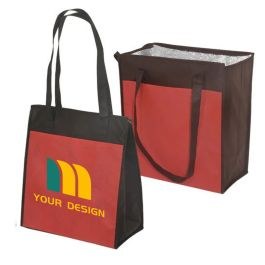
Foil-lined grocery tote
Compare its opened dimensions and structure with the real packed order and handling requirements.
Carrier configuration check: the foil-lined grocery tote lists 14.5 H × 11.5 W × 7 D inches, 80 GSM polypropylene and a current minimum of 50 bags. Compare the opened dimensions with the packed order, the route and the cleaning process before choosing it.
A reflective liner alone is not evidence of a safe temperature-holding period. We have not tested this bag's load capacity or temperature performance. If it does not fit your validated handling needs, keep a different carrier or your existing arrangement in the comparison.
Vehicle identification is another conditional purchase. It only becomes relevant when your store actually controls a vehicle used for the service and has permission to mark it. A platform driver arriving at your shop does not establish that need. Check surface compatibility and approval before selecting any vehicle sign.
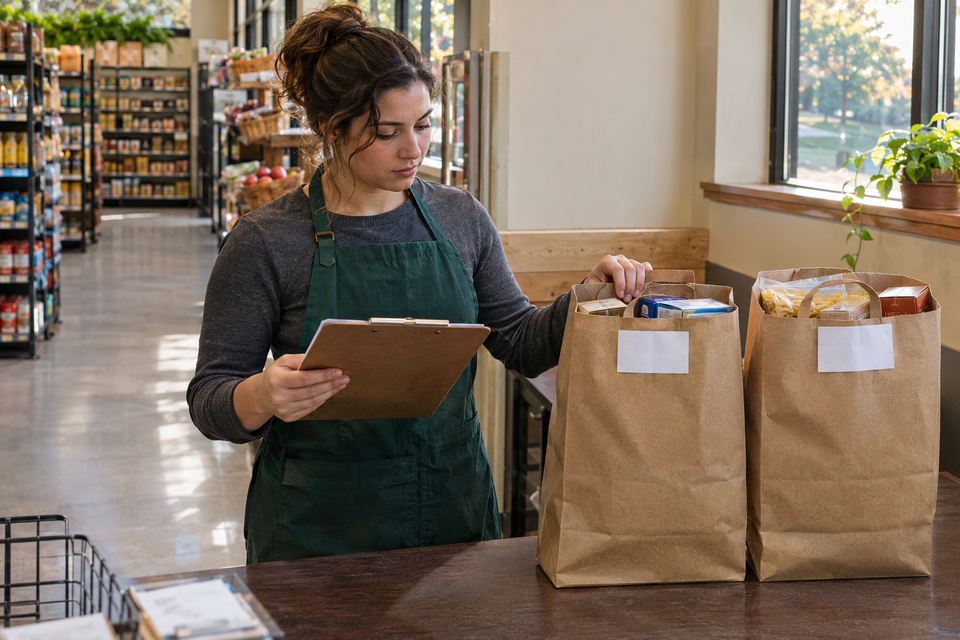
Product thumbnails show sample artwork and link directly to their listings. The AI scene illustrates order preparation, not either product being tested. Product details were checked on November 2, 2026.
Run a small workflow trial before committing to a supply order
Use representative orders and your established handling procedures. Include an order with more than one package and a handoff performed by someone other than the packer. Record what needed explanation, which information was hard to see and what required rechecking. These observations are more useful than assuming printed materials will save a particular number of minutes.
- Responsibility: name the role owning each step, including breaks and shift changes.
- Packaging: record wrapped contents, dimensions, approved handling conditions and existing alternatives.
- Identification: specify the stable printed message and the temporary order information.
- Staging: check space, statuses and any separate order components.
- Customer instructions: confirm location, arrival method and who handles questions.
- Purchase: approve the exact material, order unit, quantity, artwork, final total and needed-in-hand date.
For the carrier decision, use our guide to grocery bag sizes, packing and reorders. It separates minimum quantity, storage and actual use rather than treating a case pack as a demand forecast.
Once the process is clear, compare custom products from DecentCustom for the steps you need to support. Keep purchase approvals and final prices specific to each configuration; a wider supply order is not required to run a useful trial.
Pickup and delivery planning questions
Do we need custom bags before offering pickup?
Start with a workable service and suitable packaging. Existing bags and a clear order-reference system may be sufficient. Custom printing can add a stable store message after the practical packaging and handoff checks.
What should go on a pickup-order label?
Use the information staff need to match and complete the handoff, with a consistent way to identify multiple pieces. Keep changing order details separate from permanent bag artwork, and avoid displaying unnecessary personal information.
Does a foil-lined tote prove an order will stay at a safe temperature?
No. The listing and liner do not establish a validated holding period for your contents and route. Packaging selection must fit your operation's established handling requirements; this guide makes no temperature-hold claim.
Should a store using a delivery platform buy vehicle magnets?
Only consider vehicle signs if there is an actual store-controlled vehicle use, suitable surface and marking permission. Platform delivery alone does not establish any of those conditions.