Grocery store operating guide
Use consumption, usable stock and receiving space to build an order quantity, then work back from the date supplies must be ready.
Plan a grocery supply order from the quantity you can use, the stock that will actually be available and the space that will receive it. Then check whether approval, production and transport can fit the service date.
A lower unit price does not resolve an overflowing shelf or a delivery that arrives after the materials are needed. Equally, counting an unopened carton without checking its contents can make an apparent stock reserve misleading.
The worked example below shows how an uncovered need can be smaller than a product’s minimum order, and how that changes the next decision.

Separate the service date from the supply-order date
Write down when the materials must be ready for staff to use. That date may be earlier than an event, a pickup session or the public opening of a new service. Staff need time to receive the delivery, check the print and configuration, place the materials and understand the process.
These dates belong to different decisions:
| Date | What it controls | What you need to confirm |
|---|---|---|
| Service or event date | When the customer-facing activity happens. | The operator’s actual schedule and whether the activity is going ahead. |
| Materials-ready date | When supplies have been received, checked and put in place. | Who receives them and what setup or staff preparation is required. |
| Required delivery date | The latest acceptable arrival under the plan. | A destination-specific supplier estimate and a workable allowance for your own preparation. |
| Artwork and configuration approval | When the correct design, dimensions, quantity and options are approved. | The authorized approver and the proof they will review. |
| Order and payment | When the confirmed configuration is submitted. | The supplier’s timing basis, total and current order requirements. |
Do not use a customer’s pickup appointment as a print-production lead time. For example, Lansing’s CSA instructions connect harvest planning with expected collection days. That illustrates a service commitment; it says nothing about how quickly another supplier can produce custom bags.
DecentCustom’s ordering path includes customization, a design preview, cart and payment. Check the current configuration and delivery estimate before promising a date. A general shipping statement or the experience of a different SKU is not confirmation for this order.
Count usable stock and record the unit
Keep separate counts for each format. A small paper bag and a large grocery tote should not be combined as interchangeable stock unless they have been accepted for the same job. Also separate materials held for another activity from stock available to the service you are planning.
For each item, record:
- The unit: individual bag, label, sheet, roll or another clearly defined ordering unit.
- Usable stock expected at the materials-ready date, after known earlier use and reservations.
- Confirmed inbound quantity expected by that date, excluding deliveries already included in the stock count.
- Expected use over a named planning period, based on comparable records where available.
- An explicit reserve assumption and the reason for it.
- The receiving space and packing configuration, including any temporary peak when deliveries overlap.
A reservation, an estimate and a confirmed delivery are different inputs. Mark uncertain inbound stock as uncertain and consider the plan without it. An average from a quiet week should not silently become a forecast for a new pickup service.
Space constraints are real even when the product is ordinary. In a first-hand account of a small Nebraska mercantile, Sheree Goertzen describes very limited back stock and the trade-offs involved in distribution. That is one store’s account, not a universal minimum order or a custom-print budget.
Worked example: need 80 more bags, but the minimum is 200
All planning inputs here are hypothetical. They demonstrate the calculation and do not describe a customer’s actual use. Suppose a shop needs a suitable small paper bag for protected dry items. It estimates 40 bags per week for four weeks after its materials-ready date and chooses a reserve of 20 bags.
Uncovered need = planned use + reserve − projected usable stock − confirmed additional inbound
- Planned use: 40 bags/week × 4 weeks
- 160 bags
- Illustrative reserve
- 20 bags
- Projected usable stock on the ready date
- 70 bags
- Additional confirmed inbound by that date
- 30 bags
- Uncovered need: 160 + 20 − 70 − 30
- 80 bags
The 70-bag projection already allows for earlier use and reservations. The 30 inbound bags are not included in that 70. Replacing these assumptions with actual records may change the answer.
The current minimum for the small white paper bag shown below is 200 bags. Its listed case pack is 500; that case-pack figure does not make 500 the minimum. Ordering 200 would bring the example’s available quantity to 70 + 30 + 200 = 300 bags before the four-week use begins.
That is 120 bags above the 180-bag planned use-plus-reserve requirement. Those extra bags may be useful later, but they still need storage, funding and a reasonable prospect of being used with the approved artwork.
Now suppose the operator’s space plan allows for only 250 bags in the actual incoming packaging. This is another hypothetical input, not a capacity inferred from a product image. A 300-bag arrival peak exceeds it by 50 bags. The order meets the minimum and still fails the space plan.
The decision changes with the constraints
Do not increase the order just to reach a lower price tier. Review a later delivery after more stock is used, an approved smaller-lot alternative, or different usable storage. Verify any alternative’s fit, terms and total before choosing. If none meets the service date, keep the existing workable materials and revise the custom-order plan.
Check sensitivity to the uncertain inputs. If the expected 30-bag delivery is not confirmed, uncovered need becomes 160 + 20 − 70 = 110 bags. If expected weekly use changes, calculate it again. Neither revision changes the product’s minimum; it changes the gap you are trying to cover.
Check the delivery peak, not just the eventual shelf quantity
Ask how the goods will arrive and where the complete delivery can go. Carton dimensions, packing quantity and stacking limits cannot be established from the bag’s opened dimensions. A fit check needs the actual incoming pack and your actual storage arrangement.
Include goods already due in, stock waiting for another service, receiving access and the person who will inspect the delivery. Keep the normal access route usable. If the plan depends on splitting a delivery or receiving on a particular day, confirm that arrangement rather than assuming it is available.
Also consider artwork life. A stable store logo may remain usable across normal replenishment. A date, offer or temporary pickup instruction may become obsolete before a larger order is consumed. Put changing details on a replaceable notice or other appropriate temporary medium when that suits the service.
Check the actual product and ordering unit
Compare custom paper bags only after the packed item and quantity plan are clear. The examples below show why specifications and ordering units need their own check.

Small white paper bag
The page lists 4.75 W × 8.75 H × 3 inches and an unlined white-paper construction for dry, protected items. Current minimum: 200 bags; listed case pack: 500. Compare the fully wrapped item and closure allowance. It is not a liquid, grease-resistant or temperature-control package.
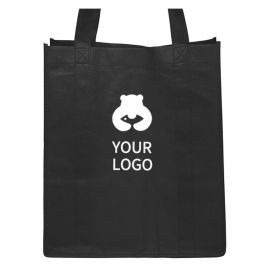
Non-woven grocery tote
The product page lists 13 W × 15 H × 10 inches, 80 GSM non-woven polypropylene and a 5 W × 8 H-inch imprint area. The third dimension is not named on the page, so confirm the opened shape against your packed items. Current minimum: 12 bags; listed case pack: 100. No tested carrying capacity is established here.
Catalog sample artwork is shown. Current product pages were reviewed on November 3, 2026. Displayed minimums, case packs and starting prices perform different roles; none is a forecast of your store’s demand or a guarantee of stock or delivery.
Turn the calculation into a short order brief
Record the service, materials-ready date, expected use period, actual unit, projected usable stock, confirmed inbound, reserve assumption and uncovered need. Add the proposed purchase quantity, peak receiving quantity, verified storage arrangement and complete configuration total.
Then name the artwork approver and the fallback if the delivery estimate or space check does not work. Use this brief when comparing custom products from DecentCustom. It gives you a way to accept, revise or defer an order instead of relying on the lowest displayed price.
Supply-planning questions
Is the case pack the quantity we must buy?
Check the actual minimum and purchase options. For the white paper bag here, the minimum is 200 while the listed case pack is 500. Do not replace the minimum with the carton figure.
Can we count stock expected from an unconfirmed delivery?
Keep it as an uncertain input and calculate the plan without it too. Count only confirmed additional inbound in the confirmed-stock version, with the expected arrival date recorded.
Should we use the same reserve every time?
Use a stated assumption suited to the item and service, then review it against actual use and delivery experience. The 20 bags in the example are illustrative, not a recommended reserve for every shop.