Separate a store case-price question, a retail delivery checkout and a business wholesale inquiry. Give each buyer the correct starting point and explain what still needs confirmation. Sending a wholesale request does not reserve stock, establish a price or book a delivery.
Buying a case does not automatically make an order wholesale
Some shoppers want a case price from their neighborhood store. A household ordering delivery through a retail platform has a different process. An organization asking about ongoing supply needs a business conversation. The order size alone does not tell the customer which route your store actually offers.
A current example makes the distinction visible. Joe Randazzo’s locations page describes store bulk case-price requests, qualifying large-volume special orders and retail delivery through Instacart. Its separate wholesale page asks businesses to describe the products, typical quantity and location so its team can discuss current supply and delivery options. These are one Michigan operator’s services, not a standard offer every produce shop must provide.
Store purchase or case-price inquiry
Direct the shopper to the relevant store for the current product and case-price question. Confirm the specific item and packing unit before treating “one case” as a complete specification. Our guide to case orders and small purchases also explains why their carrying arrangements differ.
Retail platform delivery
Use the retailer’s current official platform entry where offered. The shopper needs to check the address, available items, delivery arrangement and terms shown for that order. A store’s general produce range is not proof that the same item or quantity is available through the platform.
Business wholesale inquiry
Explain the organization’s products, quantities, location and intended supply pattern through the business contact route. The team still needs to respond about the actual request. Do not redirect every small retail question into a business supply form merely because the store also has a wholesale department.
A wholesale inquiry with enough detail to begin
The following is fictional. Loamfield Market, Leah and the community kitchen are invented, and no message has been sent. The proposed quantities are example requests, not measured demand, accepted orders or published pack specifications.
Subject: Community kitchen produce supply inquiry
Hello Loamfield wholesale team,
I am Leah, preparing a supply request for a community kitchen in the Metro Detroit area. We would like to discuss apples and carrots for our kitchen’s planned use.
Our initial request is four supplier cases of apples and two supplier cases of carrots. We have not agreed the case contents or weight. Please tell us the available products, pack specifications and quantity units before quoting the request. We can then confirm whether those packs match what the kitchen needs.
We would prefer to begin with a delivery next Wednesday, if a suitable arrangement is available, and discuss a possible repeat schedule afterward. Neither the first date nor a recurring arrangement is confirmed. Please tell us what location and receiving details you need through your normal business-order channel to check service for our site.
Please confirm current availability, the proposed pricing and any applicable delivery conditions or charges. Let us know which details need agreement before you can accept an order. This inquiry is not permission to substitute products or ship an unconfirmed quantity.
Thank you,
Leah, community kitchen supply coordinator
The message gives the team a useful starting point while making the missing pack and receiving details explicit. In a real inquiry, use your actual organization, products and location. Provide the specific receiving information through the supplier’s normal channel rather than placing private delivery details on a public sign or card.
Keep the request separate from the accepted arrangement
A complete fictional reply while the request is pending
Hi Leah,
Thank you for the product and quantity outline. We have received your inquiry, but we have not accepted an order or scheduled a delivery.
We still need to confirm the available apple and carrot packs, the quantities in the agreed units, pricing, the service arrangement for your site and a workable receiving date. We will also need the receiving details required through our normal business-order process. Please wait for that confirmation before treating next Wednesday as booked or making a repeat schedule dependent on it.
We will identify the next details to agree in this conversation. If the proposed packs or delivery arrangement do not fit your operation, we can discuss the available alternatives before an order is accepted.
Loamfield wholesale team
In the fictional store, Priya owns this open inquiry and records the unanswered pack, location and date questions together. The retail counter does not convert it into a platform order without an agreed reason. Once the arrangement changes, update the shared record rather than leaving different teams with different versions.
Use current produce availability and origin information when answering product questions. A general seasonal description cannot confirm the batch, stock or quantity for a particular wholesale request.
Give a household shopper a retail answer
A shopper asking for a few vegetables delivered home needs a usable retail route, not the kitchen’s wholesale inquiry. The exact route depends on what the store currently offers.
Fictional counter or website copy
“For an ordinary retail purchase, use our store’s current shopping route. Where retail platform delivery is offered, start from our official platform entry and check the options for your address and order. For a store case price or special quantity, ask the relevant store about the specific item and packing unit. For business supply, use our separate wholesale contact route with your products, quantities and location.
“A message asking about a case price is not a delivery booking. A business inquiry does not reserve a retail platform slot. We will confirm the applicable arrangement for your actual request.”
Replace “where offered” with your verified route information when preparing real customer copy. If a route is unavailable, say so plainly rather than sending the shopper through a form that cannot complete the job.
A printed directory should point to stable routes
A small paper card can summarize which conversation to start. Keep daily stock, live prices, exact delivery windows and order approval in the current channel. Check the real destination before printing a contact or web address; a printed route that nobody maintains creates another dead end.
Complete example card wording
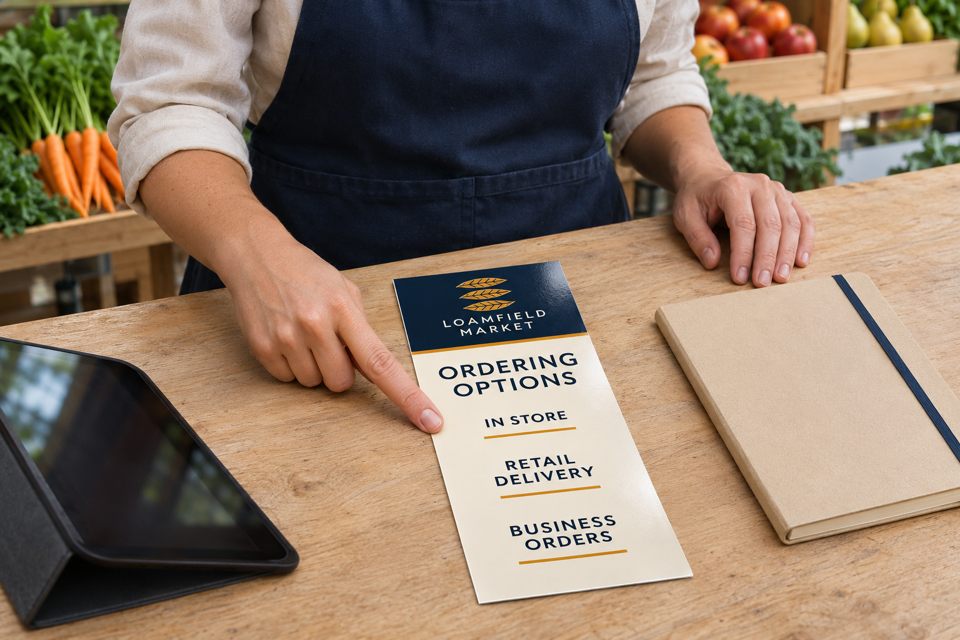
LOAMFIELD MARKET — ORDERING OPTIONS
IN STORE: Ask the relevant store about current produce and case-price requests.
RETAIL DELIVERY: Use the official retail platform entry where offered and check the options for your order.
BUSINESS ORDERS: Contact the wholesale team with your products, quantities and location. Availability, pricing and delivery require confirmation.
Use the store’s current official contact details for the route you need. This card does not confirm an order.
Compare rack card formats only after assigning a person to maintain the route details. Existing website copy, email replies or an ordinary printout can do the job when information is still changing.
Verify the route before printing the directions
Use one ordinary retail request, one case-price question and one business inquiry to check that your instructions lead to the right team. Resolve missing destinations and ownership first. If a stable paper directory still helps, bring the actual copy, configuration and quantity to DecentCustom for review.