Check two things before a produce-bag order: how many suitable bags the store actually needs, and how the selected quantity will arrive and fit in the available storage space. The bag’s unfolded dimensions, the minimum order and the case pack answer different questions.
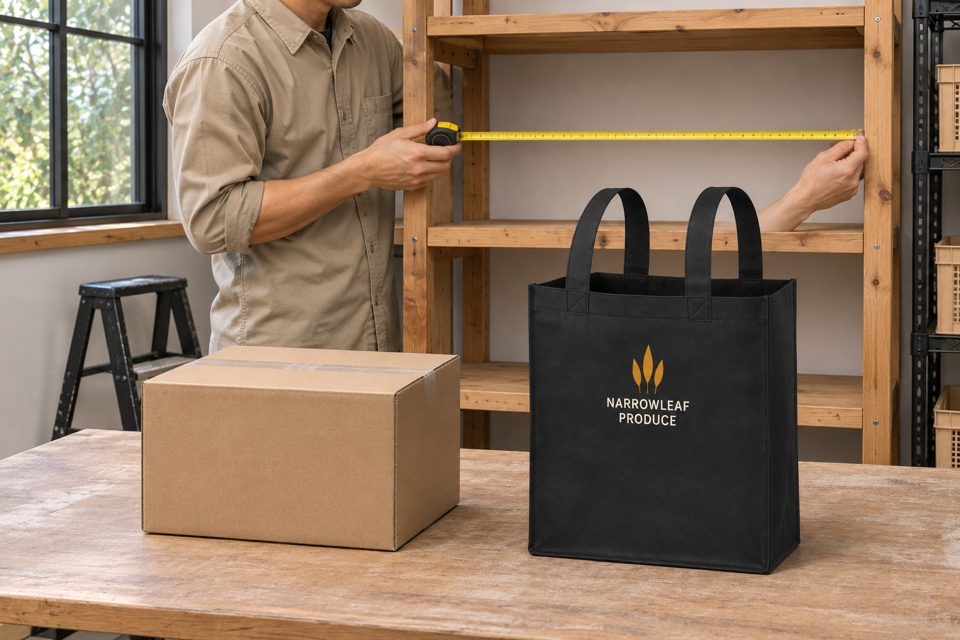
The right purchase quantity starts with the store’s own use
Count suitable, unallocated bags already available, keep reserved stock separate, and identify the carrying jobs ahead. Do not assume every customer needs one printed bag or that every produce case should be repacked. The guide to case orders and small purchases explains why those jobs differ.
A large operator’s resources do not establish a smaller store’s needs. Joe Randazzo’s wholesale page asks business buyers about their use, quantity and location. Its produce-storage facilities are not evidence of your bag consumption, available shelf space or print budget. Likewise, the compact and larger stores described on its locations page do not share one universal storage layout.
If the current count or use is unknown, record it as unresolved and complete that check before approving a quantity. An unknown balance is not zero. Suitable existing stock or an ordinary carrying option may already cover the job.
Four specifications that should stay separate
Individual bag dimensions
These describe the product being used. They do not tell you its folded thickness, the height of a stack or the external dimensions of the delivery carton.
Minimum purchase quantity
This is the smallest order quantity currently offered for the relevant configuration. It does not establish your actual requirement or the quantity that fits on your shelf.
Case pack
This is a packing specification. Keep the stated unit clear and do not silently turn it into a minimum purchase or a carton-size measurement.
The selected order’s actual packed configuration
Ask for the number of cartons, each external carton size and the gross weight for the quantity and configuration you intend to buy. Different order quantities may require different packing arrangements; confirm yours rather than estimating it from an unfolded bag image.
Compare custom grocery bag formats against the actual carrying use before making the storage comparison. A smaller box does not make an unsuitable bag the right product.
A worked comparison: the long side needs a place to go
All dimensions, people and decisions below are fictional. Narrowleaf Produce is an invented store. The proposed carton size is a calculation input, not a supplier quotation or a shipping specification for decentcustom-to-000131.
The example inputs, in inches
Clear usable opening: 24 wide × 16 deep × 15 high.
Hypothetical closed carton: 25 × 15 × 12.
Model: The whole carton must fit inside the clear opening in an ordinary axis-aligned orientation.
There are six ways to assign the carton’s three sides to width, depth and height. Every assignment puts its 25-inch side on one of those three axes. The opening is shorter than 25 inches on each axis:
| 25-inch side placed along | Clear limit | Comparison |
|---|---|---|
| Width | 24 | 25 > 24 |
| Depth | 16 | 25 > 16 |
| Height | 15 | 25 > 15 |
Result: None of the six axis-aligned orientations fits this model. Do not turn that into a claim about every possible angled movement or about shelf strength. The calculation does not approve diagonal loading, overhang or stacking; it identifies an unresolved storage arrangement before the order is committed.
In a real stockroom, record usable clear space and the access needed to put away and retrieve supplies. External shelf dimensions alone can hide supports, adjacent stock or a narrower access opening. The actual arrangement also needs an appropriate load and storage review; a dimensional match alone is not that review.
Ask about the packing for your quantity, not a generic carton
Here is Narrowleaf’s complete fictional inquiry. The proposed 24 bags are a request for comparison, not an established consumption requirement. No message has been sent and no order has been placed.
Proposed individual-bag quantity and storage check
“We are considering 24 individual non-woven grocery bags, decentcustom-to-000131, for a suitable outer-carrying role. Our current stock and use still need final review, so this is not purchase approval.
“Your listing shows a minimum of 12 bags and a case pack of 100. Please confirm the configuration for a proposed order of 24 individual bags, not 24 cases. Tell us the actual number of shipping cartons, each carton’s external dimensions and gross weight for that order.
“Our example storage opening is 24W × 16D × 15H inches; we still need to verify the real available location and its appropriate storage conditions. The hypothetical 25 × 15 × 12 carton in our planning exercise has no axis-aligned fit there. We are not assuming that hypothetical carton is your packing size.
“Please explain the available packing arrangement for the proposed quantity and how unused bags should be kept protected. We will check access and the appropriate storage arrangement after receiving the actual information.
“Our proposed artwork is the Narrowleaf Produce name and three-leaf emblem. Please confirm the selected print configuration, complete quotation including shipping and taxes, and a receiving arrangement for the date we ultimately agree. We have not established that date or authorized the order.”
Keep produce-supply discussions and printed-bag purchases separate, using the correct contact route for each. The guide to wholesale and retail ordering routes explains the produce side; buying printed supplies does not confirm a food delivery arrangement.
Close the two open decisions before approving the order
Fictional hold decision and handoff
Rae, stock counter: Completes the suitable, unallocated stock count and documents the carrying use that remains. The proposed quantity of 24 stays provisional until that review is complete.
Owen, purchasing decision-maker: Holds the custom order while the actual carton configuration and an appropriate storage location remain unverified. Checks a suitable existing supply, a smaller available purchase or another verified location before increasing the quantity for a discount.
Receiving team: Once an order is agreed, uses the confirmed carton information and assigned location. Checks the actual arrival against that arrangement and records discrepancies before relying on the planned quantity or space.
Quantity approval and space confirmation are separate results. A supplier minimum does not settle either one; a photo of a bag sitting next to a shelf does not settle the packing question.
Bring a quantity and a receiving plan to the supplier
Resolve the actual use, available stock and selected order’s packaging. If a custom purchase remains useful, bring those details and the artwork to DecentCustom for the current configuration and complete quote. Keep an appropriate existing arrangement when a new order adds no established benefit.