Start the nursery conversation with the place the tree will grow, not just the small tree you like in a pot. A few clear site notes can show which questions still need an answer before you choose.
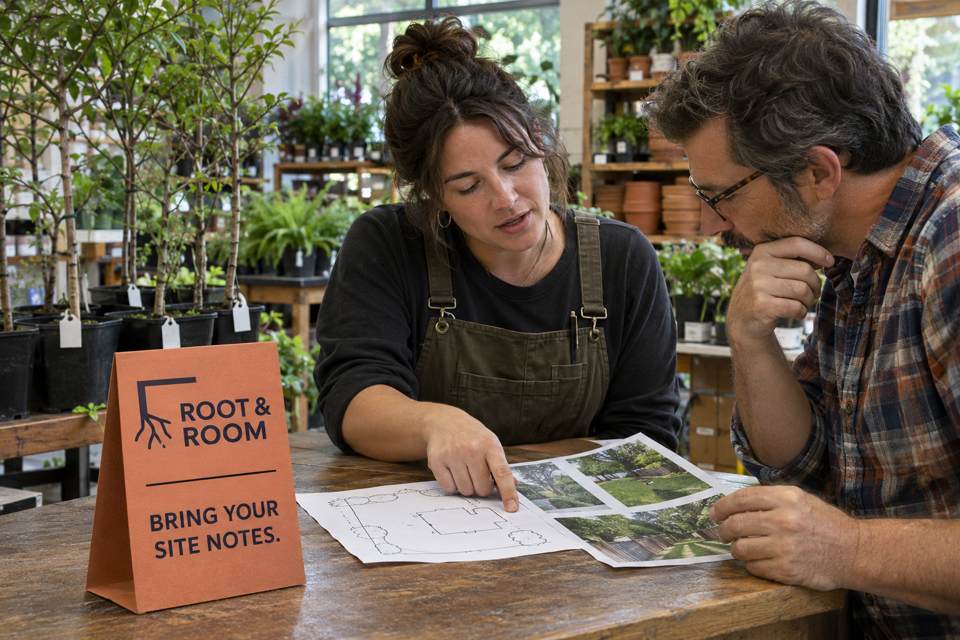
Bring the tree’s future growing conditions into the conversation
Before shopping for a tree, bring location information, an overview photo, a simple site sketch, observations about light and water, and the purpose you want the tree to serve. Mark important unknowns clearly. A small nursery specimen is not a picture of its mature height or spread.
The Arbor Day Foundation’s right-tree, right-place guidance identifies growing requirements, mature size, form and landscape function as selection considerations. That makes a site brief a useful starting point for a Forests Day nursery activity or an ordinary shopping visit. It does not turn a brief into a professional site assessment.
Use these six headings on existing paper or your phone:
- Place: city or region, whether the site is an existing bed, lawn or container, and any permission or ownership question. Give a service provider a precise address privately when needed.
- Space: sketch the proposed position and visible nearby buildings, paving, boundaries and other trees. Label actual measurements and their units. Do not convert a bed’s surface dimensions into available root volume.
- Light: note what you observed, the date and time, and whether nearby trees were in leaf. A single bright photograph does not establish a full day of summer sun.
- Water and soil: describe observations such as standing water after rain. Keep any actual soil-test results with their date; do not guess soil chemistry from color alone.
- Constraints: note visible overhead features and identify underground-service information as unknown when it has not been checked. Do not mark a location “clear” because no pipe or cable is visible.
- Purpose and care: state whether you want shade, screening or another function, and what maintenance you can realistically arrange. Ask which mature characteristics fit that purpose.
A hardiness zone adds information about cold; it does not answer all six headings. USDA’s explanation of its Plant Hardiness Zone Map describes it as a guide based on average annual extreme minimum winter temperatures. USDA also identifies other environmental factors and local microclimates. A zone match alone is not a guarantee that a tree will suit this particular bed.
A useful brief can leave the tree choice undecided
This is a fictional preparation example. The dimensions and observations are invented to show how to describe uncertainty, not to prescribe a tree or planting position.
Root & Room enquiry: tree for an existing bed
Place and goal: central Ohio, an existing residential planting bed. We would like some afternoon shade near a sitting area. We have not chosen a species or cultivar.
Space: the visible bed surface measures approximately 14 feet by 10 feet. The sketch marks the house, patio edge and existing shrubs. Rooting space, service locations and appropriate clearances have not been assessed.
Light: one summer photograph shows afternoon shade from the house. We have not logged the duration of direct sun. The current photograph was taken with nearby deciduous trees out of leaf.
Water and soil: we saw water standing in one part of the bed after one rainstorm. We have no soil-test or drainage-assessment result.
Next question: what further site information would you need before discussing suitable trees, and do you offer that advice here or refer customers to another local service?
The next useful action may be to improve the site information rather than buy immediately. A staff member might need a clearer photograph, a test result or a site visit from an appropriate professional. The brief gives them a specific gap to discuss; it does not make the missing assessment disappear.
Keep original nursery labels for plants already purchased. A label can identify the supplied plant or cultivar, while a later guess about a tree elsewhere is a different record. If your question concerns an existing unknown tree, first record observations of an existing tree rather than treating the purchase brief as an identification guide.
Confirm advice, stock and services as different things
A complete first message could be: “I have a site sketch, dated photos and the notes above. Before I visit, can you confirm whether you advise on tree selection for this type of site, whether an appointment or fee applies, and what information I should add? I am asking about suitability first, not reserving a tree yet.”
After discussing a candidate, record its actual species and cultivar when applicable, the relevant mature-size information and any site conditions still unresolved. Keep the source and date with those notes. Do not turn “small tree in a pot” into a promise that it will stay small.
Then ask a separate availability question: “Is that exact plant and size currently available at this location? Does your reply hold one for me, or should I reconfirm before travelling?” A recommendation is not a stock reservation. A photograph of nursery inventory is not confirmation of what remains when you arrive.
Delivery and planting are separate service questions too. Confirm whether they are offered for the actual address, what the quoted work includes, who is responsible for the next step and which conditions remain open. Do not assume that buying a tree includes installation or that a seasonal display date is a suitable planting date for every location.
The result you need is a clear next step: gather missing information, arrange the appropriate consultation, or compare a documented candidate. This preparation guide is not a species recommendation or an instruction to dig at an unchecked site.
An indoor reminder can tell customers what to bring
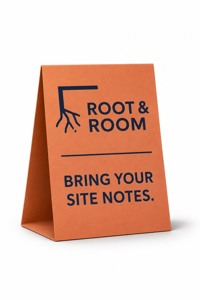
Existing signs or a message in an appointment confirmation may be enough. For a recurring indoor information point, the linked custom paper table tents for a nursery information counter list a 5 × 7 inch format, 14pt stock and a default glossy finish. The current minimum quantity is 25.
The fictional Root & Room artwork reminds customers to bring site notes. It does not promise professional advice or outdoor durability. Compare custom table tents for other indoor notices, and confirm the selected artwork and configuration with DecentCustom.