Name the December 31 start and January 1 finish, then state exactly which event the invitation covers. A countdown time does not establish admission to a venue.
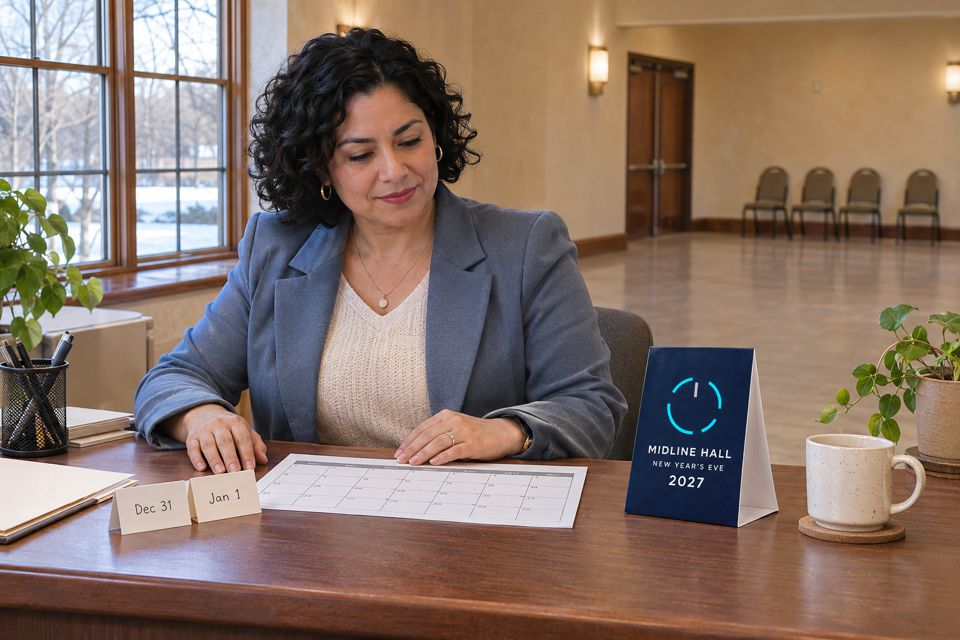
A 2027 celebration can begin in 2026
For an evening that crosses midnight, “New Year 2027, 9–1” leaves two avoidable questions: which day should someone arrive, and does 1 mean afternoon or the following morning? Write the start and finish separately, including the year at this calendar boundary. Add the venue’s time zone when the invitation may reach travelers or remote guests.
The OPM federal holiday schedule places New Year’s Day on Friday, January 1, 2027. That identifies the federal holiday; it does not set a private restaurant’s hours, admission policy or New Year’s Eve program. In this cycle, an evening beginning Thursday, December 31, 2026 can finish Friday, January 1, 2027.
A useful date line therefore reads: Thursday, December 31, 2026, 9:00 p.m. to Friday, January 1, 2027, 1:00 a.m., Pacific Time. Use that line only if those are the organizer’s confirmed times. The year in a celebratory headline should never be the only calendar information.
Read the year and the access terms on the same source
An official page can remain online after its event. When checked for this article, the Space Needle’s New Year page still described ringing in 2026. Its historical program separated attraction visiting hours from an outdoor celebration that continued around midnight. Those are different activities, and that old schedule is not evidence for a 2027 visit.
By comparison, an October 30, 2026 Seattle Center announcement mentions a market New Year’s Eve party welcoming 2027. That announcement alone does not establish every admission condition or prove that another ticket includes it. Follow the current organizer’s event-specific details before printing times, access or inclusions.
For your own venue, put the event booking confirmation beside the proposed invitation. Match the event name, room and date first. Then find the actual entry window and end time. If a general-hours page and the event confirmation differ, ask the organizer which service each covers. Keep an unresolved item out of the invitation until the responsible organizer answers it.
A finished invitation with the important conditions together
Here is a completely fictional example, M12. Midline Hall’s coordinator has confirmed an evening in its Harbor Room, a 9:00 p.m. opening, an 11:30 p.m. final entry and a 1:00 a.m. finish. The example assumes a reserved event ticket; no actual booking or offer exists.
Midline Hall — Welcome 2027
Join our Harbor Room New Year’s Eve gathering from Thursday, December 31, 2026, 9:00 p.m., until Friday, January 1, 2027, 1:00 a.m. All times are Pacific Time. Final entry is 11:30 p.m. on December 31.
A reserved Harbor Room event ticket is required. Your booking confirmation provides the entry instructions. A daytime visit or another room’s reservation does not include this event. This invitation is information only and is not an admission document.
The four-hour duration is a feature of M12, not a standard New Year’s Eve package. The final-entry deadline is also separate from the finish. If a real event has age restrictions, required identification, particular inclusions or a re-entry policy, obtain the approved wording and place it with the booking information. Do not infer those conditions from this fictional example.
“Can we arrive at 12:15?” needs a dated answer
Suppose an M12 guest asks that question. An answer of “we’re open until 1” would overlook final entry. The complete response would be:
For the Harbor Room event, 12:15 a.m. is Friday, January 1, 2027. Final entry is 11:30 p.m. on Thursday, December 31, 2026, so that arrival falls outside the confirmed entry window. The 1:00 a.m. finish does not extend entry. Please contact the event organizer before changing your plan; we have not approved a late-entry exception.
This is the point of checking a realistic guest question before approving artwork. If the answer depends on an unconfirmed exception, the coordinator should resolve that exception or retain the existing published terms. A decorative countdown cannot settle an admission question.
Print the settled information, not an implied ticket
If the existing booking page and counter display already make the dates clear, updating their confirmed wording may be enough. A new display is optional. For a dry indoor counter that needs a separate reminder, consider a small folded paper tent carrying the event name and the approved date line. Put the full access conditions in readable booking information rather than shrinking everything into decorative type.
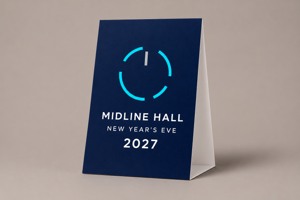
A folded paper information display
This 5 × 7 inch paper table tent lists 14pt stock, full-color printing and a glossy default finish; the page also names matte. Its folded paper form needs no separate display stand. Confirm any nondefault configuration before ordering.
Compare custom table tents and give DecentCustom the approved artwork and intended use. The current minimum quantity is 25; that is an order condition, not a recommendation to print 25 reminders or evidence of 25 guests.
The navy Midline Hall design is an AI concept. It does not prove outdoor durability, a production finish, event permission or admission validity. Before releasing a real print file, read its dates aloud against the organizer’s current confirmation and ask the after-midnight arrival question once more. If the answers disagree, hold that version and correct the source of the mismatch.
Sources checked November 11, 2026, UTC. Midline Hall and M12 are fictional. No event ticket, reservation, late-entry exception or order was created.