A useful salon arrival message takes a client from the correct street to the correct door, without promising a parking benefit your business cannot provide. Separate directions, parking permission and validation conditions.
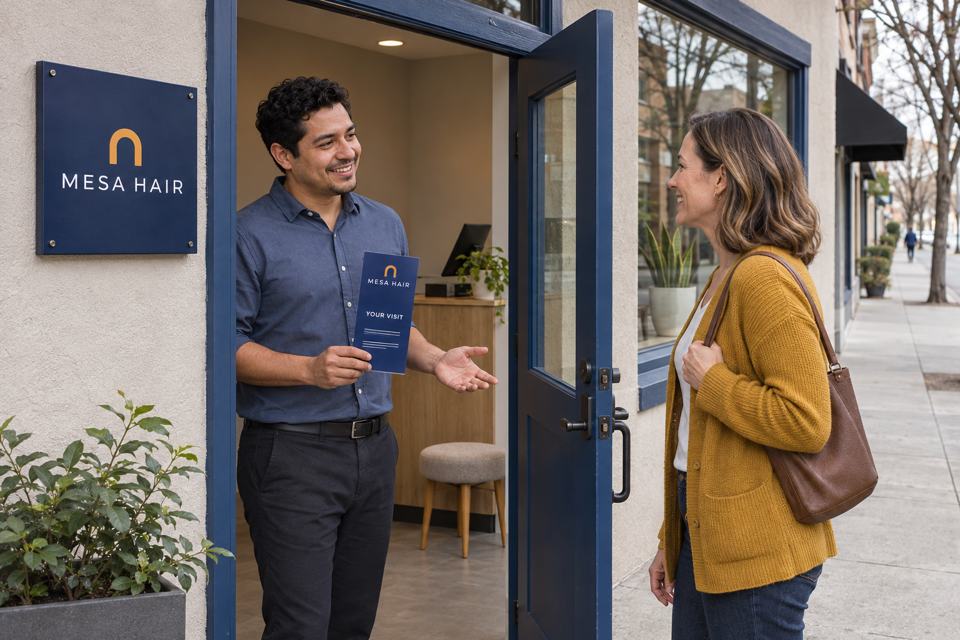
Write the last part of the journey, not just an address
Start with the salon’s exact business name, street address and suite, where applicable. A map pin can reach a shared building while leaving the client unsure which entrance to use. Describe the vehicle entrance separately from the entrance where a person checks in. Add the short walk between them when that is the point clients commonly miss.
Fringe’s published parking directions provide a concrete example. The salon identifies garage entrances on NE 71st and NE 72nd Streets, retail spaces toward the rear, and a walking route using the stairs or elevator toward the NE 71st Street and Woodlawn Avenue NE corner. It then identifies its salon entrance on NE 71st Street. Each detail answers a different arrival question.
| Part of the message | Question it answers | What to verify |
|---|---|---|
| Destination | Which business and suite am I visiting? | Current address and the provider named in the booking |
| Vehicle entrance | Where can I enter the parking facility? | Actual entrance street and operating conditions |
| Permitted space | Which spaces can I use? | Posted designation and applicable operator rules |
| Walk and check-in | How do I reach the salon door? | Current pedestrian exit, salon entrance and reception point |
A mention of an elevator is useful route information, but it does not establish a fully accessible journey. Do not label a route accessible from a photograph or map alone. Give a contact path for clients who need specific entrance or access information, and confirm the actual arrangement before making a promise.
Keep parking permission separate from validation
A shared garage can contain spaces with different conditions. Fringe directs salon visitors to retail spaces, says it does not validate parking, and limits the use of PCC-designated spaces to a visit that also includes shopping at PCC. The nearby Green Lake Village PCC store page advertises 90 minutes of validated parking with a purchase. That purchase condition must stay attached to the benefit; it is not free parking included with a salon appointment.
Keep dated information dated. Fringe’s page identifies an hourly garage rate specifically as of January 2025. This article does not present that amount as today’s rate. Direct clients to the garage’s current posted charges and conditions rather than preserving an old number in every reminder or printed card.
Another business can have a different arrangement. Foxycut’s own site describes free parking at its Georgetown location. That statement does not establish free parking for a Green Lake salon, a reserved space, or permission to use every nearby lot. Use the actual location’s information instead of copying a competitor’s reassuring phrase.
A completed arrival message with a clear boundary
Fictional example: Mesa Hair occupies Suite B in a small building with a paid shared garage. Its receptionist has checked that salon visitors may use the spaces marked Retail Visitor. The building has a separate grocery tenant with purchase-based validation, and Mesa does not provide that validation. The garage’s price can change. The salon’s pedestrian entrance is the blue street-level door, rather than the garage vehicle gate.
Your appointment is with Mesa Hair, Suite B. Enter the shared garage from Cedar Lane and use spaces marked Retail Visitor, following the current posted rules and charges. Mesa Hair does not validate parking. Spaces reserved for the grocery tenant are subject to that tenant’s conditions and are not included with your salon appointment. After parking, use the pedestrian exit to Cedar Lane and come to the blue Mesa Hair door beside Suite B’s window; check in at reception. If you cannot identify the correct entrance, contact reception using the details in your appointment confirmation before continuing.
This message completes the fictional route without inventing a free period, quoting an unverified fee or promising an available space. Cedar Lane, the storefront and the arrangement are invented to demonstrate the structure; they are not directions to a real business. A real salon should insert its verified destination, route and contact details before use.
Keep the appointment’s exact time and any service-specific arrival instructions in the current booking confirmation. A general location card should not appear to confirm a new time or grant permission for late arrival. If a client is delayed, they need the salon’s actual contact channel and current policy, not a promise that parking difficulty automatically extends the appointment.
Test the directions from a first-time visitor’s perspective
Have someone unfamiliar with the location read the message at the point where a choice is required: selecting a garage entrance, choosing a space, finding the pedestrian exit and identifying the salon door. Ask what they would do next. Record an ambiguous step and revise that step, rather than adding a longer sales paragraph.
Review the message when the garage operator changes a rule, an entrance closes, the salon moves suites or a validation arrangement changes. Keep one current digital version linked from the appointment confirmation. If a printed card also exists, identify the affected stock and revise it before handing it to another client. An old parking claim remains misleading even when the salon’s logo and address are still correct.
A useful review result is specific: “the card now identifies the pedestrian exit and no longer implies salon validation.” It is not proof that every client will arrive on time. Record actual arrival questions if you want to learn whether the revision helps.
Use a printed card only for a real handoff need
An accurate confirmation message may already solve the problem. If clients also need something to take away after an initial consultation, printed rack cards for salon arrival information can carry the stable destination, entrance description and a reference to current parking conditions.
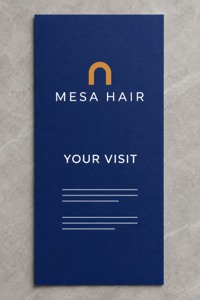
AI design concept for fictional Mesa Hair. This is a printed information card, not a parking permit, a physical wayfinding sign or proof of an actual reservation.
The linked product page lists 3.74 × 8.27-inch paper cards, standard 14pt stock as the default and a current minimum order of 50. Compare that batch with the number of genuinely useful handoffs and the likelihood of a parking-rule change. Do not buy a batch merely because one arrival message needs correcting; update the existing digital instructions first.
Compare custom rack card formats and bring the approved artwork and actual requirements to DecentCustom. Keep a readable description of the door and contact path in the message itself, even if you also link a map.