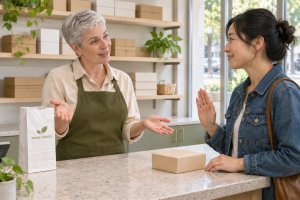
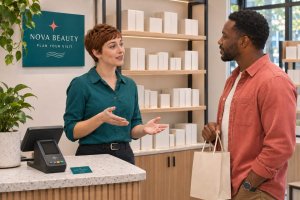
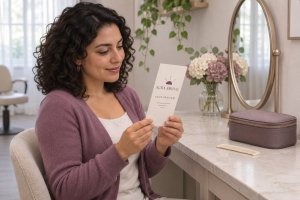
Before sending someone to a store, establish what they want to do and whether that specific business offers it to them. Public shopping, professional supply purchasing, a private consultation and collecting an online order need different preparation.
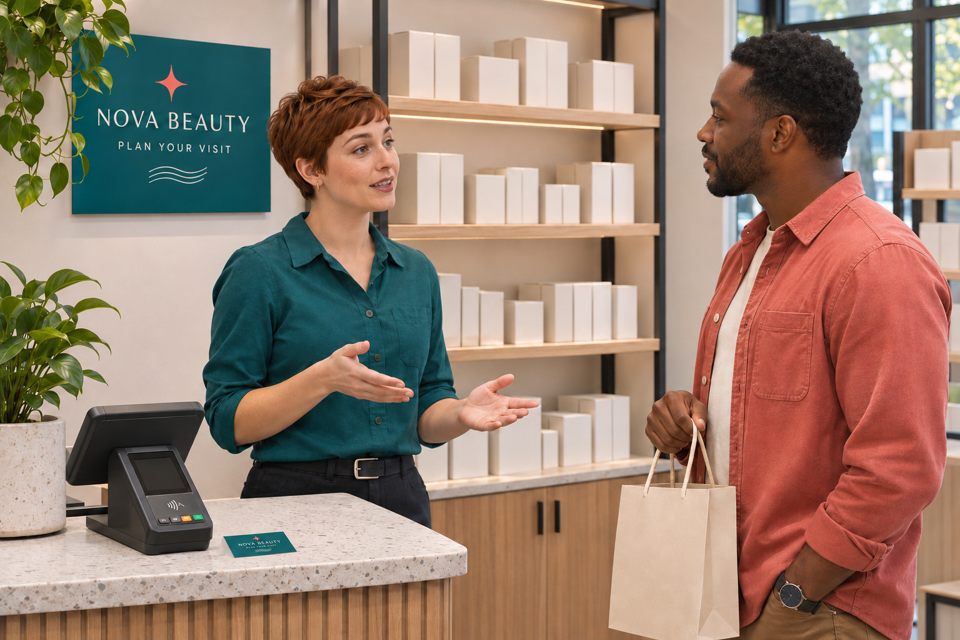
Start with the visitor’s task, then check the particular store
Ask a short first question: “Are you shopping for a product, attending a consultation, checking professional purchasing eligibility, or collecting an existing order?” This identifies the route without asking the visitor to disclose a personal health history or display credentials in a public conversation.
The distinction is visible in actual store descriptions. Sally Beauty’s Northgate store page describes serving retail consumers and salon professionals. By contrast, CosmoProf’s Seattle page identifies the business as a distributor to licensed beauty professionals. Similar products or the word “professional” in a product description do not establish identical purchasing eligibility.
Appointments are another question. Fabulous You Wigs’ contact page says the business operates by appointment only and gives routes for arranging one. A published address identifies the location; it does not turn a consultation request into a scheduled visit.
| Visit route | Preparation that matters | What does not establish it |
|---|---|---|
| Public retail shopping | The specific store’s public shopping offer and the actual item enquiry | A similar product offered by a different professional supplier |
| Professional supply purchasing | The supplier’s current eligibility process and applicable account requirements | A consumer’s interest in a professional-quality product |
| Private consultation | An accepted appointment, location and provider’s actual preparation instructions | A contact form submission, address or ordinary business hours alone |
| Online order collection | The order’s ready notice, collection store and current pickup instructions | An order acknowledgment or payment record alone |
For pickup, Sephora’s US pickup FAQ says customers receive an email or app notification when items are ready. It also identifies an in-store pickup point. That is a collection process for an existing order, not a reservation for a beauty service.
Three completed routing decisions
1. A consumer asks about a professional supplier
Fictional enquiry V1: A Nova Beauty visitor wants to buy a product seen on a professional supplier’s website and assumes every beauty shop has the same purchasing rules. The assistant checks the named supplier’s published scope instead of telling the visitor simply to arrive with payment.
The supplier you named describes serving licensed professionals. Please use its current eligibility contact route before planning a purchase there; we have not established your eligibility or an accepted account. If you want ordinary public retail shopping instead, choose a store that expressly offers that route and check the exact product with that store. We have not confirmed that another shop stocks an equivalent item.
The decision is complete: the visitor knows which question belongs to the supplier and has a public-shopping alternative to investigate. The assistant has not invented accepted credentials, a student exception or a product substitute.
2. A consultation address appears in search
Fictional enquiry V2: A visitor finds an appointment-only retailer’s address and wants to come that afternoon. They have sent an enquiry but received no accepted time. The assistant directs them to the retailer’s published scheduling route and records the visit as not yet confirmed. The address stays a destination to verify after agreement, rather than an invitation to walk in.
Once the provider confirms the actual appointment, the visitor uses that confirmation for the date, location, contact and preparation. There is no need to print another generic appointment card if the existing message already supplies those details clearly.
3. A paid order has no ready notice
Fictional enquiry V3: A shopper has an online payment acknowledgment and wants to collect immediately. The assistant identifies the selected store and checks whether the order has its ready notice. In this example it does not. The shopper’s next step is to wait for the actual collection notification or ask the store through its current order-support route; the assistant does not call an unprepared order ready.
These examples resolve different preparation questions. Passing one check does not pass the others: a professional account does not create an appointment, and an appointment does not establish that a separate pickup order is ready.
Keep broader health and assistive retail enquiries with the right provider
A directory category can contain ordinary shops, appointment businesses and specialist services. Do not assume a beauty retail visit, a pharmacy enquiry and an equipment assessment have the same eligibility, documents or staff. Identify the actual service and use the responsible provider’s own channel.
This article does not determine medical eligibility, insurance coverage or a professional qualification. Do not ask visitors to send private records through a public comment, generic sign or marketing card. Public instructions can explain where to ask; the provider controls the appropriate individual process.
Review store information when its location, shopping scope or appointment method changes. A directory result and a brand-wide service list are starting points, not confirmation that a particular branch offers every service today.
A contact card helps only when its job is clear
Correct an inaccurate store page or confirmation first. A simple public contact card can help someone continue an eligibility or appointment enquiry after speaking with staff, but it should direct them to the working business contact rather than imply permission to buy, enter or receive a service.
Keep public contacts separate from private records
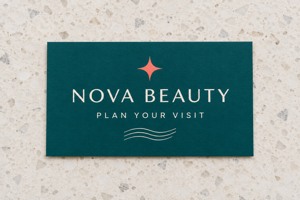
These store contact business cards list a 3.5 × 2-inch format, standard 14pt stock and standard corners as defaults, with a current minimum of 50 and ordering in increments of 50. Compare that batch with an actual handoff need.
Compare printed marketing materials and give DecentCustom approved wording and artwork. The Nova card is an AI concept, not an access pass or qualification. Add verified public contact information to the proof; keep individual eligibility and order records in their proper channels.
Sources reviewed November 12, 2026: the named Sally Beauty and CosmoProf store pages, Fabulous You Wigs’ contact page, Sephora’s US pickup FAQ and the linked DecentCustom product. Operator examples apply to those businesses. Nova Beauty and enquiries V1–V3 are fictional; no account, appointment or order was created.