A message about a completed service is a follow-up request. A request to move a future appointment is a booking change. Route each one correctly, and make the eventual confirmation say exactly what has been agreed.
Identify what the client is asking to happen
Begin with the action needed: review a concern about a completed service, change an existing appointment, book additional work, or report a late arrival. A message saying “I need to come back” can mean any of the first three. Clarify that action before assigning a new service or changing a slot.
Fringe’s current policies illustrate why the distinctions matter. The salon asks clients with a service concern to contact it within seven days. Its ordinary cancellation notice and its longer notice for a specified treatment are separate rules. Those published conditions belong to that provider; they are not a universal seven-day correction guarantee or a rule to print on every salon’s card.
Use the provider’s current instructions for the actual service. Do not turn an invitation to discuss a concern into a promise of a refund or a free procedure. Record the message’s receipt separately from the eventual decision about an appointment, scope or charge.
| Client’s need | First useful information | What completes the handoff |
|---|---|---|
| Review a completed service | Original service date, provider and a concise description of the concern | The responsible person reviews it and communicates the agreed next step |
| Move an existing booking | Which appointment, requested change and acceptable alternatives | An accepted replacement is recorded and the old slot’s status is explicit |
| Add a different service | Requested work and any existing appointment it affects | The provider confirms scope, price and time before reserving the revised work |
| Report a delay today | Current appointment and estimated arrival, if known | The salon explains what can actually proceed under its current policy |
Collect these details through the business’s appropriate private channel. A public counter card should not carry a named client’s concern or service history. General contact information can point to the right route without reproducing the private booking record.
A follow-up request needs a review, then a definite next step
Fictional completed example: A client contacts Orbit Hair about a haircut completed on Monday. Reception records the original visit and the client’s description, then passes the message to the responsible stylist. At this stage reception acknowledges receipt; it has not promised a correction, price or time.
The stylist reviews the request and offers a discussion appointment on Thursday at 4 p.m. The client accepts. Orbit records that appointment as a review of the original concern, with no additional service booked. Its final reply reads:
Your follow-up discussion with your original stylist is confirmed for Thursday at 4 p.m. We have linked your message to Monday’s haircut. This visit is to review the concern you described; no additional service has been booked. The stylist will explain any proposed next step and its terms before you decide whether to proceed. Please use this message thread if you need to change the review appointment.
The fictional handoff is complete because the recipient, purpose, accepted time and current scope are clear. The example does not decide what work a real client needs or whether any charge should apply. Those decisions require the actual provider’s review and the applicable arrangement.
A proposed replacement is not yet a changed appointment
For a future booking, distinguish the request from the accepted replacement. In a second fictional Orbit case, a client asks to move Tuesday’s 2 p.m. haircut to Friday. Reception checks the booking’s actual change conditions and offers Friday at 11 a.m. Until the client accepts and the booking record is updated, Friday is only an offered alternative.
After acceptance and the recorded update, the completed confirmation says:
Your haircut has been moved from Tuesday at 2 p.m. to Friday at 11 a.m. with the same stylist. The Tuesday appointment is canceled and the Friday appointment is confirmed. The service remains a haircut; no color appointment has been added. This confirmation replaces the earlier appointment message.
If a change charge applies, disclose its actual terms during that exchange before acceptance; do not copy a competitor’s amount or infer an exemption from this example. If the preferred alternative is unavailable, offer the choices the provider can genuinely accommodate instead of issuing a misleading replacement confirmation.
Make the contact route realistic for the business. Foxycut’s visit page, for example, explains that a receptionist is not always present. Publishing a contact number does not establish continuous front-desk coverage. An acknowledgment should state the actual status, and a business should not promise an instant reply it has not arranged to provide.
A contact card supports the route; the booking record holds the decision
First check whether the client’s existing appointment confirmation already provides a working contact path and clear instructions. If it does, another printed item may add little. A take-away card can be useful when a client needs the business’s stable public contact details after an in-person visit.
Keep the public wording stable
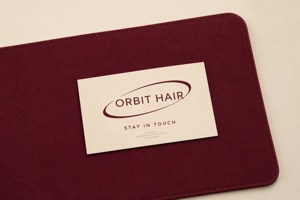
These salon contact business cards use a 3.5 × 2-inch format, with 14pt standard stock and standard corners as defaults. The current minimum quantity is 50, and the page lists ordering in increments of 50. Compare that quantity with the real handoff need before ordering.
Compare printed marketing materials and give DecentCustom the approved artwork and actual requirements. The Orbit card is an AI concept. Add verified public contact details to the proof; avoid printing personal service records, a promised outcome or a blanket cancellation rule.
Check the finished process by reading the final reply: can the client tell whether the message was received, whether a time was accepted, what is booked now and what happened to the previous slot? If one of those remains unclear, correct the confirmation before sending more reminders.
Reviewed November 12, 2026: Fringe’s current policy page, Foxycut’s visit information and the linked DecentCustom product page. Examples illustrate administrative communication, not technical hair advice, contract interpretation or an actual service outcome. Orbit Hair and both cases are fictional.