Check the workload of each artist and the availability of each client, rather than dividing the total work by the number of artists. Then confirm the service window, venue access and the point when everyone must be beauty-ready.
Start with the time everyone must be beauty-ready
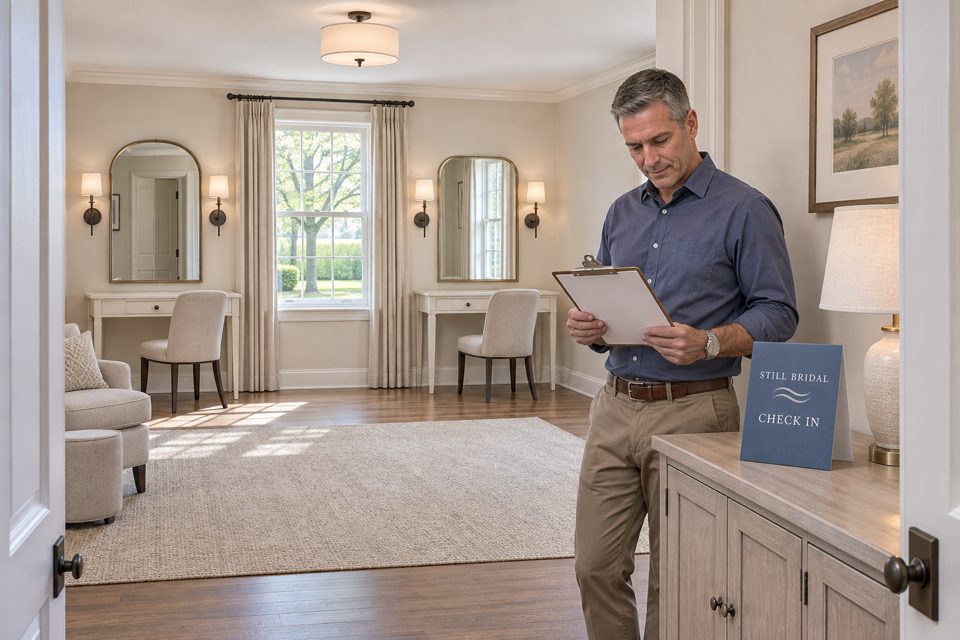
Give the provider the getting-ready location, the agreed beauty-ready deadline and the work requested for each person. Distinguish that deadline from the ceremony, photography, dressing and departure times. Artists also need a workable arrival and setup arrangement; an available room at the service start is not necessarily early enough for setup.
Bridal Beauty Agency’s FAQ asks for an estimated getting-ready location and readiness time when preparing a quote. Its one-wedding-per-day statement applies per stylist. It does not establish an unlimited team or confirm a particular morning’s availability.
Luxe Artistry’s FAQ explains that each artist works with one client at a time and asks for people to be available when artists start. It favors a continuous, flexible flow rather than rigid individual appointments. Confirm your own provider’s working method instead of imposing a timetable copied from another studio.
Use service durations approved for the actual work. A published typical duration is not a promise for every client. The example below uses invented, explicitly agreed service times to show a capacity check; it is not Luxe’s schedule or a recommendation for how long hair or makeup should take.
Why 195 minutes of work may not fit into 240 artist-minutes
Fictional example: Still Bridal is preparing three clients: the bride receives hair and makeup, and two attendants receive makeup only. That is four services for three people. The agreed allocations are 60 minutes of bridal hair with Artist H and three 45-minute makeup services with Artist M. In this example the bride’s hair and makeup will not occur simultaneously.
The initial proposed service window is 8:30–10:30 a.m., or 120 minutes for each artist. Setup is outside that window. Total available artist-time is 2 × 120 = 240 minutes, and the planned work totals 60 + 3 × 45 = 195 minutes. That pooled comparison looks comfortable, but it hides the makeup workload.
| Artist | Assigned work | Available service minutes | Result |
|---|---|---|---|
| H: hair | 60 minutes | 120 | Fits the stated window |
| M: makeup | 3 × 45 = 135 minutes | 120 | 15 minutes short, before any buffer |
Artist H’s unused time cannot automatically become Artist M’s time. Do not assume H is booked or equipped to perform the makeup work, or that an assistant is interchangeable with another artist. Ask the provider to approve a feasible arrangement.
A revised sequence must also avoid double-booking the client
For this fictional case, the venue and provider confirm that access and setup can be completed before an 8 a.m. makeup start. Artist M agrees to that earlier service window; Artist H’s approved bridal hair slot is 9–10 a.m. The three clients accept the revised readiness instructions.
| Artist M: makeup | Artist H: hair | Client overlap check |
|---|---|---|
| 8:00–8:45: bride | Bridal hair starts later | Bride’s makeup finishes before her hair starts |
| 8:45–9:30: attendant 1 | 9:00–10:00: bride | Different clients receive the concurrent services |
| 9:30–10:15: attendant 2 | Bride’s hair finishes at 10:00 | Attendant 2 and bride are different clients |
| All makeup complete at 10:15 | All hair complete at 10:00 | 15 minutes remain before the 10:30 beauty-ready deadline |
The revised makeup window supplies 150 minutes from 8–10:30: 135 minutes of assigned work plus a 15-minute buffer. The bride has a 15-minute interval between makeup ending at 8:45 and hair starting at 9. No client has overlapping services in this example. Dressing, photography and travel still need their own arrangements outside this beauty-service check.
The table demonstrates feasibility for the stated fictional assumptions, not guaranteed completion. A provider may use a flexible flow instead of these slots. If earlier access, setup or artist availability cannot be confirmed, the proposed revision is not usable; review staffing or the agreed work with the provider rather than publishing the earlier start as settled.
Make the final message match the approved plan
Still Bridal’s revised arrangement is approved: makeup begins with the bride at 8 a.m., followed by the two attendants. Bridal hair is 9–10 a.m. Makeup is planned to finish at 10:15, leaving 15 minutes before the 10:30 beauty-ready deadline. Venue access and setup have been confirmed separately. Use the current private service plan for each person’s readiness instructions. This replaces the earlier proposed 8:30 makeup start.
This is the completed handoff for the fictional case. In a real booking, include the actual date, location, responsible contact and approved readiness instructions. Recheck the plan when a service, participant, location or deadline changes. Do not change only the public notice while leaving the team and clients with the old version.
A public check-in notice has a smaller job
The working service plan belongs with the responsible team and clients. A shared notice can simply identify where arriving people should check in. It cannot add an artist, shorten a service or replace the private plan. Check whether the venue already has a suitable information point first.
Use one message where it helps
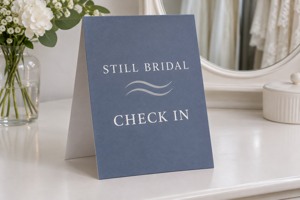
These paper table tents for a bridal check-in point list a 5 × 7-inch format, 14pt stock and a current minimum quantity of 25. One event needing one notice does not by itself justify that batch.
Compare custom table tent formats and give DecentCustom approved artwork and requirements if a new printed notice has a real use. The Still design is an AI concept, not proof of an appointment, venue capacity or artist availability.
Reviewed November 12, 2026: Luxe Artistry and Bridal Beauty Agency FAQs and the linked DecentCustom product. The Still Bridal clients, durations and revised arrangement are fictional. This article demonstrates an administrative feasibility check, not a technical beauty procedure or an observed wedding outcome.