Plan materials from the agreed group booking: who is attending, who receives a service, which services are reserved and what the venue already provides. Eight booked services can belong to fewer than eight people.
A group enquiry needs an agreed service arrangement
Start with the group service your business actually offers. Several appointments close together, an arranged party and exclusive use of a venue can have different staffing, timing and access conditions. Write the confirmed arrangement clearly before preparing an invitation or calling it a private event.
Pink Polish’s events page invites enquiries for groups of four or more, including birthday, bridal and corporate occasions. Its form asks for a group size and event timing. The page also sets out event-specific deposit and change conditions. A submitted enquiry is not proof of an available appointment or a confirmed private hire.
The business’s group-booking FAQ likewise separates event arrangements from ordinary visits. For your own booking, review the current terms with the responsible coordinator and make the agreed contact visible to the organizer. This article does not interpret a deposit agreement or submit an event request.
Confirm practical permissions separately. For example, Little Red Day Spa’s FAQ permits guests to bring food and beverages and says dishware is available. That is this operator’s published provision. It does not establish food, drink or decoration permission at a nail salon or another venue.
Keep the guest count and the service count separate
A useful group record identifies the service clients, each person’s selected work and any accompanying visitor the venue has agreed to receive. Keep the necessary individual details in the appropriate private booking record. A public counter notice does not need a named treatment list.
Fictional completed planning example: Fable Nail has confirmed a group of six service clients. Two will receive both a manicure and a pedicure, two will receive a manicure only, and two will receive a pedicure only. The venue has also approved one accompanying adult who will not receive a service.
| Booking component | People | Reserved services |
|---|---|---|
| Manicure and pedicure | 2 | 2 manicures + 2 pedicures = 4 |
| Manicure only | 2 | 2 manicures |
| Pedicure only | 2 | 2 pedicures |
| Total service clients | 6 | 4 manicures + 4 pedicures = 8 services |
| Approved accompanying adult | 1 | 0 services |
| Total expected visitors | 7 | 8 services for the six clients |
The coordinator has agreed the service allocation and timing with the provider. The arithmetic alone does not show that eight services can run simultaneously, how many technicians are needed or which workstation sequence is appropriate. Those decisions belong to the actual service plan.
Our confirmed group has six service clients and eight reserved services: four manicures and four pedicures. Two clients receive both services. One additional adult has been approved to accompany the group without a service, so seven visitors are expected. Use the private booking list for the individual allocations and the current confirmation for arrival timing. This arrangement does not include exclusive use of the salon or an additional guest gift.
This message completes the fictional count and scope handoff. In a real group, include the actual confirmed arrival details before sending it. Keep a requested extra companion pending until the venue agrees; an invitation from the organizer alone does not establish access.
Count each material for its actual purpose
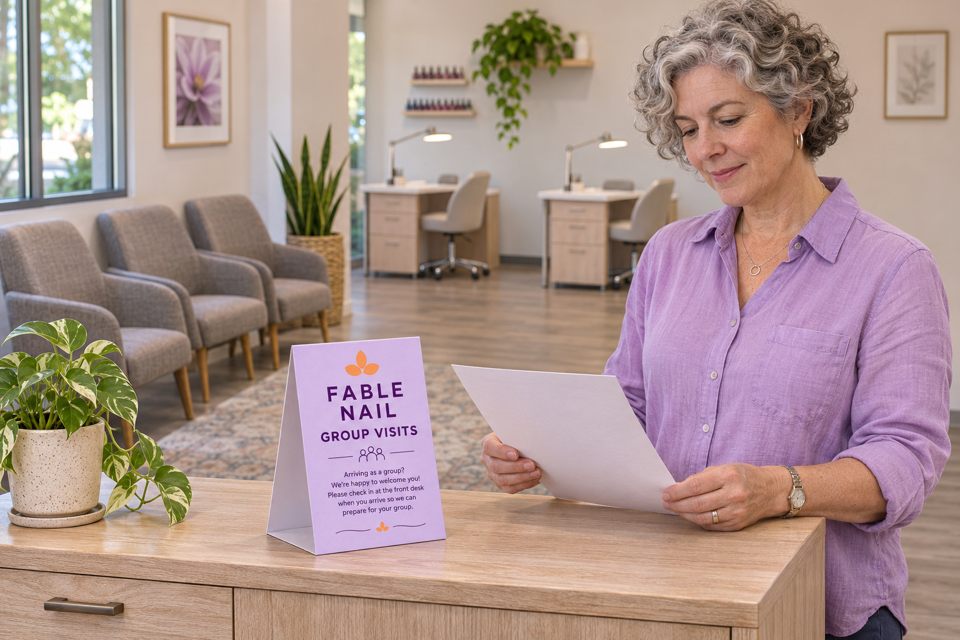
For Fable’s example, a service-allocation record needs six client entries carrying eight selected services. Arrival planning accounts for seven visitors. A shared public check-in message needs one suitable information point at the agreed location, rather than one sign for every manicure or pedicure.
An optional item intended for each person needs its own defined recipient list and a reason for providing it. Do not turn eight service units into eight gift packs. Ask whether an existing carrier, included kit or approved venue supply already meets the need before buying anything extra.
Keep professional service supplies under the provider’s established requirements. This example does not calculate treatment products, towels or tools from headcount. For refreshments, first establish whether they are allowed, who supplies them and what dishware is already available. A permission to bring refreshments does not by itself create a need for new branded cups.
Use public signs for stable directions, such as the agreed place to check in. Keep individual bookings, changing service choices and contact details in their appropriate records. Correct the organizer’s invitation when the venue, arrival time or scope changes; a generic counter sign cannot update every guest’s copy.
A service cancellation can leave the visitor count unchanged
Suppose one of Fable’s two-service clients later asks to drop the pedicure but still attend for the manicure. The requested service total would fall from eight to seven, while the six service clients and approved accompanying adult would still total seven visitors.
Mark that as a request first. The booking owner must review the applicable terms and confirm the revised service record. Until then, retain the existing confirmed allocation and make the pending change visible. Once the owner confirms it, send the revised service summary to the organizer and update the affected booking entry.
This distinction helps avoid two errors: leaving an unwanted service in the working list, or reducing visitor provisions for someone who is still coming. It does not determine any fee, refund or entitlement under the provider’s terms.
A shared arrival notice may be all the print needed
Use the venue’s existing clear check-in information if it already serves the visit. Consider a new counter piece only when the approved public message needs a distinct place and the venue permits it. Confirm the real check-in role before printing sample wording.
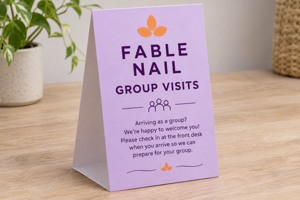
A folded paper counter notice
These paper table tents for group arrival information list a 5 × 7 inch format and 14pt card stock, with glossy as the default finish. The current quantity control starts at 25. If the immediate need is only one notice, consider whether an existing sign is sufficient before ordering a batch.
Compare custom table tent formats and give DecentCustom the approved message, chosen configuration and actual use date. The Fable artwork is an AI paper-tent concept with sample wording, not an acrylic holder, a private-event ticket or an appointment confirmation.
The materials plan is useful when each item has an actual purpose, the correct count and an owner. Extra merchandise is not required to make the group booking complete.
Sources and selected product reviewed November 12, 2026. Fable Nail, its group and all counts are fictional. Published arrangements apply to their respective providers. Actual capacity, schedule, permissions, service supplies and contractual terms require their own confirmation; no attendance or business outcome was measured.