A ready notice says an order can be collected; it does not necessarily start or restart the collection deadline. Identify the retailer’s actual rule and keep the order time, ready time and final collection cutoff as separate fields.
Two five-day policies can start at different events
Sephora’s US pickup FAQ gives customers five full days after placing the pickup order. Its own example says an order placed on Tuesday can be collected through store closing on Sunday, whether it was placed on Tuesday morning or evening. The FAQ separately explains the ready notification. That later notification does not replace the order-based start described in this rule.
The Vitamin Shoppe’s pickup page describes a different start: items remain available for five days from receipt of the ready-for-pickup email. It also asks customers to wait for that email before visiting. “Five days” alone therefore leaves out a condition that matters to the customer.
Keep each rule with its actual retailer, country and order type. Do not transfer the US Sephora FAQ to a different country or assume a separately identified store arrangement uses the same terms. Nor should a staff member convert full days into business days or promise an extension without the provider’s actual agreement.
Keep the event, readiness and cutoff distinct
| Record field | What it establishes | Evidence to use |
|---|---|---|
| Order placed | When this order entered the relevant purchase or reservation process | The original order record |
| Ready for pickup | When the order was reported ready for collection | The actual ready notice and any item-specific details |
| Collection cutoff | The last accepted collection time under the applicable rule | The current order instructions, policy and verified store conditions |
Attach the selected collection location and applicable local time zone to the record. The order’s date is not the shopper’s intended visit date. A pickup estimate is not the actual ready notice, and a prepared order is not a collected one.
Do not replace a provider’s own order identifier or barcode with a decorative store label. Keep the current notification available through the appropriate private channel, including the provider’s instructions for a different person collecting the order.
A completed correction: the ready email did not add another day
Fictional example: Cove Beauty’s approved policy gives five full calendar days after the order date. Order C18 was placed Tuesday, November 17, 2026, at 7 p.m. Pacific Time. Its ready notice arrived Wednesday, November 18, at 11 a.m. The store has confirmed Sunday’s closing time as 6 p.m. for this example.
An employee mistakenly drafts a reminder using the ready date as the start and names Monday, November 23. Before sending it, the coordinator checks the actual order-based policy. The five full calendar days after Tuesday are Wednesday 18, Thursday 19, Friday 20, Saturday 21 and Sunday 22. The correct fictional cutoff is Sunday, November 22, at 6 p.m. Pacific Time.
C18 is ready for pickup at the collection store identified in your order confirmation. Under Cove’s confirmed order-based policy for this example, please collect by Sunday, November 22, at 6 p.m. Pacific Time. The order was placed on Tuesday, November 17; Wednesday’s ready notification did not restart the five-full-day window. The draft reminder naming Monday was incorrect and has been replaced. Please use your current order instructions for collection.
The coordinator corrects the internal record and the draft message together, then checks that the old date is no longer being reused. This is a completed correction, not an extension of the hold. Cove’s policy, order and hours are invented; do not use the dates or 6 p.m. closing time as another retailer’s instructions.
Ask about the missing condition instead of guessing a deadline
If a ready-based rule gives a period but the order message does not make the final cutoff clear, ask the retailer to confirm it. Do not quietly decide that every period ends at closing or that every “day” is a business day. A changed store schedule or a disputed notification time also needs the actual order-support answer.
Read estimated preparation times with their conditions. The Vitamin Shoppe’s page includes closing-time and other eligibility qualifications, and excludes ship-to-store orders from its two-hour pickup offer. An advertised preparation time should not become an unconditional reminder saying the order is ready now.
If the collection window is no longer usable, use the provider’s current order-support options. A cancellation notice, an uncollected bag and a payment adjustment are separate facts. This article does not determine when a refund or card adjustment has actually completed.
Keep changing deadlines out of a general print run
The actual order notification should hold the individual cutoff. A general guide can explain where clients find it and whom to contact when it is unclear. Correct the existing notification or store instructions before deciding that another printed item is needed.

A stable prompt for collection questions
These postcards for general pickup instructions include a 4 × 6-inch option and list 16pt premium stock as the default. The page specifies ordering in increments of 50. Confirm the actual selected configuration and quantity before comparing it with a real handoff need.
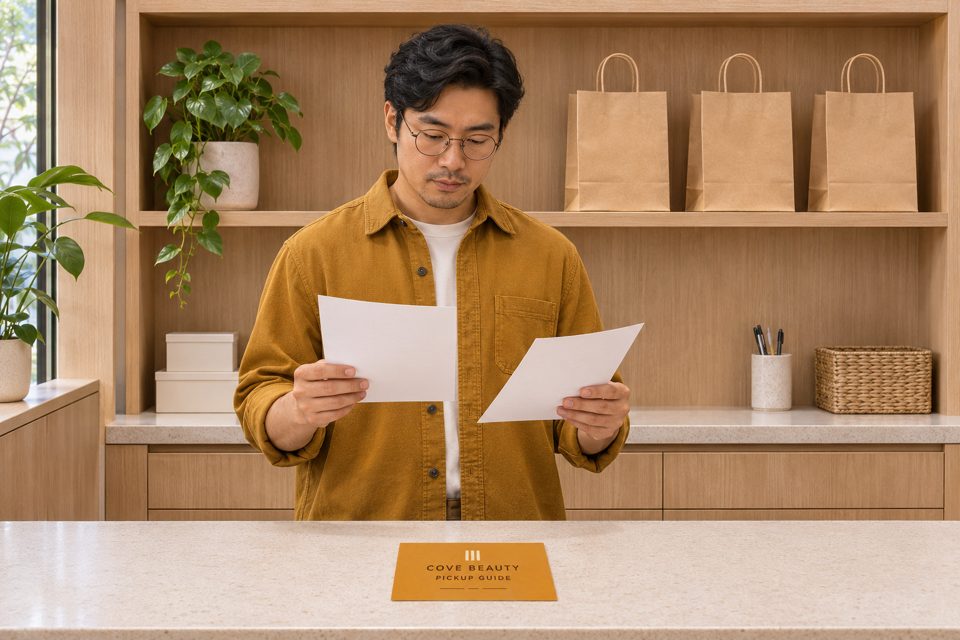
Compare custom printed marketing materials and provide DecentCustom with approved text and artwork if a general guide adds something useful. The Cove design is an AI concept, not a pickup barcode, an individual deadline notice or a guarantee of order readiness.
Sources checked November 12, 2026: Sephora’s US pickup FAQ, The Vitamin Shoppe’s pickup page and the linked DecentCustom product. The operators’ rules apply to their respective orders. Cove Beauty and C18 are fictional. No real order, collection or payment adjustment was performed.