Give clients the name of the business that provides their service and the correct place to book or change it. A shared salon address, a specialist team and a student clinic can involve different responsibilities; the building name alone does not explain the appointment.
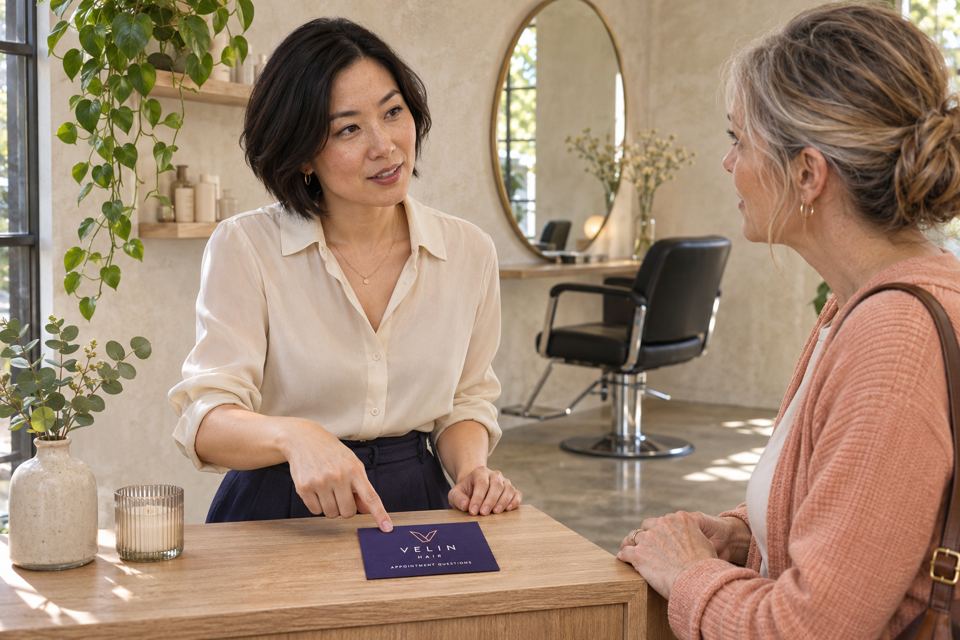
Three real salon models need different explanations
Start with the arrangement your business actually uses. A shared address does not tell a visitor whether one reception team coordinates every service, several independent businesses rent separate rooms, or students work with educators. Do not make clients discover that distinction after they arrive.
| Published operator example | What its own page explains | What your information should clarify |
|---|---|---|
| Fringe Hair Salon’s policies | Its colorists provide color services; its stylists provide cuts and trims. Individual biographies show rates. | Who provides each requested service and how the actual appointments are coordinated. |
| Sola’s salon-suite information | Professionals operate their own businesses with their own services, pricing and schedules. | The independent business name and its booking contact, alongside the correct location. |
| Evergreen Beauty College’s student salons | Students provide services under licensed supervision, with educators involved. Guest Services assists with appointments and feedback. | The student-service setting and the appropriate guest-service contact for that campus. |
These are three operators’ descriptions, not three rules that cover every salon. Fringe’s division does not mean all stylists elsewhere only cut. Evergreen’s page also explains that student services take longer because learning and educator consultations are involved; do not copy a conventional salon’s timing into a student-clinic promise.
Keep four details together for each service
For the service a client is considering, a coordinator should be able to identify:
- The provider: the actual business and, where relevant, the specialist or team.
- The booking owner: the working channel for enquiries, confirmations and changes.
- The visit: the agreed location, suite or campus and the current arrival instructions.
- The scope: what the existing confirmation includes and what still requires another arrangement.
Put those details where the client chooses the service: the menu, provider page or booking confirmation. If a shared directory links to individual professionals, verify that each link reaches the intended business. Two people with the same first name need more than a first-name-only contact label.
Keep public opening information separate from a tenant’s building access. Sola advertises around-the-clock access for professionals alongside control over their schedules. That does not establish that a client may enter a particular studio without an appointment at any hour. Obtain the actual business’s arrival instructions rather than turning a rental amenity into a walk-in invitation.
Likewise, a building’s facilities contact is not automatically authorized to quote a stylist’s price or change a client’s booking. Identify who can answer the particular question instead of forwarding every enquiry to the address owner.
A completed enquiry: same building, separate services
Fictional example: Velin Hair is an independent haircut business in a building that also contains other beauty businesses. Its owner, Alma, receives an enquiry from a client with an existing haircut confirmation: “Can you add color? I thought the studios in the building were one salon.” Velin does not offer color services.
Your current confirmation is for a haircut with Alma at Velin Hair. Velin does not provide color services, and I have not booked a color appointment for you. Other studios in this building are separate businesses with their own menus and bookings. If you want a color service, please confirm it directly with a provider that offers it. Your haircut remains as currently confirmed unless we agree a change through Velin’s booking contact. I can resend our location and arrival instructions if you need them.
The client replies: “I understand. Please keep my existing haircut. I will enquire separately about color.” Alma records the haircut as unchanged and the explanation as answered. There is no color booking to mark complete and no shared reception promise to add. The example is finished with a clear client choice, not an invented second appointment.
If the client instead wants to coordinate two services, leave that request open until the relevant providers confirm their own arrangements. Do not cancel, move or combine appointments merely because a client has asked whether it is possible. This is communication guidance, not a recommendation about the technical order of hair services.
Shared facilities do not settle who buys every supply
The same role distinction helps before ordering branded materials. Sola’s brand FAQ describes typical fixtures, utilities, Wi-Fi and laundry access, while professionals bring their own tools and products. That description does not establish the contents of a particular location’s agreement, ownership of every towel or responsibility for replacing supplies.
For a real purchase, identify who owns the item, who uses it and who may approve its replacement. A studio owner’s contact cards may belong to that independent business. A building directory may need the site operator’s involvement. An existing client robe, service kit or specialist container has a different purpose from a marketing card; adding the same logo does not make those items interchangeable.
Ask about the actual missing function. If clients cannot find the correct booking contact, correct that information. If an existing card is accurate and sufficient, continue using it. Neither problem automatically calls for more apparel, guest gifts or a new batch of printed material.
Use a contact card only when it provides a useful route
A small card can help someone remember which independent business to contact after a conversation or referral. Keep the business name prominent, describe the actual service briefly and include the checked public booking route. A building name can support location information without implying that its operator provides the service.
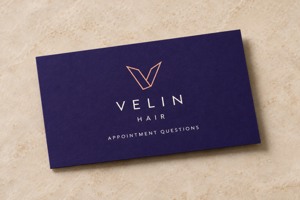
A paper contact card for the actual business
These salon business cards use a 3.5 × 2 inch format, with 14pt standard stock and square corners as default options. The current product page starts at 50 cards and specifies increments of 50. Check the selected stock, finish and quantity before ordering.
Compare custom marketing materials for the actual communication task. Give DecentCustom approved business wording, the working public contact route and the chosen configuration. The Velin card is an AI design concept with no usable contact details; it needs real approved information and a reviewed proof before production.
Before sharing a finished card, use its contact route yourself and confirm it identifies the intended business. Keep appointment changes and client details in the appropriate booking channel. A printed card supplies directions to that channel; it is not a booking confirmation or proof of anyone’s qualifications.
Operator and product sources reviewed November 11–12, 2026. Velin Hair, Alma and the enquiry are fictional. Local agreements and current appointments need their own confirmation. No client data, representative market statistics, print performance, search ranking or business result was verified.