Check what the booked service already supplies and what happens to each item afterward. A robe used during a visit, a towel returned to the salon and a client’s included home-care kit are different allocations; they should not become one extra-gift shopping list.
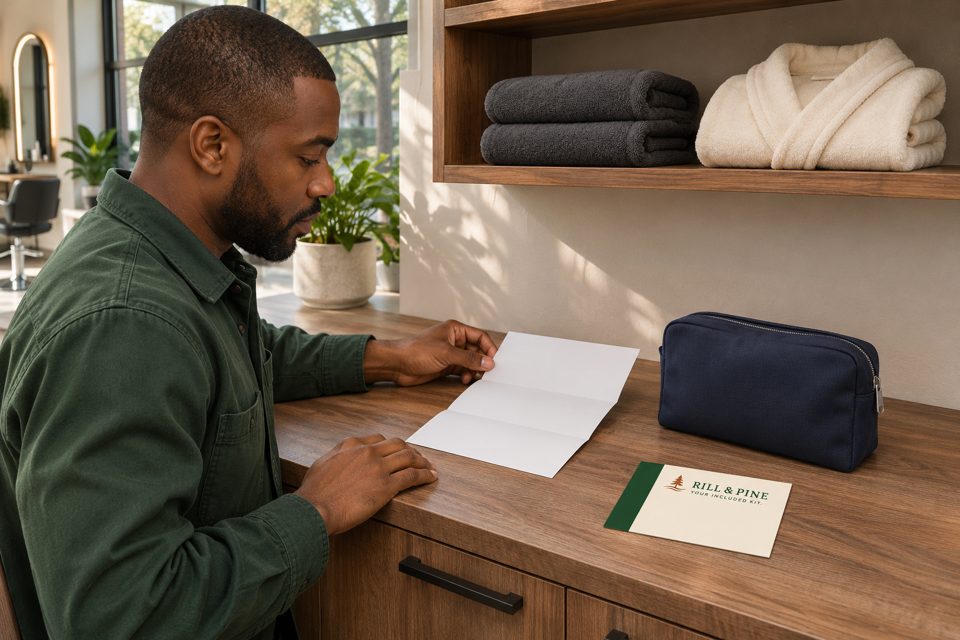
Read what the service already provides
Look at the actual service description and confirmation before making a supply list. “Salon supplies” can include things the business lends during a visit, products used by a professional and items a client is meant to take home. Each needs its own check.
For concrete examples, Little Red Day Spa’s FAQ lists towels, robes and toiletries among the items it provides. Audrey Lambert Hair’s amenities page directs clients to a robe and describes neck towels. Those descriptions support checking the business’s existing provision before buying another item. They do not establish that a guest may take the linen home.
A take-home kit has a different purpose. Mane Suite’s published extension-service description says clients leave with a home-care kit and detailed instructions. Check the particular booked service and the provider’s current contents list; the page does not give us a verified pouch size or an item-by-item inventory for every appointment.
Keep that distinction in customer-facing wording. “A robe is available during your visit” communicates a different arrangement from “Your selected service includes this take-home kit.” Use whichever wording the business has actually approved, and say where the client should ask about an uncertain inclusion.
Give each existing item a purpose and destination
| Item or component | What to verify | Decision before buying extras |
|---|---|---|
| Robe or towel used on site | Who owns it, its intended service use and the established return or handling point. | Follow the business’s existing process and check the actual available stock. |
| Included take-home kit | The selected service, approved components, required original instructions and intended recipient. | Complete the promised kit before adding an optional gift or outer carrier. |
| Professional product or container | Which exact item belongs to the service and who controls its use and information. | Retain its original identity and instructions. A branded container is a separate purchasing question. |
| Optional presentation item | Whether the client wants it and whether the existing package already serves the handoff. | Order only for a defined additional need; existing suitable packaging may be enough. |
Keep the linen count separate from the kit allocation. Ten booked clients do not automatically mean ten new robes, ten new bags and ten extra gifts. The service may already supply suitable reusable items, and the actual linen requirement depends on that operation’s established process. This article does not prescribe washing, disinfection or professional protective equipment.
A kit count needs a completeness check
Count assembled kits against the current approved component list. Check the actual variant and original information as well as the visible outer package. Twelve pouches on a shelf do not establish that twelve clients’ promised kits are ready.
Useful internal fields are the relevant service or kit version, components checked, instruction version, allocation and any unresolved item. Keep personal client information in the appropriate restricted record. The packing copy should contain only the reference needed for that handoff.
If a required component is missing, assign the question to the person responsible for that service. If the original instructions are missing or out of date, obtain the correct authorized version. A general marketing insert should not silently become a replacement care guide, and adding a second pouch does not complete the original kit.
A completed example: twelve existing kits, one missing guide
Fictional planning example: Rill & Pine has allocated twelve included kits to twelve confirmed service appointments. The coordinator checks each against the studio’s approved list. Eleven are complete. The twelfth contains the required physical components but lacks its current instruction sheet.
The starting record is 11 complete + 1 incomplete = 12 allocated kits. The incomplete kit stays out of the ready count. The coordinator identifies the missing document to the service owner, who checks the provider’s authorized current original, obtains the correct copy and reunites it with that kit. After the normal component and version check, the coordinator records 12 complete kits and 0 incomplete.
Kit check K12 is complete. We checked all twelve existing kits against the approved list. Eleven were complete at the first check; the remaining kit was missing its current instruction sheet. The service owner supplied the authorized current copy, and we checked it with that kit. All twelve are now complete for their existing allocations. No additional kit or outer pouch was ordered. Client handoffs are still to be recorded when they actually occur.
The guide problem is resolved, while delivery remains a separate step. These invented numbers explain reconciliation; they are not a recommended stock level or evidence that a particular supplier authorizes reprinting. In a real case, obtain the document through the provider’s permitted method.
A shared paper prompt can help clients find the right answer
Use an existing confirmation, approved guide or clear verbal explanation where it already works. Consider another printed piece only if it has a distinct job, such as directing general inclusion questions to the studio’s responsible contact. Keep changing kit contents and specialist care directions in their correct original records.
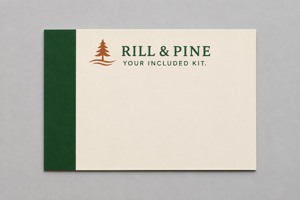
An optional paper information card
These printed salon information cards offer postcard sizes including a 4 × 6 inch format with horizontal or vertical orientation. The listed default stock is 16pt, and the page specifies quantity increments of 50. An increment is not, by itself, confirmation of the minimum for every selected configuration.
Compare custom marketing materials only after deciding what information is missing. Give DecentCustom the approved public wording and chosen size and finish. The Rill & Pine artwork is an AI concept, with blank space rather than actual care directions; it is not an approved client guide or a claim that a kit is included.
Finish the review with the existing items properly identified, promised kits complete and any true purchase gap assigned to its owner. A decision to use the supplies and information already available is a useful result.
Sources reviewed November 12, 2026. The operators describe their own services; confirm the inclusions for your particular booking. Rill & Pine and K12 are fictional. No actual stock, client handoff, professional care procedure, protective performance or business result was tested.