GivingTuesday does not require a central registration, a particular donation platform or a purchase of branded supplies. Your chosen local activity can still require its own signup. Start by deciding what your group will actually do, then confirm that action through the responsible organizer.
Do we have to register for GivingTuesday?
The official GivingTuesday FAQ says there is no central registration. It also notes that a locally led campaign may require signup or a profile. Those are different questions: joining the wider movement does not reserve places at a particular activity.
If your group wants to volunteer with a host, follow that host's current process. An expression of interest, a campaign hashtag or a printed card does not establish that the host can receive your group. Keep the plan pending until the actual arrangement is confirmed.
Must we use a new donation platform?
No specific fundraising platform is required by GivingTuesday, and the organization does not automatically provide each nonprofit with its own campaign page. Its FAQ directs organizations toward their own suitable communication or fundraising route.
For an activity that does not collect money, a current information page or group brief may be enough. If your organization does fundraise, have its responsible person approve the actual destination and public wording. Do not replace a known organizational route with an unfamiliar link just because a template includes a donation button.
Does participation cost money or require a branded kit?
The movement is free to participate in. A platform or service you choose can have separate costs. Free participation therefore does not mean every proposed event or service is free, and it does not create a requirement to buy custom merchandise.
A small organization's question can be about capacity before it is about design. In one public small-nonprofit discussion, the author describes a small team with little money to spend on fundraising events. That is one anonymous historical account, not a representative survey or a verified GivingTuesday result. It is a useful reason to keep a new plan within the team's actual capacity.
Can we participate without donating money?
Yes. GivingTuesday describes generosity through time, skills, goods and other actions as well as money. Its US page identifies December 1, 2026 as the annual date and gives time and gratitude as participation routes.
Choose a specific action that another person or organization can actually use. Before organizing a goods drop-off, check the receiving organization's current requested items and arrangements. Before announcing a volunteer outing, confirm its places and instructions. A broad invitation to be generous does not establish either of those details.
A small group completes the plan without buying supplies
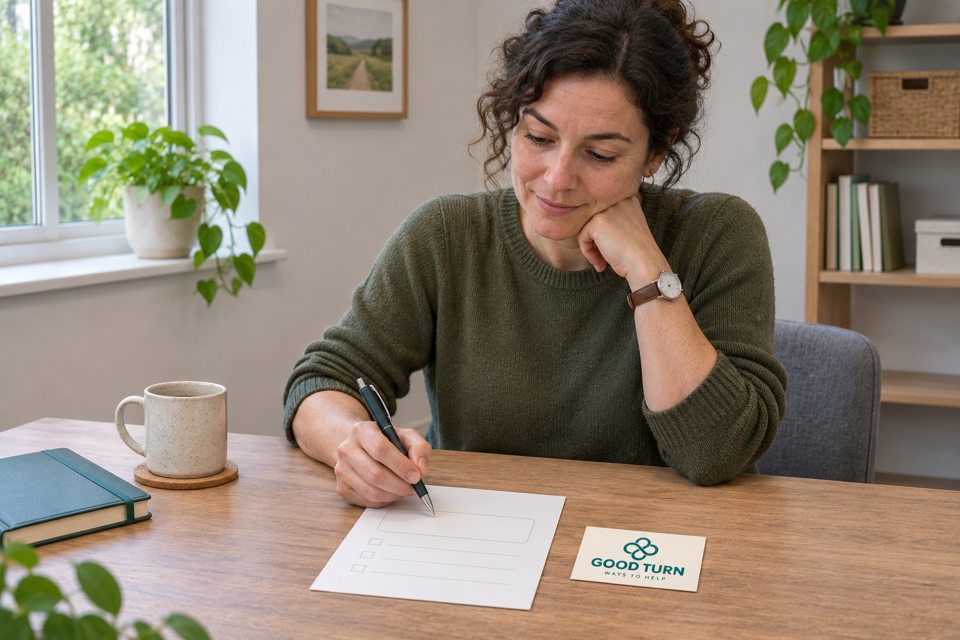
Fictional example: four adults in Good Turn want to help on GivingTuesday. Their first draft says they must buy a campaign kit and register with the movement before contacting a local host.
The coordinator checks the official FAQ and removes those supposed requirements. The group chooses one existing volunteer opportunity rather than inventing its own event. It follows the host's signup process; the host confirms the four places in this fictional example.
The coordinator sends the confirmed time, meeting point, host instructions and update route through the group's existing digital channel. Each member acknowledges the brief. The host already supplies the activity materials under its instructions, so the group removes duplicate purchases from its list.
The final record separates two decisions: no central movement signup was needed, while the actual host booking was completed. The group places no custom print order. This example demonstrates a completed planning decision; it reports no real booking, volunteer work or fundraising outcome.
When would a printed information card help?
Consider print only after identifying a recurring physical information point that existing materials do not serve. Stable group contact information has a different life from an event time, a changing item request or a one-off volunteer confirmation. Keep those changing details in a current route that someone maintains.
An optional stable-contact card

Ordinary printed business card
These business cards for a stable community contact list a 3.5 × 2 inch format, default 14pt stock, glossy paper and standard corners. The current minimum and purchasing increment are both 50. The four-person example does not establish a need for 50 cards.
Compare custom business cards only when a separate ongoing use exists. Bring approved wording and the actual configuration to DecentCustom for a proof review. Check actual-size readability and the preparation date before ordering; no arrival before December 1 is promised.
Reviewed November 17, 2026. Official FAQs support the participation answers; the current US page confirms the 2026 date. Local arrangements remain the host's responsibility. Good Turn is fictional. This guide does not determine fundraising legality, tax treatment, donor eligibility or an actual organization's costs or results.