A circle, a length of string and a ruler can start a useful Pi Day conversation. The learning comes from recording what was measured, dividing in the right order and explaining why a physical result is approximate.
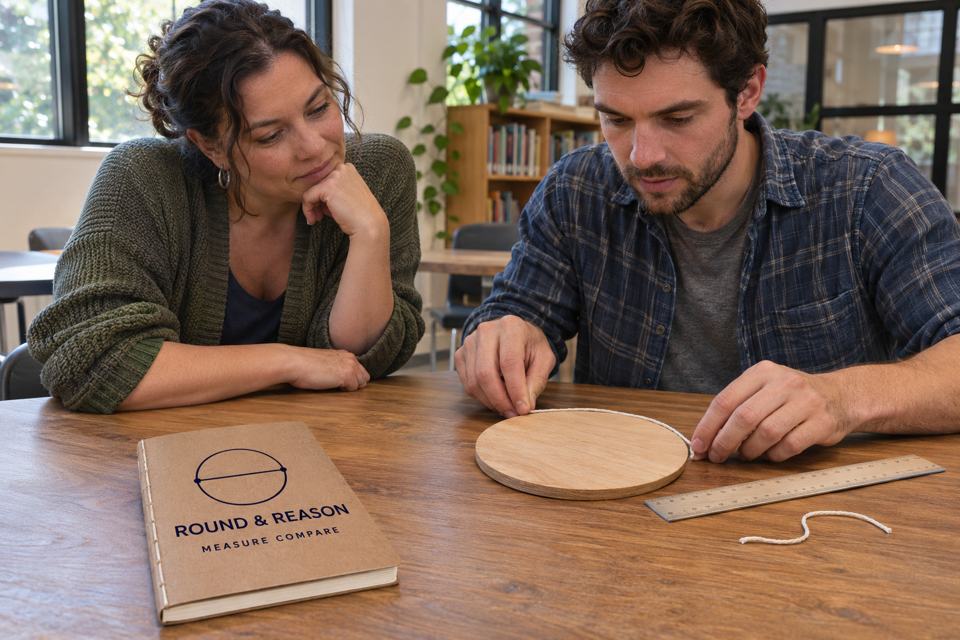
What is pi, and what are you measuring?
Pi is the ratio of a circle’s circumference to its diameter: π = C ÷ D. Circumference is the distance around the circle. Diameter goes straight across it through the center. Use the same length unit for both measurements; the units then cancel in the ratio.
NASA’s student explanation of pi identifies this ratio as a constant and distinguishes pi from its familiar approximation, 3.14. A larger circle has a longer circumference and a larger diameter, rather than a different value of pi.
Pi Day falls on March 14. The Exploratorium’s original Cutting Pi activity offers another physical approach using string. This guide’s notes table and troubleshooting examples are separately authored planning examples; they are not the museum’s handout or an endorsed lesson.
For a community class, decide what you want a participant to explain before ordering themed supplies. “I can identify C and D and describe a measurement problem” is a more specific discussion goal than “I saw a notebook with 3.14 on it.” It is a planning goal here, not a measured learning outcome.
Prepare a table that preserves the original readings
Round & Reason is a fictional community learning session for adults. Its host sets out several plain circular objects, cord, rulers and existing paper. Participants work in pairs: one positions the cord or ruler, while the other checks the endpoints and records the reading. The host checks that materials and the activity suit the actual group.
Choose a clearly defined circular edge. A flat disk is easier to describe than a container that narrows toward its base. If using a container, specify which rim is being measured and use that same circular cross-section for both C and D. A top-rim circumference paired with a bottom diameter describes two different circles.
- Identify the object and edge. Write “disk A, outer edge,” rather than just “round thing.”
- Record circumference. Bring the cord around that edge once, mark where the ends meet and read that length against the ruler. Keep the cord close to the edge without deliberately stretching it.
- Record diameter. Read across the same circle through its center. Check that the line crosses the widest part, not a shorter off-center chord.
- Keep units visible. Enter both lengths in centimeters, or both in inches. Record the actual readings before dividing; do not replace them with numbers chosen to produce 3.14.
- Calculate and comment. Divide C by D, then add a note about anything that made the reading uncertain. Retain a second reading separately if you repeat the measurement.
Useful notes fields are object/edge, C with unit, D with unit, C ÷ D and observation. A repeat should have its own row. Quietly changing the original entry prevents the group from explaining what improved.
Worked example: three illustrative results
These numbers are invented teaching examples, not measurements collected from a class or the AI image. Ratios are displayed to two decimal places so the calculation can be checked.
| Example object | C (cm) | D (cm) | C ÷ D |
|---|---|---|---|
| A | 31.4 | 10.0 | 3.14 |
| B | 47.0 | 15.0 | 3.13 |
| C | 63.0 | 20.0 | 3.15 |
For B, 47 ÷ 15 = 3.1333…; the displayed result rounds to 3.13. For C, 63 ÷ 20 = 3.15. These differences do not mean that pi changes with object size. Physical objects, positioning and ruler readings need examination.
Example A’s displayed 3.14 is not proof of an exact measurement either. A rounded ratio can look familiar while hiding limitations in the underlying readings. Ask how the lengths were obtained before congratulating the group on a perfect result.
Why did we get 6.28, 31.4 or another unexpected answer?
A result near 6.28: check whether the denominator was the radius. In the invented A example, 31.4 ÷ 5 = 6.28. Five centimeters is half the stated diameter. The needed denominator for C ÷ D is 10 cm.
A result of 31.4: check units before changing the measurement. Dividing 314 millimeters by 10 centimeters as bare numbers gives 31.4. Converting 314 mm to 31.4 cm first gives 31.4 ÷ 10 = 3.14. This is a unit mismatch, not a discovery about the circle.
A result somewhat above or below 3.14: check the chosen edge, a gap or overlap at the cord mark, an off-center diameter and the ruler’s reading scale. These are possible causes to investigate, not a diagnosis established by the result alone. Repeat the relevant step and keep a note of what changed.
Avoid averaging unlike measurements merely to obtain a familiar answer. A circumference at one rim and a diameter at another must be corrected at the measurement stage. A calculator cannot repair that mismatch.
Close with an explanation rather than a digits contest
Ask each pair: “Which two lengths did you compare, and what would you check if the result changed on a repeat?” A useful answer names the edge, identifies the diameter through the center, states consistent units and describes a specific check. It need not recite many digits of pi.
Ask a second question: “Does our table prove pi is exactly 3.14?” The answer is no: 3.14 is an approximation, and physical readings have limitations. This station explores a relationship through measurement; it is not a mathematical proof of pi’s value or irrationality. Keep actual participant observations separate from claims about the activity’s effectiveness.
Optional notebooks should serve the notes task
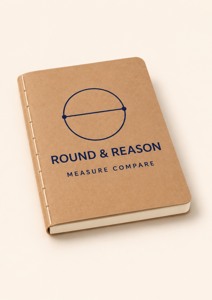
Existing paper is sufficient for one station. For a recurring program that needs individual records, the linked kraft-cover A5 notebooks for recording activity notes list blank paper, 80 sheets and an 8.26 × 5.83 inch format. The current minimum is 12; the 500-piece case pack is a separate specification. A pen is not included.
The blank pages can hold drawings and repeat readings. The notebook does not include cord, a ruler or a tested teaching program. Compare custom notebooks and padfolios for other note formats if the session has a genuine ongoing need, and confirm the selected artwork with DecentCustom. The navy circle-and-diameter cover is an AI design concept, without an institutional partnership or a promise of improved learning.