A conversation about a neighborhood newsletter can preserve details missing from a display case. Begin with a clear purpose, let the narrator shape the account and keep remembered dates separate from verified dates.
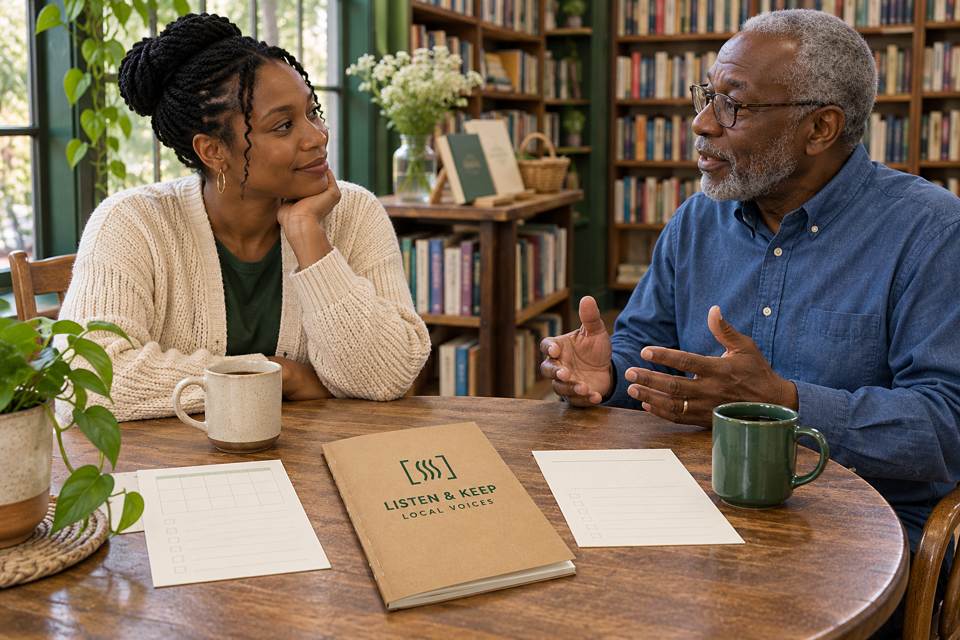
Give the conversation a purpose the narrator understands
For Black History Month, a bookshop or community group might explore how local people produced, shared or read neighborhood publications. Invite an adult because their own experience is relevant, rather than expecting one person to explain an entire community or supply a moving story on demand.
The Oral History Association’s best-practices guide recommends preparation, documented informed consent and clear discussion of recording, review, preservation and access. It also recommends training for first-time interviewers and planning an appropriate home for finished material. Address those arrangements before collecting a recording.
Listen & Keep is a fictional bookshop project. Its initial brief is: “Explore one adult volunteer’s own experience helping a neighborhood newsletter reach readers.” The host will discuss the subject and proposed uses in advance. Recording, later public use, review and storage arrangements remain to be agreed; agreeing to a conversation alone is not treated as permission for every use.
If the host is not ready to manage that process, start with a published reading instead. The Black History Month reading-display example offers a source-based activity that does not require collecting someone’s personal account.
Eight prompts that leave room for the narrator’s account
The National Park Service’s interviewing guidance favors open questions, one question at a time, attentive follow-ups and avoiding questions that suggest the desired answer. The following original prompts adapt that approach to the fictional newsletter project; they are not a script the narrator must complete.
- How did you first become involved with the newsletter?
- What do you remember doing on a typical day when copies were being prepared or shared?
- How did the publication reach the people who wanted to read it?
- Which objects, places or routines help you remember that work?
- What helps you place this experience in time?
- Which parts did you take part in yourself, and which did you hear about from someone else?
- What changed in the way people received neighborhood news during the period you remember?
- What have I not asked that you would like future readers to understand?
Listen before moving to the next prompt. If a narrator mentions a delivery route, ask them to describe it in their own terms. Avoid turning a guess into the question: “You must have delivered these every Friday in 1978, right?” supplies a schedule and a year the narrator may never have stated.
Allow topics to be declined and pauses to happen. A month’s theme does not entitle the host to private details or distressing experiences. Keep the agreed purpose visible while allowing the narrator to explain what matters to them.
A useful note keeps the uncertainty visible
The following is an invented practice exercise, not a real person’s testimony. A fictional narrator recalls helping circulate a newsletter “around the late 1970s.” Nothing in that phrase establishes an exact year, a weekly schedule or the publication’s total circulation.
| Field | Completed exercise note |
|---|---|
| Account as given | The narrator recalls helping distribute a neighborhood newsletter around the late 1970s. |
| Time status | Approximate period as remembered. Exact year unverified. |
| Experience boundary | Personal involvement in distribution; the project has not established who founded or printed the publication. |
| Follow-up | Ask what other life event or surviving issue helps place the experience in time, without offering a preferred year. |
| Separate verification task | If an actual publication is identified, locate a dated issue or repository description and record its source independently. |
| Public wording status | Not cleared for publication in this exercise. Any real excerpt needs the agreed review and use process. |
Keep the narrator’s account distinct from the interviewer’s interpretation and later documentary evidence. If a dated issue is eventually found, it can support a particular fact about that issue; it does not automatically verify every remembered event.
The OHA guide also asks users to respect the narrator’s perspective, recognize an interview’s subjectivity and, where possible, verify information presented as factual. Do not ask an AI tool to fill in a missing year, reconstruct a quotation or turn rough notes into words attributed to the speaker.
Decide what happens after the conversation
Preserve the agreed project context with the material: who participated under the chosen naming arrangement, when the session occurred, the subject, the relevant recording or note version and any access conditions. Avoid collecting or displaying a home address simply to make the record look complete.
Use the project’s agreed process for review, corrections, restrictions and proposed publication. Keep original material distinguishable from edited excerpts. A corrected transcript, a website quote and a social-media clip are different versions; label them so staff do not publish an unreviewed draft by mistake.
A notebook is not a preservation system. Plan how originals, permitted working copies and related documentation will be stored and cared for, and confirm any intended repository’s actual acceptance process. This article supplies preparation examples, not a legal release, a recording service or a promise that an archive will accept the material.
A notes notebook can support preparation
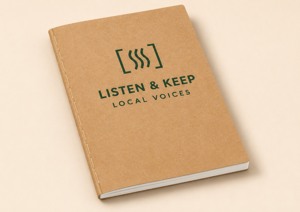
The linked kraft-cover A5 notebook for interview preparation lists blank paper, 80 sheets and an 8.26 × 5.83 inch format. The current minimum quantity is 12; the 500-piece case pack is a separate specification. A pen is not included.
The blank format can hold a question outline and separate recollection, observation and verification notes. It does not supply recording permission, archival preservation, access control or a guarantee of historical accuracy. An existing notebook may be sufficient for one conversation.
Compare custom padfolios and notebooks for other note formats if a larger volunteer project has a real need. Confirm the actual selected notebook and artwork with DecentCustom. The AI cover design is a fictional planning concept, not a museum partnership or a certification of the paper.