Before announcing a GivingTuesday donation drive, get the receiving organization's current list and delivery instructions. An item can be useful and still fall outside that particular collection. State the accepted category, condition, location and appointment route clearly so donors can make a useful trip.
Can people donate used items, or does everything have to be new?
Check the exact item category. There is no single condition rule that applies to every organization or every kind of goods. In one public Seattle donor discussion, a person offering usable kitchenware was unsure whether a charity's list meant everything had to be new. That is a practical question a collection notice should answer.
As a specific current example, Mary's Place's official goods page lists new and like-new small household items, including kitchenware, while excluding used clothing, toys and stuffed animals. “All new only” and “all used items welcome” would both misrepresent that page. The receiving organization decides whether a particular item fits its current needs.
How do we write an accepted-items list that people can actually use?
Write the item and its condition together. A headline such as “Bring something useful” leaves the donor to guess. A list copied from another collection can produce the same problem.
| Notice field | What to put there | What to avoid |
|---|---|---|
| Receiving organization | The actual partner and its current official list | Implying a partnership from a shared event name |
| Accepted category | The specific goods approved for this collection | A broad “anything helps” invitation |
| Condition | The requirement attached to each accepted category | Treating one category's rule as universal |
| Delivery route | The approved location and any booking instructions | Using an office address without checking its purpose |
| Current information | Where donors can check changes before travelling | Leaving an expired printed notice as the only source |
If an item is absent from the list, ask through the organization's published inquiry route before advertising it as accepted. A donor's good intentions and an organizer's spare storage space do not establish the receiving partner's agreement.
Can donors just arrive with their goods?
Only if the actual receiving instructions allow it. Mary's Place currently says goods drop-offs require an appointment; its official contact page corroborates that requirement. This is a named organization's rule, not a requirement imposed by GivingTuesday on every participant.
The event date does not confirm an available appointment. Keep a host's booking route distinct from a general invitation to participate, and do not announce an unconfirmed collection window.
Where should we get the collection and drop-off instructions?
Start with the organization that will receive the goods. Feeding America's food-drive guidance directs organizers to their local food bank for current needs and collection procedures. That reinforces the practical point: use the receiving partner's instructions, rather than assuming a national campaign supplies local delivery arrangements.
For public notices, put the approved essentials in the message itself and provide the official current-information route. Readers should be able to decide whether their item fits and what they must do before travelling. A product page or decorative sign cannot answer those questions for the partner.
A completed correction: from “all goods, anytime” to a usable notice
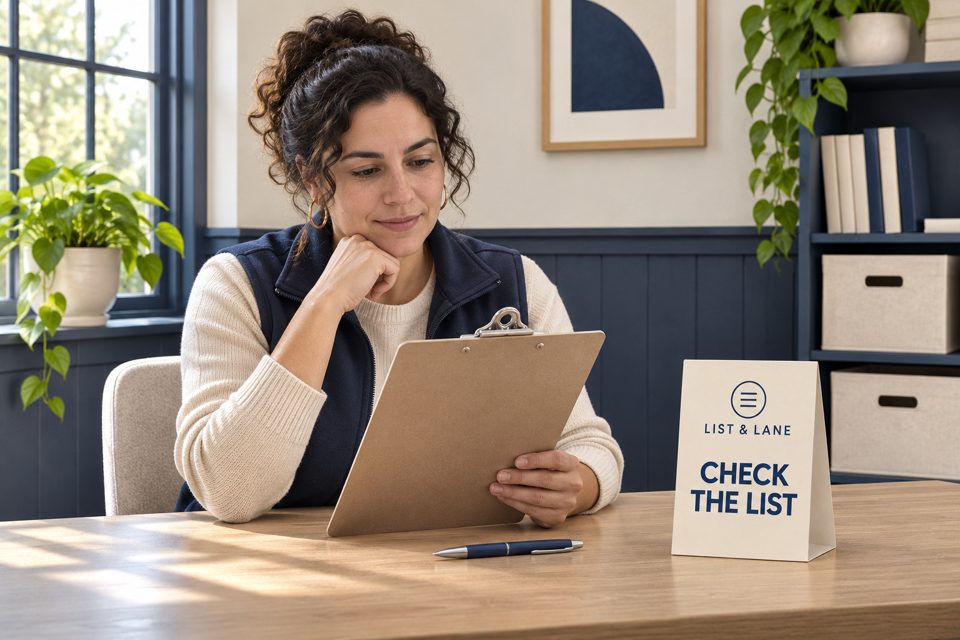
Fictional example: List & Lane prepares a flyer inviting people to bring “all useful goods, anytime.” Its coordinator holds the proof because neither the category nor the delivery arrangement has been approved.
In this example, the responsible host confirms a new-towels-only collection and supplies its appointment route. The coordinator removes the broad invitation, names the accepted category and condition, and directs donors to the host's approved booking instructions before travelling. The host reviews the corrected digital notice.
The group replaces the inaccurate message in its existing display and places no new print order. This completes the communication decision; it does not claim that a real charity accepts towels, that an appointment is available or that any goods were received.
An optional sign for approved instructions
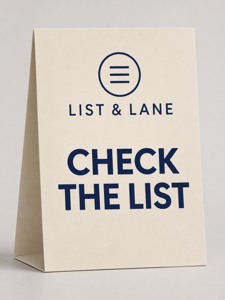
Folded paper table tent
These table tents for approved donation-drive instructions list a 5 × 7 inch face, default 14pt stock and glossy finish. The current minimum is 25. That minimum does not establish a need for 25 display points.
Compare custom table tents only after the message and display locations are settled. Bring the actual configuration and approved wording to DecentCustom for proof review. Existing accurate displays may already do the job.
Reviewed November 18, 2026, using official pages read November 17. The donor discussion is one qualitative example, not evidence of how frequently customers ask this question. Receiving rules may change. No donation acceptance, partnership, appointment availability, print-arrival date or campaign result is verified here.