A flower-order cutoff, a workshop start and a delivery window answer different questions. Label each time with its service, date, time zone and confirmation status. A request received before a cutoff does not by itself establish availability or a particular arrival time.
Say what happens at the stated time
“Friday at one” might mean the start of a class, the moment a recipient needs flowers or the earliest possible pickup. Writing the number without the action leaves the next person to guess.
- Request cutoff: the latest time to submit a request for the stated offering. Describe any review conditions; do not turn receipt into a confirmed booking.
- Order or reservation confirmation: the shop's actual answer about the selected service and its arrangements.
- Pickup slot: the collection period for that order, at the confirmed pickup location.
- Delivery window: the agreed or proposed arrival period, clearly identified as such. It is not automatically a precise appointment.
- Workshop start: the time instruction begins for that session, separate from when to request a place.
Butterfly’s Rest's ordering FAQ makes same-day service conditional on inventory, capacity and destination, and directs buyers to selected pickup dates and windows. This operator-specific example shows why a general cutoff cannot answer every scheduling question.
Use the current description and confirmation for the actual service. A workshop registration rule does not establish a flower-delivery deadline. An old seasonal preorder suggestion does not prove that an arrangement is available today.
Put the request time beside the service time
Fictional worked example: Aster & Line Floral is preparing a service note for Friday, November 20, 2026. All dates, hours and arrangements below are invented. The example uses Pacific Time throughout; it is not a live offer.
Flower pickup request
Request by: Thursday, November 19, 3 p.m. Pacific Time.
Requested collection: Friday, November 20, 10 a.m.–noon.
Still to confirm: the selected arrangement, whether the shop can accept it and the collection details.
Status: a request for review; not ready for collection.
Flower delivery request
Request by: Thursday, November 19, 3 p.m. Pacific Time.
Proposed delivery: Friday, November 20, noon–4 p.m.
Still to confirm: destination eligibility, the arrangement and whether the proposed window can be accepted.
Status: proposed window; no precise arrival appointment.
Workshop reservation request
Request a place by: Tuesday, November 17, 5 p.m. Pacific Time.
Session: Friday, November 20, 1–2:30 p.m.
Still to confirm: the attendee's place and the selected session's instructions.
Status: requesting a place does not establish a confirmed reservation.
The same Friday appears in all three entries, but the buyer needs different answers. The workshop's Tuesday request deadline cannot be substituted for the flower-order deadline. The pickup period does not describe the delivery route. Keep the service name attached when copying a time into an email or notice.
A delivery window that overlaps the event may not meet the need
In the fictional example, a customer needs flowers in place before the 1 p.m. workshop. The proposed noon–4 p.m. delivery window extends beyond that start. Its earliest time is not a promise that the flowers will arrive at noon or before one.
You need the flowers in place before your 1 p.m. session on November 20. The proposed delivery window is noon–4 p.m., so we cannot use that window to promise arrival before your start. We will check whether an appropriate earlier arrangement is possible. If you would consider collection, we also need to confirm that option and who would collect. No revised delivery or collection arrangement is confirmed yet.
This answer keeps the conflict visible. Do not solve it by inventing a travel time, assuming another person will collect or moving an existing booking without checking. Record the customer's required in-place time separately from the shop's proposed service window.
A different customer might ask to order after the stated cutoff. An accurate reply for this fictional plan is:
The request cutoff shown for this offering has passed. We need to check what arrangements, if any, we can still accept for your date. Please tell us whether you need pickup or delivery and when the flowers must be in place. We have not confirmed same-day service or an arrival time.
The reply asks for the missing decision inputs. It does not turn a general “we may be able to help” into an accepted order.
Give staff one current version of the service note
For the fictional schedule, a working header could read: D-03 — November 20 service requests; Pacific Time; requests remain subject to confirmation. Keep the owner and last-checked date in the shop's working record, alongside the actual current instructions.
If a pickup period changes, check affected order confirmations and contact the relevant buyers through the shop's actual service process. Updating a public notice does not prove that an existing customer has received the change. Keep unresolved arrangements visible until the responsible person confirms them.
Before displaying the note, ask a colleague to identify the request deadline, service time, time zone and present status for each offering. If they answer using a different row's time, revise the wording before relying on the notice.
Keep changing dates out of an evergreen handout

Prompt a date-and-service check
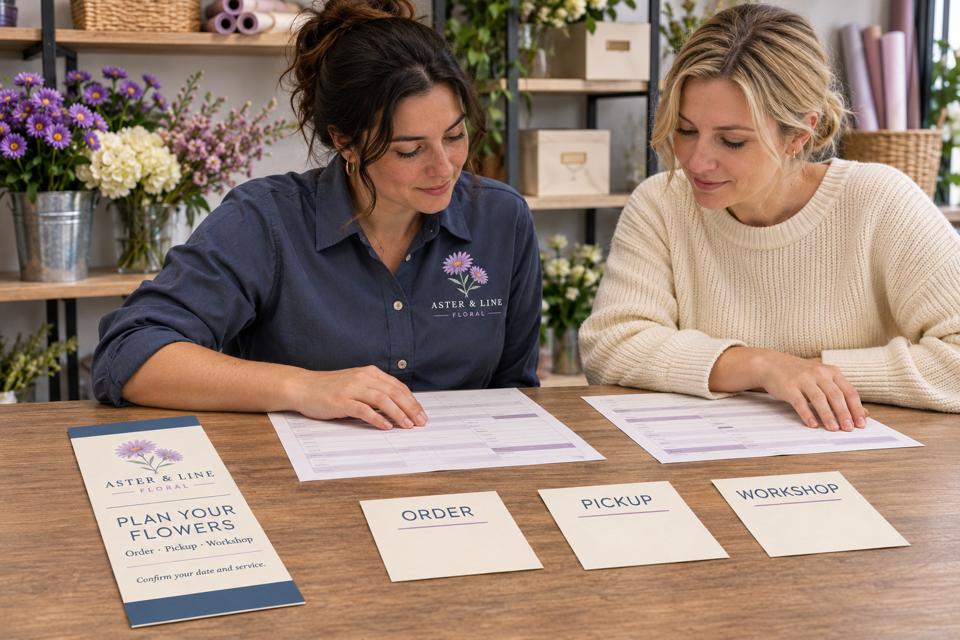
An existing confirmation message or digital service page may already work. If a small take-away guide is useful, DecentCustom's custom paper rack cards list a 3.74 × 8.27 inch format, stock options and a current minimum quantity of 50. Check the final configuration; the illustrated flat paper card does not include a display holder.
The concept asks readers to confirm their date and service rather than presenting a permanent booking calendar. Three fictional service examples do not establish a need for 50 cards.
Compare rack card formats after approving the purpose and wording. Give DecentCustom the artwork, required format and quantity. Keep live availability, individual times and confirmations in the service process staff actually maintain.
Reviewed November 9, 2026. Aster & Line Floral and the November 20 schedule are fictional. No actual order, workshop reservation, delivery slot or business outcome was confirmed.