A clear gift-wrapping quote identifies which items qualify for the store-purchase rate, how each outside item is assessed and what the service includes. Count the pieces being wrapped, distinguish an estimate from an approved amount and explain remaining charges before the customer leaves the items.
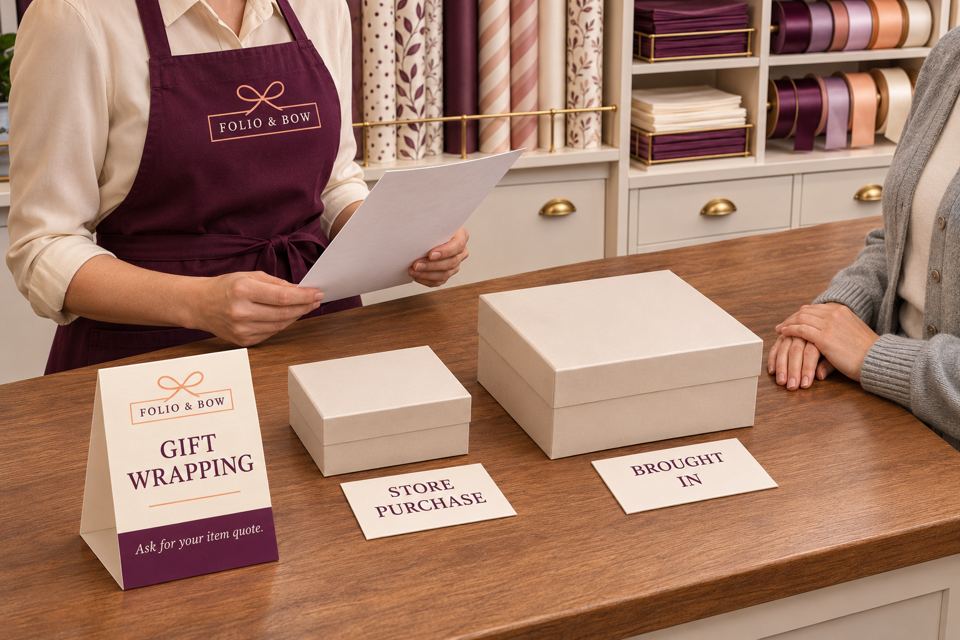
Say which item qualifies, not just “wrapping from…”
A buyer may bring several gifts to the same counter: some purchased in the shop, others bought elsewhere. If the shop uses different pricing for those groups, the quote needs to show which rule applies to each item. “One customer” and “one purchase” do not necessarily mean one wrapping charge.
At this review, Sip and Ship's current wrapping page lists $6.50 for each item purchased in its shop and a separate estimated guide for customer-provided items. That is one shop's published structure, not an industry rate or a DecentCustom wrapping service.
For the actual job, ask how many separate pieces will be wrapped, which came from the shop and whether any need a different presentation. Check the items rather than guessing their category from “small gift” in a message. A description may omit an awkward shape, an existing box or the customer's preferred finish.
If the customer wants several pieces combined into one presentation, confirm that arrangement and quote it explicitly. Do not assume that combining pieces automatically earns the single-item rate or that every store offers the same option.
A mixed order needs an understandable subtotal
Fictional worked example: Folio & Bow receives four items. Its invented rates and amounts below demonstrate the arithmetic; they are not Sip and Ship prices, a market-rate recommendation or a live quotation.
Two store-purchased items
Items: a boxed notebook and a boxed scarf, to be wrapped separately.
Example rate: $7 per item.
Component: 2 × $7 = $14 for these two items under the example's store-purchase arrangement.
Two customer-provided items
Items: one book and one larger boxed gift, also to be wrapped separately.
Provisional amounts: $9 and $14.
Component: $9 + $14 = $23 estimated, pending the shop's assessment and confirmation.
Combined estimate
Working subtotal: $14 + $23 = $37 estimated before any applicable tax.
Scope: wrapping four separate items only.
Not included or quoted: shipping, transport packaging or additional presentation changes.
Status: the outside-item amounts and the final total still require confirmation.
The subtotal remains an estimate while part of it is provisional. Writing a precise number does not make it final. Keep the known component and the uncertain component visible, rather than describing all four items as “$7 wrapping” or “$37 confirmed.”
These figures explain a quote; they do not calculate the shop's labor cost, margin or suitable selling price. A real price decision needs the shop's actual materials, work required and service arrangements.
Explain what the wrapping amount buys
For each accepted job, identify the agreed presentation and included materials. In the fictional Folio & Bow example, the quoted scope is standard paper wrapping, tissue where needed, the agreed standard box where needed, ribbon and a gift tag. Additional premium materials or a changed presentation have not been approved.
The intake conversation should resolve these questions:
- Will each piece be wrapped separately, or is a combined presentation being requested?
- Does the quoted amount include any necessary standard box, ribbon and tag?
- Does the shop need to inspect the actual item before confirming the amount?
- Is the customer requesting a particular material or finish that changes the quote?
- Is this a collection job, or does the customer also need a separate packing and shipping assessment?
A decorative box or bow should not be described as a protective shipping solution without the appropriate assessment. Keep the wrapping quote separate from the transport task. Likewise, confirming a price does not establish that the job will be ready at a time the shop has not agreed.
Give the customer an answer they can approve
For the fictional four-item job, the staff member can explain the estimate in full:
We have recorded four separate items for wrapping: two bought here and two brought in. The two store purchases are $7 each under this example arrangement, giving $14. The outside items are provisionally $9 and $14, giving an estimated $23.
The combined wrapping estimate is $37 before any applicable tax. It covers the standard presentation we have listed; shipping, transport packaging and later presentation changes are not included. We still need to assess and confirm the outside-item amounts and final total with you before proceeding on that basis.
Please confirm whether you want the four pieces wrapped separately as listed. If the requested presentation or amount changes, we will explain the revised scope and seek your agreement before carrying out that change.
This wording is an example of the fictional shop's process, not a universal contract or cancellation policy. Replace it with the real service scope and approval route. Record the customer's actual decision with the job reference, rather than treating a counter sign or an unanswered message as agreement.
If the customer prefers a lower-cost presentation, explain only options the shop actually offers. An existing suitable box or a simpler finish may be worth discussing; neither should be promised to reduce the amount until the shop checks the proposed work.
A counter sign can start the quote conversation
Keep changing job details in the quote
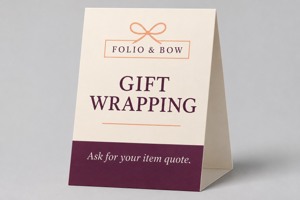
An existing service page, quote form or reusable board may be enough. If a stable counter prompt is useful, DecentCustom's paper table tents for a service counter list a 5 × 7 inch format, 14pt card stock and finish options. Current quantity validation starts at 25; a four-item example does not establish a need for that quantity.
The illustrated “Ask for your item quote” message invites a specific assessment. It does not publish permanent prices, record approval or replace a receipt. Check the folded footprint and final configuration for the actual counter.
Compare table tent formats after approving the message. Give DecentCustom the artwork, display requirements and quantity. Keep individual item descriptions, changing amounts and customer decisions in the shop's working quote record.
Reviewed November 9, 2026. Folio & Bow, its four-item job and all example amounts are fictional. No actual customer quote, tax amount, wrapping turnaround or business outcome was verified.