Confirm the transaction before deciding what to bring, retain or hand over. Accessories, original packaging and shipping documents serve different purposes, and a device handoff needs a record of what was actually accepted. A branded outer bag cannot answer those questions.
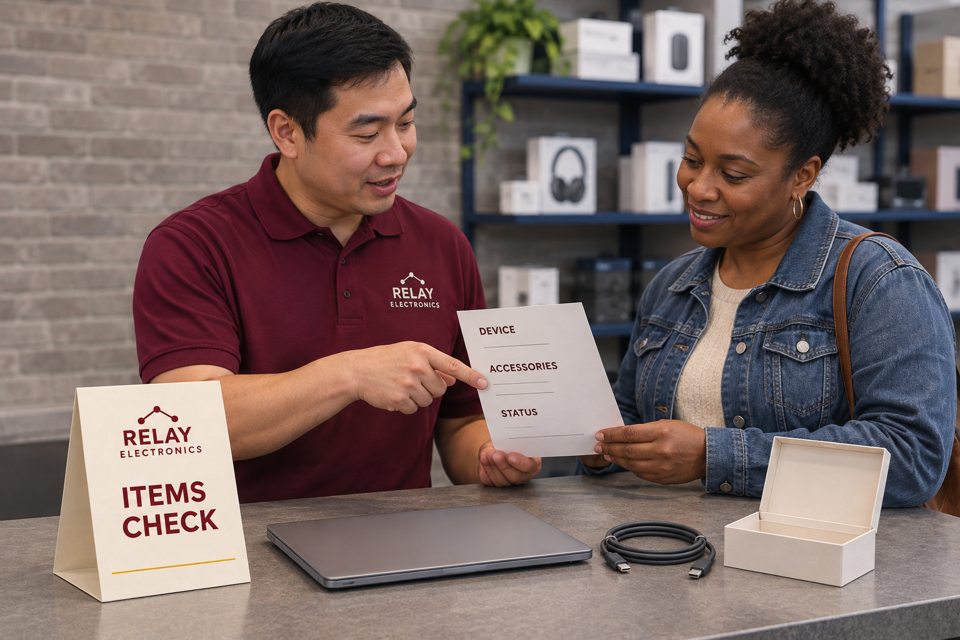
Start with why the device is changing hands
“I'm bringing a device back” could mean a new-purchase return, a used-device trade-in, a repair intake or collection after service. Identify the purpose, the business handling it and the particular device before giving a preparation list. A sale receipt does not automatically describe a repair intake, and a trade-in estimate is not approval of a new-device return.
Ask which current confirmation or instruction belongs to this transaction. Keep its reference in the established order or service record. If the customer has two transactions, keep their device identities and documents separate. Do not choose a shipping label by the box it happened to arrive in or create a decorative replacement for an official document.
Use the responsible provider's current process for any shipping or device preparation. This guide concerns communication and accounting for items; it does not supply battery transport instructions, account-unlocking steps or data-erasure procedures. Private identifiers and authorization belong in the appropriate restricted record, not on a public counter sign.
An original box and a functional accessory are different questions
GameStop's trade-in accessory guidance distinguishes functional components from packaging. Its console example calls for the original controller and required cables or chargers. It says original boxes, printed manuals and paper inserts are not required. Missing functional components can affect value or acceptance, with the final decision made in store.
Compare that with AT&T's new-device return policy, which describes original components, original packaging and proof of purchase as part of its like-new return requirements. It also lists trade-in as a different program. These are two providers describing different transactions; neither example establishes the rule for every electronics business.
The practical question is therefore not “Do electronics stores need the original box?” Ask “What does this provider require for this device and this transaction?” If the original box is missing, report that fact and obtain the relevant answer. Do not promise acceptance, tell the customer to buy a replacement box or assume that a reusable shopping bag meets the requirement.
Likewise, separate an accessory's presence from its suitability. “A cable is included” does not establish that it is the required cable, compatible with the model or tested. Record a qualified staff member's actual finding when available. Until then, mark the question as unresolved instead of silently turning a customer's description into a technical conclusion.
A filled handoff record: R41 intake acknowledgment
Fictional working example: Relay has accepted a laptop for an agreed assessment. The customer also handed over its charger and a soft sleeve, but the acknowledgment initially says only “laptop.” R41 illustrates how to correct the item record; it is not an actual service policy, diagnosis or ownership check.
- Transaction and device
- Assessment intake for the laptop identified in the existing private service record. This is not a trade-in or a new-purchase return.
- Items physically checked at intake
- One laptop, one charger and one soft sleeve. Adviser Mina checks the items with the receiving colleague rather than copying the incomplete acknowledgment.
- Record discrepancy
- The acknowledgment lists only the laptop. The charger and sleeve must be added to the appropriate intake record after the receiving check, and the customer given the corrected acknowledgment.
- Item outside the intake
- The customer kept a separate wireless mouse. It is not listed as received or promised for return.
- Packaging question
- No original retail box was received. Staff confirm any packaging requirement for this assessment with the service team; they do not import another retailer's new-device return rule.
- Current status
- Intake item record corrected to laptop, charger and sleeve after the receiving check. This does not establish condition, compatibility, repair authorization or completion.
In an actual case, retain the correction through the business's normal record process rather than overwriting the history without explanation. If a colleague cannot confirm an item was accepted, record the discrepancy and who is investigating it. Do not mark it as received merely because a customer remembers bringing it, or dismiss it simply because the initial acknowledgment omitted it.
Answer a customer whose acknowledgment is incomplete
The R41 customer asks, “Your receipt only says laptop. You also took my charger and sleeve—are those included when I collect it?” A complete answer separates the receiving check from a promise about a future handoff:
Fictional customer reply after the receiving check: We checked the intake with our receiving colleague and confirmed that we accepted your laptop, charger and soft sleeve. Mina has added the charger and sleeve to the intake record and provided the corrected acknowledgment. Your wireless mouse was not handed over and is outside this intake. At collection, we will check the recorded items with the person authorized to collect them. This correction confirms the items received; it does not mean the assessment or any repair is complete.
If that check has not been completed, say so instead. For example: “The acknowledgment currently lists the laptop. Mina is checking your report about the charger and sleeve with the receiving colleague. Their intake status remains unresolved; we will update you through the service record when the check is complete.” Do not send the confirmed version before the receiving evidence supports it.
Reconcile each recorded item when the device leaves
Use the corrected accepted-item list at collection or another authorized handoff. Check what is physically being returned, any item retained for an agreed reason and who will resolve a discrepancy. A device marked ready does not itself confirm that every accessory has been handed back.
Fictional R41 collection checkpoint: The authorized collector receives the laptop and charger, but the recorded sleeve cannot be located. The handoff entry reads “laptop and charger handed back; sleeve unresolved; Mina following up.” It does not say “all items returned.” The wireless mouse remains outside the intake because it was never received.
Follow the business's discrepancy process and give the customer the actual follow-up route. Do not substitute a new promotional bag for the missing sleeve and call the record complete. An agreed resolution, if later reached, needs its own accurate entry rather than an invented outcome in the initial collection record.
Preserve relevant original packaging, specialist containers and transaction documents. An accessory acknowledgment accounts for items, while a protective container has a different job. Ordinary branded bags and labels do not establish impact protection, electrostatic protection or safe battery transport.
A public prompt should direct questions, not expose the record
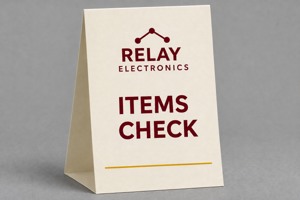
Stable wording for an authorized dry counter
If customers need a visible invitation to check their item acknowledgment, paper table tents for item-check questions can carry a general “Items Check” heading. This listed paper format is 5 × 7 inches on 14pt card stock, with finish options; current quantity validation starts at 25.
Keep customer names, serials, accessories, estimates and promised dates in the proper transaction record. Confirm readable artwork, folded footprint, placement permission and actual quantity needed. The AI paper concept does not show a technical certification or a protective packaging solution.
Compare table tent options only if an existing sign or direct explanation leaves a real gap. Give DecentCustom approved public artwork and the required configuration. An intake acknowledgment or digital follow-up may already do the job without another printed item.
Reviewed November 9, 2026. Relay, Mina and R41 are fictional. Provider examples describe specific published transactions, not universal requirements; actual device condition, compatibility, ownership, service eligibility and product performance were not verified.