FARM STORE OPERATIONS · CSA CARRYOUT
Choose a carrier around how the share is collected. Keep customer bags, farm-owned tubs and accepted returns on separate routes.
Start with what happens at the pickup table
For market-style CSA pickup, the customer needs a way to pack the current permitted selection. For a prepacked share, the customer may need to transfer its contents into a personal carrier while leaving the farm’s container behind. A bag choice should follow that handoff.
Before buying a new bag or box, confirm the share format, current contents, ownership of each container and the trip home. An existing suitable carrier may already cover the task. A logo does not establish fit, food-contact suitability or a safe carrying load.
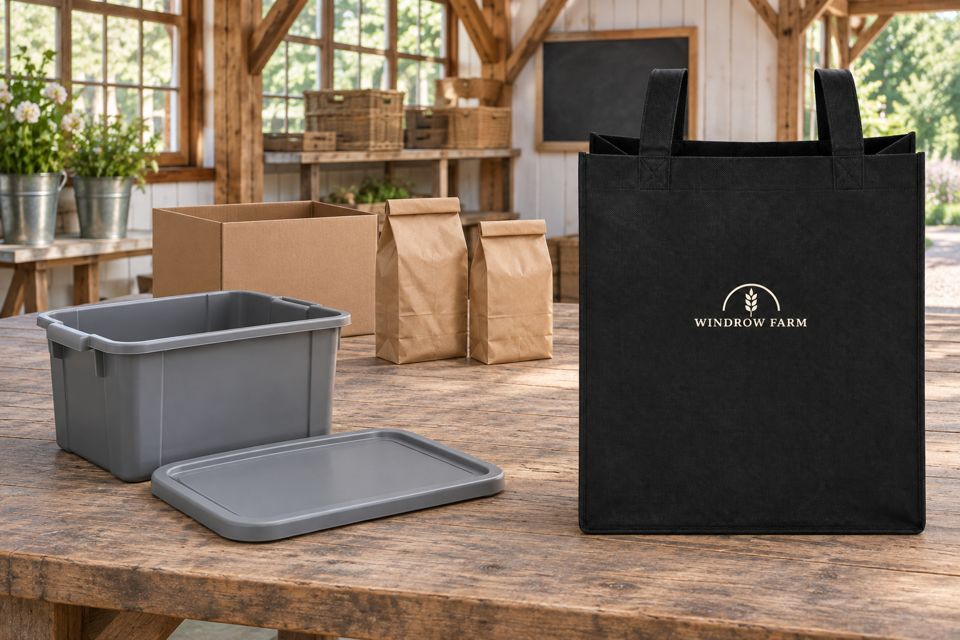
Match the carrier instruction to the collection method
Lansing’s CSA FAQ asks members to bring a box or bags for its market-style collection. The week’s quantities determine what they pack. An old photograph of a typical share should not become a fixed carrier-capacity promise.
The UW Farm CSA page asks members to bring a bag and leave its tubs and bins at the farm. Its first-time shareholder canvas-bag example is a particular program practice, not evidence that this article’s non-woven tote was supplied there.
Keep these ownership details with the CSA pickup and friend-collection instructions. A substitute collector especially needs to know whether “boxed” means taking a box home or transferring produce out of a farm-owned tub.
Ask the actual program rather than inferring the answer from the word “share.” Specify what is already packed, what members select themselves, where transferring happens and which instructions control the amounts.
Two completed briefs for a fictional farm
Suppose Windrow Farm offers two collection formats. For this teaching comparison, both involve the same planned mixed-produce selection: protected delicate items, longer produce and denser items that should not be treated as interchangeable shapes. No weights, dimensions, food handling procedure or physical fit have been measured.
Brief A: staffed market-style collection
Starting point: The member checks in with the CSA team, then selects the current share amounts from the approved display instructions.
Carrier plan: Bring the member’s existing suitable bag or box. The employee clarifies the selection before packing; the member keeps protected delicate items from being crushed by the denser portion and checks that longer items can be carried without forcing the closure or handles.
Ownership: The member’s carrier leaves with the share. The farm’s display bins remain at the table.
Unresolved before use: Actual contents, packaging needs, filled dimensions and manageable load must be checked. A second suitable carrier remains an option if one cannot handle the selection.
Brief B: prepacked collection with a farm-owned tub
Starting point: Follow the actual share-matching and sign-in procedure for the prepacked format. Do not select extra produce from a market-style display.
Carrier plan: Bring a personal carrier and transfer the assigned share at the designated packing point, following the farm’s actual handling instructions.
Ownership: The personal carrier leaves. In this fictional setup, the tub and its lid stay in the designated farm collection area.
Unresolved before use: The operator must confirm the transfer area, container-return arrangement and how the actual share fits the personal carrier. No after-hours storage or handling permission is created by this brief.
The two briefs explain different actions even if the produce selection is similar. A bigger branded bag alone would not tell someone which share to take or whether a farm tub must stay.
Write the bring, take, leave and return list separately
A short ownership list prevents the word “reusable” from hiding several different routes:
- Bring
- The customer’s suitable carrier, plus anything the actual pickup instructions require.
- Take home
- The correct share in that personal carrier, following the program’s handling and matching procedure.
- Leave on site
- Farm-owned bins, tubs and lids when that program says they stay. Use its designated place rather than leaving them wherever space appears.
- Return only when accepted
- Items covered by the particular farm’s return program, brought to the specified receiving point.
Granor’s farm-store FAQ describes reusing its boxes, customers’ reusable bags and accepting glass milk-bottle returns. That is a named farm’s arrangement, not an invitation to bring every spare container to any CSA site.
Keep returns separate from the outbound share while staff resolve acceptance. A clean-looking box or bottle does not establish that another operator can reuse it. Do not mix an unapproved return into the farm’s ready-to-use supply.
Ask a useful first-visit carrier question
For the fictional boxed format, a member’s completed inquiry could read:
I am collecting a prepacked Windrow share for the first time. Does the farm tub and lid stay at the pickup point? I have an existing bag and a spare box. What should I know about this week’s larger or delicate items before choosing which to bring? Please confirm where I should transfer the share and where the empty tub belongs.
This is an example message, not an inquiry that was sent. It asks about the actual load and handoff before assuming a new purchase is needed.
A completed existing-carrier decision
In a fictional review outcome, the member and responsible employee check the actual protected selection and find that the existing box serves that pickup arrangement. The tub remains on site, and the member takes the share in the box. The decision is to use the existing carrier rather than order a new tote.
No physical trial was performed for this article. For a real review, inspect the carrier’s condition and suitability, actual packed dimensions, load arrangement and the person’s trip. If a carrier does not serve the task, change the arrangement or consider an appropriate alternative. Do not invent a universal weight limit from a product photo.
Consider a printed tote only for a verified carrier need
If the actual review identifies a reason for a new bag, compare custom grocery bags against that brief. Keep the food’s required packaging and handling separate from the outer carrier.
Black non-woven tote concept
The black non-woven grocery tote is listed as 80 GSM polypropylene, with an open main compartment and inner bottom board. Listed dimensions are 13W × 15H × 10 inches; the page does not name the third dimension in that line. The listed imprint area is 5W × 8H inches.
The current minimum is 12; case pack 100 is a different figure. The approximate 22 lb listing is not a carrying-capacity rating. This is non-woven polypropylene, not the UW program’s canvas bag.
The AI artwork and empty scene prove no filled-share fit, food-contact, insulation, wash-life, breakage protection or environmental outcome. Confirm the actual configuration and use requirements before ordering.
Approve the handoff and carrier together
Keep the format, actual selection, carrier decision and ownership instructions in one brief. Update it when the share format or larger seasonal items change. Make sure the same instructions reach a friend collecting on the member’s behalf.
Once a new carrier is justified, compare appropriate options at DecentCustom. A working existing box or bag, with a clearer bring-and-leave instruction, may already be the complete solution.
Prepared by DecentCustom from the linked operators’ program pages, original industry research and current catalog, reviewed November 6, 2026. UW is an educational farm; its practice does not establish this SKU’s use or supply. Windrow Farm, the briefs, inquiry, decision and AI artwork are fictional. No load, packing, food-contact or customer test was performed.