Delivery, setup, operation, teardown and return are separate event tasks. Put a named team, its confirmed scope and its handoff condition beside each one. If a task has no confirmed owner, keep it visibly pending rather than assuming the venue, planner or delivery crew will absorb it.
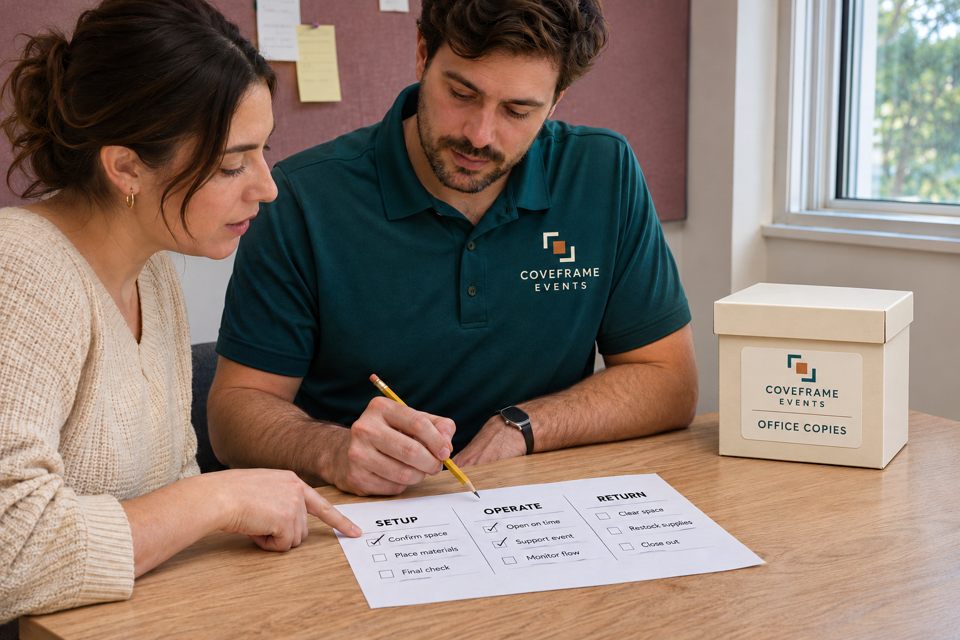
What does each supplier actually undertake?
Begin with the current event proposal, supplier confirmation and venue arrangement. A job title or the word “delivery” does not define every action required to finish the event. Ask what the team does, what it receives from another team and what it leaves ready for the next person.
Three published service examples show why the distinction matters:
- AXIS Pioneer Square’s FAQ separates caterer responsibilities for furniture and room transitions from clients’ ceremony and table décor. Its site representative supports venue needs and is not an event planner. Its rental period includes setup and teardown.
- R90 Lighting’s dry-hire information places setup, show operation and teardown with the customer’s crew. It also identifies flight-case requirements for much of its inventory. Hiring equipment does not itself hire an operating team.
- 5 Star Rental’s FAQ, for its North Texas service, distinguishes item-specific setup arrangements and describes returns using original containers and provided laundry bags. Those instructions should not be replaced with a different supplier’s routine.
These are provider-specific examples. They are useful questions for reviewing your own arrangement, not interchangeable rules for every venue or rental company. Do not copy one operator’s return hours, labor coverage or packing requirements into another booking.
A filled example: one celebration, several owners
Fictional planning exercise: Coveframe is coordinating a celebration at fictional Clearstone Room. Briar Props supplies décor, and Stage Team supplies technical service. The assignments below are invented to demonstrate a working record; none belongs to the businesses cited above.
The coordinator labels the record C17, version 2. It refers to separate venue, prop and technical confirmations. Each stage describes an action rather than naming one team as responsible for “everything.”
1. Delivery and receipt
- Confirmed owner
- Briar Props’ delivery team brings its identified order to the agreed receiving point. Coveframe’s receiving contact checks it against Briar’s packing record.
- Handoff
- The receiving contact records what arrived and any discrepancy. Receipt does not mean the items have been installed or accepted as ready for guests.
2. Setup
- Confirmed owner
- The contracted catering team places the venue tables and chairs under the agreed room arrangement. Briar’s team installs its own props within its confirmed scope.
- Still pending
- The host’s separately purchased welcome display has no confirmed installer. Coveframe marks it “assignment required”; it is not added to Briar’s task list without an answer.
3. Operation during the event
- Confirmed owner
- Stage Team’s named event contact handles the technical service described in its confirmation. Coveframe coordinates timing requests through that contact.
- Boundary
- A supplier’s delivery driver is not listed as an on-site operator. The host’s volunteers are not assigned unfamiliar technical work to fill a gap.
4. Teardown and clearing
- Confirmed owner
- Briar dismantles its own installed props. The catering team clears its agreed furniture and service items. Coveframe checks that host-owned papers and decorations go to the host’s collection contact.
- Still pending
- The welcome display’s removal is unresolved along with its installation. The venue’s general cleaning arrangement is not used as an answer to that missing task.
5. Packing, collection and return
- Confirmed owner
- Each supplier’s designated team follows its own packing and collection arrangement. Coveframe records the collection status and sends any unresolved item question to that supplier.
- Completion check
- The working record distinguishes “packed,” “collected” and “return acknowledged.” A box waiting by a door has not completed all three stages.
This example has known assignments and one visible gap. It does not become a finished event plan until the welcome-display responsibilities and any other pending arrangements have actual answers. Keep venue access and collection windows beside the relevant task in the private record; guest-facing artwork is not the place to resolve them.
Ask about the gap before issuing revised instructions
Coveframe can send the responsible supplier a specific question rather than asking vaguely whether setup is included:
Fictional supplier question: Our C17 version 2 record assigns Briar’s team the installation and removal of Briar’s own props. The host also has a separate welcome display. Is installing and removing that display a service your team can include? Please confirm the scope, any additional charge and the conditions before we revise the task record. Until we have your answer and the host’s approval, we will leave that task unassigned.
A positive answer may still require details or approval; a request alone changes nothing. When the arrangement is confirmed, identify the revised record and tell the affected teams which assignment changed. Preserve the previous version so a colleague can see why an instruction was replaced.
A return record should describe the observed stage
At closeout, use the supplier’s original inventory and return instructions. Record what is known, who has the unresolved question and what would count as completion. Do not substitute a generic bag for a required case or laundry container.
Fictional C17 closeout entry: Briar’s packing record lists three original cases. Its collection contact has acknowledged receiving two. The third is packed at the agreed collection point, awaiting that contact’s acknowledgement. Coveframe has sent the case reference and collection question to Briar. Status: collection incomplete; return completion not yet confirmed.
Here, two acknowledged cases plus one pending case account for the three on the fictional list. That arithmetic describes this exercise only. It does not establish condition, waive inspection or show that the supplier has completed its own return process. Keep any damage or missing-item observation factual and attached to the original reference.
Office labels can classify copies, not approve a handoff

A limited role for a dry office-copy box
If an event business has its own dry box for ordinary office paper copies and an existing file tab is insufficient, custom labels for office-copy boxes can carry stable classification artwork. The illustrated “Office Copies” message does not identify an approved plan version or confirm a supplier’s return.
The product offers configurable shapes, sizes and materials. Its page describes sheets; confirm the sheet configuration and finished-label count rather than interpreting one ordering unit as one individual label. Check the actual surface, size, placement permission and material before ordering.
Keep suppliers’ packaging, inventory and original identification intact. Compare label and sticker options only for the defined office use, then give DecentCustom the approved artwork and configuration. Existing file tabs, a digital record and no new label purchase are valid alternatives.
Reviewed November 9, 2026. Coveframe, Clearstone Room, Briar Props, Stage Team and C17 are fictional. This guide concerns responsibility records, not installation instructions, contract interpretation or evidence of an actual event outcome.