Give each part of the annual company meeting a purpose and an output before ordering materials. A shared decision record, personal notes and a thank-you item perform different jobs. Start with the meeting people need, then choose what helps them participate and follow through.
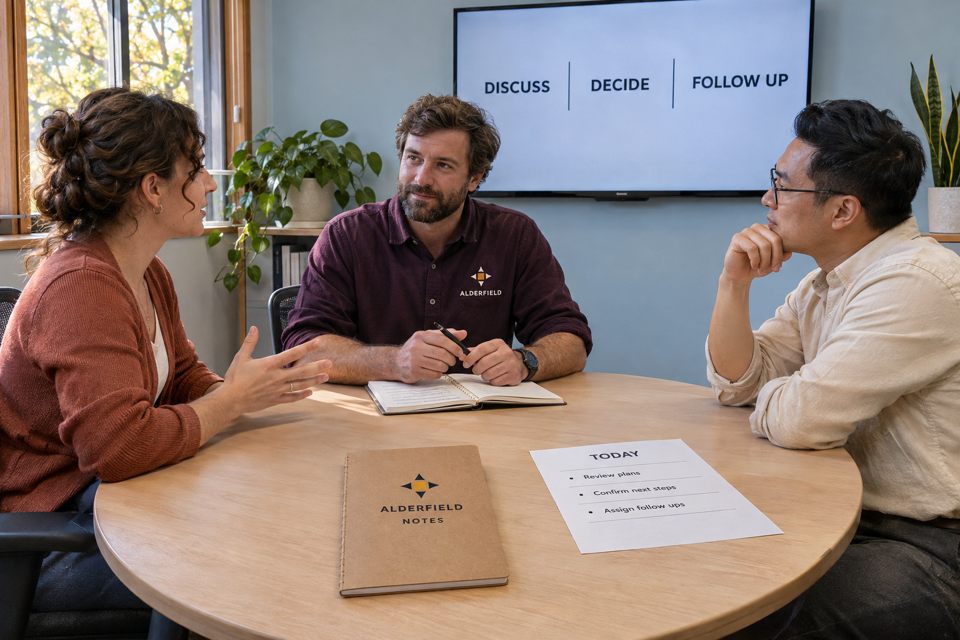
What should be different when the meeting ends?
An annual employee gathering may combine a review of the year, discussion of next steps, recognition and informal conversation. Those activities need different preparation. “Hold our annual meeting” describes an occasion; it does not yet tell an organizer what participants should leave understanding or doing.
Write a concrete output for each working session. A review might produce a shared explanation of what changed. A discussion might identify unresolved questions. A decision session might select a next step and name its owner. If the event is primarily a celebration, say so; it does not need to imitate a strategy workshop to justify the gathering.
Atlassian's team-gathering analysis emphasizes concrete deliverables, time for breaks and a closing record of decisions and next steps. Its evidence comes from its own engineering gatherings, including different subsets of agendas and survey responses. That is a useful planning reference, not proof of an ideal duration, format or result for every company's annual meeting.
This guide applies those questions to a fictional employee meeting. It is not guidance for a statutory shareholder meeting, and the example is not a recommended universal agenda.
A filled 90-minute example with a defined job
Fictional brief — Alderfield A01: a small company's annual employee meeting includes one working session on customer handoffs between departments. The purpose is to review the current process, choose one improvement to develop and identify the next owner. A separate celebration can have its own schedule; this example does not attempt to fit the entire year's business into 90 minutes.
The organizer prepares a short current-process page before the session. It distinguishes checked information from open questions and is shared through the company's approved channel. The proposed agenda is:
9:00–9:10 — Open with the question
Owner: meeting chair Sam. Explain what is being decided and what is outside this session. Output: a shared understanding that the task is to choose one improvement to develop, rather than approve a complete new process today.
9:10–9:25 — Review the current handoff
Owner: operations lead Jo. Use the prepared process page and identify which questions remain unanswered. Output: a visible list of facts and questions for the discussion.
9:25–9:45 — Compare proposed improvements
Owner: facilitator Lee. Invite the departments to explain the effect of each proposal on their work. Output: two clearly described options, their known constraints and any check needed before implementation.
9:45–9:55 — Break
Protect this interval in the draft. Do not silently convert it into another presentation when a previous speaker runs long. Adjust the agenda openly if the session's scope changes.
9:55–10:15 — Choose the next step
Owner: chair Sam, within the authority defined for this exercise. Output: one selected option to develop, a named owner and an explicit description of what remains unapproved.
10:15–10:30 — Read back and close
Owner: note keeper Morgan, with the chair. Read back the decision, action owner and follow-up point. Output: a checked entry in the shared working record, including the unanswered questions.
The six intervals total 10 + 15 + 20 + 10 + 20 + 15 = 90 minutes. That is 80 minutes of scheduled activity and a 10-minute break. It is an example calculation, not evidence that these proportions improve performance. Adapt the scope and schedule to the people, format and actual time available.
Keep the agenda, personal notes and shared decision distinct
The agenda tells participants what the meeting plans to cover. Personal notes help an individual think and remember. The shared decision record tells the authorized audience what was agreed, who owns the next action and what still needs approval.
One cannot automatically substitute for another. A participant writing “new handoff starts Monday” does not make that an approved instruction. Likewise, a printed program can identify a session without becoming the current source for later decisions.
Name the keeper of the shared record before the meeting. Decide where the approved version will live and how corrections will be made. Ask participants which note-taking format helps them, and keep private company information within the appropriate audience. Do not put internal working details into public giveaway artwork.
Choose materials by the task they serve
For A01, the existing shared process page supports the review. A visible discussion record supports comparing options. Personal paper or digital notes support individual participation. The checked action entry supports follow-up. None of those jobs inherently requires a new branded gift.
A simple materials decision for this fictional session could read:
- Agenda: keep the current version in the existing shared channel. Offer a readable paper copy where someone needs that format; check it against the same version.
- Discussion: use the room's existing display and the agreed working page. Confirm they are available and usable in the selected meeting format.
- Personal notes: use participants' existing notebooks or approved digital tools first. Ask about an unmet paper need before choosing another item.
- Recognition or thanks: decide separately what is appropriate and wanted. Attendance does not by itself define a gift list, clothing size or delivery preference.
Before printing a dated program, check the session names, times, place and current version with the person responsible. If those details are still changing, delay the print decision or use a simpler stable message. A logo can identify an organizer; it cannot keep an obsolete agenda current.
Write the next action so a colleague can use it
At the end of A01, Morgan could record the following complete entry:
Fictional A01 decision entry: The group selected a single shared handoff checklist as the option to develop. Jo will prepare a draft and obtain comments from both departments before the next operations review. The draft is not yet approved for use, and the current process remains in place. Sam will review the proposal at that meeting; Morgan will attach the decision and any revisions to the shared A01 record.
This states the selected direction, owner, next review and present status. It does not invent a rollout date or treat an idea as an implemented result. A later follow-up should say what actually happened, including an unresolved action, rather than marking the annual meeting successful because the notebooks were handed out.
A notebook is an optional personal tool
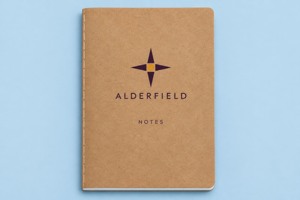
Match the format to an actual note-taking need
If a new paper notebook is useful and wanted, DecentCustom's A5 kraft-cover notebooks for meeting notes list a paper cover, 80 sheets and a blank default page type. The listed size is approximately 8.26 × 5.83 inches; a pen is not included.
Current quantity validation starts at 12. Confirm the actual format, artwork, quantity, total cost and required delivery date. A meeting's attendance does not establish a need to buy that minimum. The illustration shows a cover concept, not an approved print sample or a tested writing result.
Compare notebook and padfolio options after confirming the use. Give DecentCustom the approved cover artwork and configuration requirements. Existing notebooks, digital notes, ordinary paper and no new purchase remain valid choices.
Reviewed November 9, 2026. Alderfield, A01 and the named roles are fictional. No real meeting, employee preference or implementation result was verified.