Choose the information task before choosing a printed item. A planning consultation, a venue visit and a rental collection require different records, contacts and public messages. Start with the service the customer has actually arranged, then decide whether existing information is sufficient or a separate office prompt has a useful job.
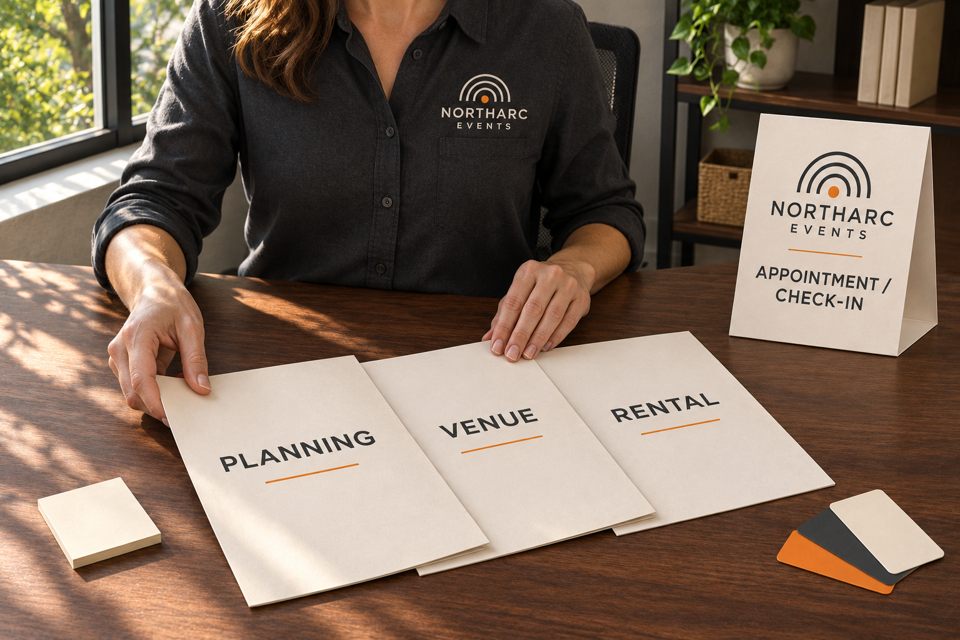
Event businesses do not all have the same customer touchpoint
A planner may meet a client to discuss a proposal. A venue team may explain a room package. A rental company may arrange an appointment to view or collect particular items. Their information needs overlap, but their service records and places of work are different.
Three operator-owned pages make those distinctions concrete:
- Hallea Events' planning page distinguishes planning service levels and identifies its office as appointment-only.
- Bell Harbor's meeting information describes a package with meeting space, meals, Wi-Fi, audiovisual support and event staff. A room inquiry can therefore involve existing services as well as physical space.
- Make a Scene's rental FAQ describes its premises as a warehouse rather than a showroom, with visits by appointment. It separately describes collection, delivery and installation service options.
These are specific businesses' published arrangements, not a standard package every event supplier provides. The useful lesson is to identify the actual service branch before choosing what an office sign, handout or information folder should say.
A business that works through video calls or at clients' venues may have no public desk at all. Do not invent a reception area to justify a table sign. Likewise, a warehouse address does not establish a walk-in shopping service.
Three filled examples lead to different material choices
Fictional examples: the following references and decisions are invented to demonstrate the review. They do not describe the operators cited above or an event we have organized.
P01 — A planning consultation
Task: Northarc Events has arranged an office consultation to review a client's proposed celebration. The discussion includes the client's priorities and a private draft scope.
Current record: the appointment confirmation and identified proposal version.
Public information: a simple appointment check-in route, if visitors actually need help finding the coordinator.
Decision: keep the changing scope, budget and client notes in the private consultation record. An existing check-in notice may be sufficient; do not print the client's proposal on a public desk display.
V02 — A venue-package discussion
Task: fictional Harbor Room is reviewing a proposed room arrangement and which services belong to its quotation.
Current record: the venue's room information, current proposal and the event-specific arrangement under review.
Public information: the venue's approved inquiry or arrival information, where appropriate.
Decision: use the existing room information while checking the proposed inclusions. Do not commission extra service cards, table materials or equipment labels on the assumption that every component must be purchased separately.
R03 — A rental-item viewing
Task: fictional Oakbay Rentals is being asked whether a particular prop can be viewed at its warehouse. No visit has been confirmed.
Current record: the item reference, viewing request and the rental team's reply.
Public information: an accurate appointment requirement on the existing service page.
Decision: confirm the viewing arrangement before issuing visit instructions. A viewing request does not establish collection readiness, a pickup booking or permission to browse the whole warehouse.
The three decisions do not produce three compulsory print purchases. P01 may justify a stable desk prompt; V02 can use existing venue information; R03 first needs a service answer. The result should follow the information gap, rather than the number of service categories in a catalog.
Explain which arrangement is confirmed and which still needs an answer
Suppose Northarc's client asks whether their planning meeting also means they can inspect a venue and collect rental props that day. Northarc can answer the actual question without treating all three services as one booking:
Fictional client reply: Your appointment with Northarc is a planning consultation at our office. We will review the current proposal and your questions there; please use the appointment confirmation for its agreed details.
The Harbor Room visit and the Oakbay prop request are separate arrangements. We have not confirmed either through those providers. The planning appointment does not give access to their premises or confirm that rental items are ready to collect.
We will keep the venue and rental questions attached to their own references and obtain the relevant teams' answers before giving you visit or collection instructions.
This is example wording for an information handoff, not a real appointment notice. The private working record should identify the person following up and preserve each provider's actual answer. A general welcome sign cannot confirm an unanswered request.
Decide whether a new material adds anything useful
For each proposed item, write its reader and action in one sentence. “A booked visitor uses this prompt to ask the office coordinator where to check in” is a defined job. “We need event branding” does not yet explain what information is missing.
Then check the existing source. If the appointment email already explains the next step and visitors can readily find the coordinator, a new sign may add little. If the information changes by client or event, keep the current answer in the appropriate record instead of reproducing it across permanent artwork.
Confirm who owns the wording and where it may be displayed. A planner's role in recommending a venue does not establish permission to place branded materials there. Borrowed props, technical cases and venue equipment also retain their own identification and instructions; an office-label idea is not approval to alter them.
Review the result from the reader's position: does it identify the right service and next action, remain accurate and leave any unresolved arrangement clearly pending? If it merely repeats an existing answer or makes the scope appear broader, revise the idea before ordering.
A paper table tent can identify a real consultation desk
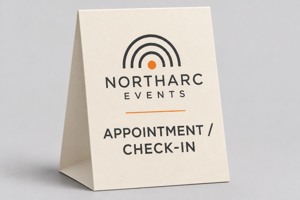
Stable check-in wording for an appropriate indoor desk
Where a separate prompt is useful, DecentCustom's paper table tents for consultation desks list a 5 × 7 inch format and 14pt card stock, with finish options. Current quantity validation starts at 25. An event's guest count does not determine how many office signs are needed.
The Northarc illustration shows a folded paper form with stable check-in wording. Confirm the actual folded footprint, readable layout, quantity and placement permission. It does not replace the appointment confirmation, private proposal or venue and rental instructions.
Compare table tent formats after deciding which desk needs the message. Give DecentCustom the approved public artwork and configuration requirements. Existing notices, digital records and no new purchase remain valid outcomes.
Reviewed November 9, 2026. Northarc Events, Harbor Room, Oakbay Rentals and P01–R03 are fictional. No actual booking, installation permission, client information, material performance or business outcome was verified.