Choose employee recognition gifts by first asking how the recipient wants to be recognized, identifying the contribution and checking whether an additional item is welcome. A useful gift supports a specific thank-you; the item alone cannot supply that meaning.

Ask about the moment before choosing the merchandise
An administrator might have a budget and an anniversary date, yet still lack the most important information: whether the employee wants a public mention, a private conversation or another way of acknowledging the work. Do not infer that preference from age, job title or how outgoing someone seems in meetings.
Gallup's 2022 discussion of personalized recognition recommends learning how people prefer to be recognized. Its 2023 guidance on authenticity also connects recognition to a specific action and the person's preferences. These principles inform this guide; they do not establish that buying a particular gift improves retention.
Send a short private question through an existing workplace channel. Explain what choices are genuinely available before suggesting them. Here is an editable request, rather than a promise of any employer benefit:
“We want to acknowledge your contribution to the project. Would you prefer a private thank-you, a team mention or another approach? If we include a small physical item, would you welcome one, prefer something you already use or rather receive no item? Is a company logo welcome? You can skip any question, and there is no need to explain a preference. We will confirm the available options before arranging anything.”
Ask about delivery details only after an item and delivery method are agreed. A preference check does not need a home address, clothing size or personal explanation when the decision could simply be a private conversation.
A complete example: keep the thank-you, remove the unwanted item
Fictional planning example: Northline Studio's administrator is preparing recognition for a colleague who improved the team's project handoff notes. The initial idea is a branded notebook presented at a team meeting. No order has been placed.
The colleague answers: “A private thank-you would suit me. I already have notebooks, so please skip another one. A short note about the handoff work would mean more.” This response changes both the delivery and the purchase decision.
- Recognition: the manager arranges a brief private conversation, rather than adding a surprise team announcement.
- Item: the administrator removes the notebook from this person's plan. An unused gift is not ordered just to make every package identical.
- Message: the manager writes an accurate, specific note about the contribution. The employee is not asked to provide their own praise.
- Format: an existing plain card is sufficient. A printed shared card design is considered only if the team has an ongoing need for it.
The resulting message could read:
“Thank you for rewriting the project handoff notes and walking colleagues through the new version. You made the sequence of responsibilities easier to follow. I appreciate the care you put into work that helps the next person get started.”
This example does not invent a measured time saving or a customer result. For your own message, check the facts with someone who knows the work. Remove a claimed impact if you cannot support it. Finish with the sender's name so the appreciation has a clear human source.
Use the answer to narrow the choice
Recipient choice needs a practical boundary. Offer a small set the employer has actually approved, with comparable eligibility and a clear way to decline. Do not advertise cash, leave, charitable contributions or other benefits that nobody has authority to approve.
| If the person says… | A reasonable next step | Confirm before proceeding |
|---|---|---|
| “I use paper notebooks.” | Consider a notebook after checking the preferred format. | Size, binding and whether branding is welcome; an existing notebook may already be enough. |
| “Please keep it private.” | Arrange an individual acknowledgment. | Who will be present; do not add a public photo or announcement without checking. |
| “I would rather have no item.” | Keep the recognition and omit the merchandise. | The sender and accurate message; do not make the person justify declining. |
| “I work remotely.” | Discuss an accessible recognition format before choosing shipping. | Whether delivery is wanted and the appropriate channel for any address details. |
These are editorial planning suggestions, not findings that every employee in a group wants the same treatment. In an anonymous managers' discussion, participants raised questions about public versus private recognition and described concerns about fairness, pay and leadership. Some responses promote recognition platforms. The thread is a qualitative warning against assuming that a reward solves the underlying issue, not representative research or evidence for a vendor.
If a person raises workload, compensation or management concerns, pass those concerns through the appropriate internal process. Do not present a mug or note as resolution. This guide covers recognition materials, not employment policy or compensation decisions.
When a shared printed card design is useful
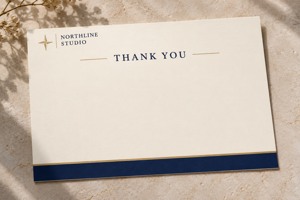
Leave room for the individual contribution
A shared design can provide the organization name and a simple thank-you heading while leaving the personal message to the sender. The AI artwork shows a fictional flat postcard, not a finished print sample.
DecentCustom's custom postcards offer size, orientation and paper options. Confirm the selected stock and finish are suitable for the intended writing method; do not assume every coated surface accepts a pen equally well.
Compare the actual formats listed under thank-you card options. If commissioning a design from DecentCustom, specify the required blank writing area, logo placement and intended use. Review the artwork proof and current quantity and delivery terms before ordering. A plain card or private email remains a valid choice when a new print order adds no useful function.
Close the decision without turning preferences into a permanent label
Keep a short, access-limited planning note: preferred acknowledgment format, whether an item is welcome, the approved choice, the sender and when the preference was checked. Record only what is necessary. “Private thanks; no notebook this time” is more useful than an interpretation of someone's personality.
If there is no answer, do not treat silence as agreement to a public ceremony, home delivery or branded gift. Use a discreet existing communication channel and leave the physical item undecided. If the person changes their mind, update the plan before artwork or shipping details are committed.
The plan is ready when the contribution is accurate, the recognition format is understood, any optional item is welcome and someone is responsible for delivering the message. Afterward, a simple private “Did that format work for you?” can inform the next occasion. It does not establish that the gift caused better morale or retention.
Prepared for US workplace administrators using the sources linked above, reviewed November 8, 2026. Northline Studio and its example are fictional. Product choices and editorial suggestions are conditional; actual recipient outcomes have not been tested.