Before printing employee award names or dates, approve three things separately: the recipient-facing wording, the facts behind the recognition and the latest product artwork. An accurate spreadsheet does not guarantee an accurate award, and an attractive proof does not verify the milestone.
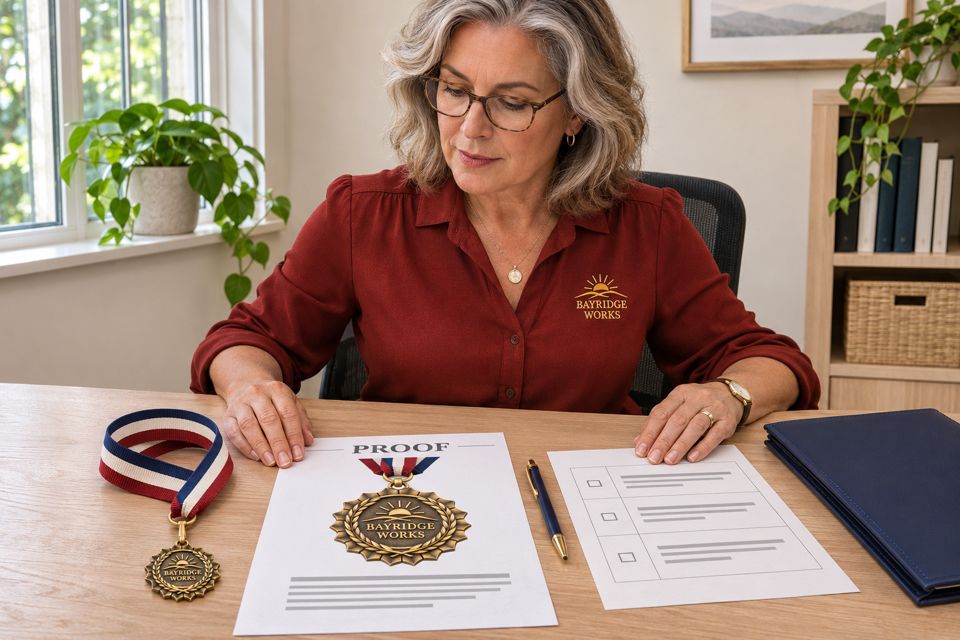
Decide what has already been approved
This guide starts after your organization has decided who will receive recognition. It helps an administrator prepare accurate copy; it does not select winners or replace an employer's approval, payroll or award policies. If recipient preferences remain unknown, begin with the recipient preference check before planning a public presentation or a physical item.
Distinguish an achievement, a service milestone and a participation thank-you. “Five years of service” requires a verified service period. “Project contribution” needs an accurate description of the work. “Employee of the Year” implies a defined award that someone authorized, rather than a decorative phrase selected by a designer.
For a real institutional example, Stetson University's recognition page asks for examples supporting a nomination and considers its fit with the award category. That is the university's process, not a rule for every employer. The useful planning distinction is that supporting reasons should exist before an award title is turned into artwork.
Check display names without requesting unnecessary records
Ask the recipient or an authorized internal coordinator to confirm the exact name to appear, including accents, spacing, hyphens and capitalization. A payroll export can be a starting reference, but do not silently assume it is the desired presentation name.
Colgate University's name guidance distinguishes preferred names used in campus contexts from legal names required in some formal records. Its institutional arrangements illustrate why display context matters. They do not establish the requirements for your organization or this print order.
A concise internal request is sufficient: “Please confirm exactly how you would like your name displayed on the recognition item, including any accents or punctuation.” There is no need to send payroll records, identification documents or a reason for the chosen name to a print supplier. Keep internal identity matching separate from the artwork list.
A worked review: one correction, two holds
Entirely fictional example: Bayridge Works has three planned recognition items. The following working list contains invented names and dates. None represents a real employee or an order.
| Draft entry | What the reviewer finds | Decision |
|---|---|---|
| Jose Alvarez — Project Contribution | The recipient confirms the display name is José Álvarez. The project owner confirms the contribution. | Correct both accents, then check that the proof preserves them. Text checked; artwork still pending. |
| Morgan Lee — Five Years of Service | The service milestone has not been confirmed by the responsible internal owner. | Hold the milestone wording. Do not calculate it from an unverified start date or infer eligibility. |
| Sam Chen — Presented 04/05/2027 | The draft does not say whether it means April 5 or May 4. The event owner confirms April 5. | Replace with April 5, 2027, then obtain a revised proof. The date is fictional, not an announced event. |
Only the José entry is ready to become a proof request at this stage. Morgan's unresolved milestone stays out of the production-ready file. Sam's corrected date must appear in the new proof; a comment alongside an old PDF is not the same as corrected artwork.
Bayridge's project owner supplies this supported example wording:
José Álvarez
Project Contribution
Thank you for documenting the equipment handoff steps and helping colleagues use the revised guide.
Bayridge Works
The fictional text names the work without adding an invented accident reduction, savings figure or company-wide ranking. In Gallup's guidance on authentic recognition, specificity is one recommendation. That supports explaining the contribution; it does not verify this fictional achievement or the effect of a printed award.
Review the rendered proof, not just the source list
Ask for a proof that identifies the selected product, decoration location, artwork version and final wording. Where names vary, establish how each variation will be reviewed. Do not assume a single sample name demonstrates that all recipient files are correct.
- Compare content character by character. Check names, title, date and organization against the approved copy. Inspect the rendered accents, not only the text pasted into an email.
- Check the physical layout. Confirm the available decoration area, line breaks and legibility with the supplier. A full-page preview can hide how small a long message becomes on a medal.
- Keep approvals distinct. Mark copy confirmed, artwork pending or ready for the specific agreed production step. A “looks good” response must not accidentally release unresolved entries.
- Identify the approved version. State the exact filename or version, reviewer and date in the existing approval channel. If anything changes, review the revised artwork before approving that replacement.
An example response after review could be: “Copy for José Álvarez is confirmed as shown in Bayridge-Award-Jose-v2. The medal decoration area and method still need confirmation. This message does not release production. Morgan remains on hold; please exclude that entry from production files.”
If a change arrives after production has been authorized, contact the supplier through the established order channel promptly. Ask what can still be changed and what consequences apply; do not promise that edits, remakes or delivery dates will remain available.
Choose an award format that can carry the message
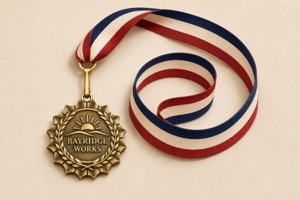
Check the medal before designing around it
The pictured Bayridge design is an AI concept based on the general scalloped medal form. It does not establish that this raised artwork, individual names or a particular engraving method are available.
DecentCustom lists metal award medals with neck ribbons, with size options described as 50–75 mm. Confirm the chosen option, usable decoration area, text limits and available customization method before preparing final artwork.
Browse the actual awards and recognition options; a category label alone does not mean every trophy or plaque style is offered. For a request to DecentCustom, provide approved display copy and the desired product option, then ask what is feasible. Share only the information necessary for that request.
If the message will not fit legibly, keep a shorter confirmed mark on the item if supported and put the individual explanation on a separate suitable card. An existing card or a corrected digital acknowledgment can also complete the recognition without commissioning an unsuitable object.
Finish when the intended recipients, factual wording and exact current artwork have each been confirmed by their responsible reviewers, and unresolved entries are clearly held back. A file being attractive, attached or uploaded does not by itself complete those checks.
Sources and current product page reviewed November 8, 2026. Bayridge Works, its people, dates and approval messages are fictional teaching examples. Institutional policies apply to their own organizations; this article offers a print-copy review method, not employment or tax advice.