Six chairs do not mean six participants all afternoon—or unlimited drop-ins. Work out how many projects your time, usable materials and actual hosting arrangement can support before inviting people to join.
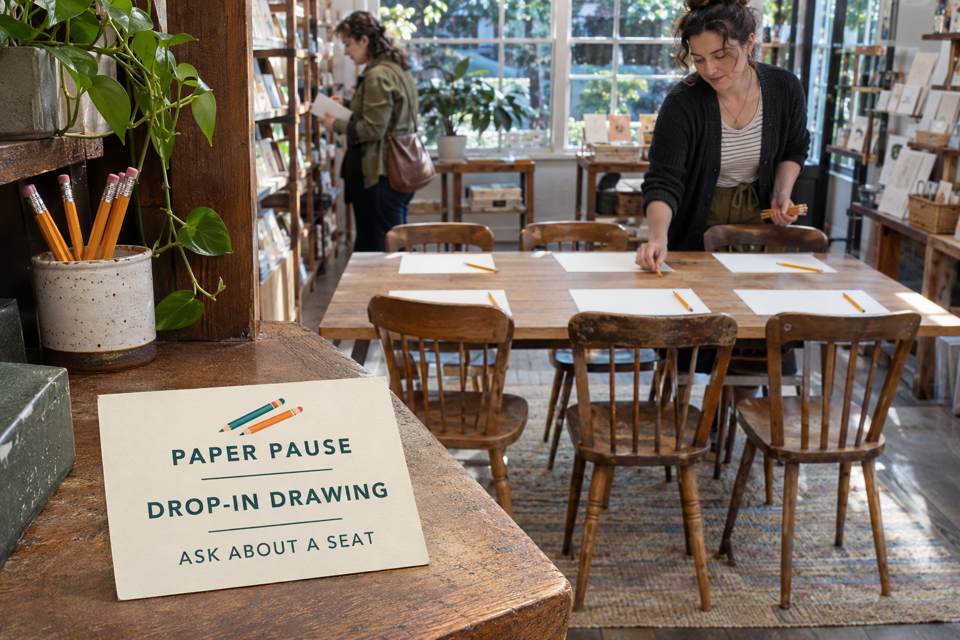
Decide whether interest, a seat or a project is being reserved
A small drop-in workshop needs three separate counts: usable activity places at one time, realistic turns during the session, and complete project materials. The smallest workable limit controls how many projects you can offer. That is a planning estimate, not a prediction of attendance.
For a shop considering an International Day of Happiness drawing activity, “drop in” should describe how someone joins. It should not imply unlimited supplies, a guaranteed place or a promise that participating will improve their happiness.
Two public examples make the distinction clear. MoMA’s past paper-folding workshop listing describes provided materials and first-come space without reservations. Oceanside Museum of Art’s Art for All information, checked in November 2026, explains that an RSVP helps planning but does not guarantee a table, seat or supplies. These are those institutions’ arrangements, not rules every shop must adopt.
Choose your own arrangement before printing. If a visitor needs a guaranteed seat, offer genuinely managed reservations with a stated session and confirmation. If you only collect expressions of interest, say so. Do not label an interest form “reserve your place” and then treat it as an unreserved queue.
Worked example: six places can still mean only twelve projects
Paper Pause is an invented shop. Its host proposes a 2:00–3:15 p.m. adult drawing activity. The following inputs are assumptions for calculation, not recommended timing or measured visitor behavior:
- Six usable drawing places, with a host available for the activity.
- Twenty minutes to introduce and complete the chosen simple project, plus five minutes to reset each place.
- Fourteen complete paper-project kits, with two set aside for demonstrations.
- Six shared pencils that are returned after use, rather than given away.
For this simplified schedule, one turn occupies 20 + 5 = 25 minutes. A 75-minute window fits three such turns. At six places, that creates 6 × 3 = 18 possible project places over time. It does not create eighteen simultaneous seats.
| Turn | Drawing time | Reset complete |
|---|---|---|
| 1 | 2:00–2:20 | 2:25 |
| 2 | 2:25–2:45 | 2:50 |
| 3 | 2:50–3:10 | 3:15 |
Materials impose a lower limit: 14 kits − 2 demonstration kits = 12 visitor projects. With these assumptions, the plan supports at most twelve projects, even though the time model allows eighteen. The six remaining theoretical project places have no assigned consumable kits. A free chair does not make a complete kit appear.
This is also why reusable tools need a different count. Six pencils may serve more than six people if they are returned and suitable for reuse. Twelve kits do not necessarily serve twelve people if a kit is incomplete or one person needs extra sheets. Check actual usable stock and keep borrowed tools identified; a new branded giveaway does not replace a missing project material.
Test the sensitive assumptions. If the actual setup leaves only four usable activity places, four places across three turns give twelve possible projects. The twelve usable kits still fit that model. If the trial project takes longer, the host must leave to serve customers, or resets take longer, recalculate the actual schedule before promising twelve.
Run the whole activity once, including explanation, material handover and reset. Use a realistic duration and allow for interruptions. The worked table assumes coordinated turns to make the arithmetic visible; a truly rolling drop-in session may have staggered finishes and fewer completed projects. This is not a building-occupancy calculation or a staffing-safety ratio.
Tell visitors what happens when the table is full
Use the verified plan to write the public notice. Here is a complete fictional example; replace every condition with the actual shop’s arrangement before using it:
Paper Pause: adult drop-in drawing
2:00–3:15 p.m. in our shop workshop area. Ask the host before taking a seat. Places are first come, first served, and paper supplies are limited. An expression of interest does not reserve a place. The last planned project start is 2:50 p.m.; starts may close earlier if materials run out. Shared pencils stay at the table.
Add the actual event date, address, cost and contact method wherever the notice is published. Keep the short printed invitation consistent with the current details. If those details are still undecided, finish the arrangement before accepting registrations or distributing dated invitations.
If the table is full: “All drawing places are in use. Please check with me before joining. I cannot promise when a place will become available.” Give an estimated next start only when the host has checked the real progress and remaining kits.
If materials have run out: “We have no complete project kits left for today, so we are closing new project starts.” Do not continue advertising an available activity simply because chairs have become empty.
After the last start: “We have closed new starts so the current projects can finish and the table can be reset.” Offer another date only if one has actually been arranged.
Afterward, record actual starts, completed projects and unused materials separately. Do not treat every passerby or RSVP as a participant. If instructions or joining conditions caused confusion, use three activity feedback questions to identify a specific change for next time. That review is more useful than assuming a busy-looking table proved the activity’s success.
A postcard can carry the invitation, not create a reserved place
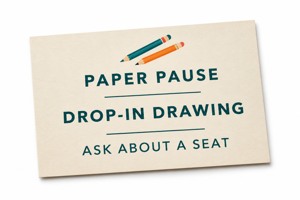
Existing paper notices may be enough for a small trial. For a recurring activity, the linked custom postcards for a recurring drop-in invitation include a 6 × 4 inch format with 16pt stock and a default glossy front. The page lists ordering increments of 50; that is not a reason to plan fifty participants.
The fictional Paper Pause artwork says “Ask About a Seat” and leaves the changing arrangements to the host’s current notice. Compare custom postcard formats for other shop notices, and confirm the chosen layout and configuration with DecentCustom. The card is an invitation concept, not a booking system, material kit or printed-color proof.