Hanukkah 2026 begins at sundown on Friday, December 4 and ends at nightfall on Saturday, December 12. For a community invitation, write the date of the actual gathering as well as its confirmed start time and location. The holiday's date range is not an eight-day event booking.
Which evening starts Hanukkah in 2026?
The first evening is Friday, December 4, 2026. Hebcal's 2026 Hanukkah calendar gives the full range from that evening through nightfall on Saturday, December 12. Chabad's current Hanukkah FAQ also identifies December 4 as the first evening.
Include the year when reviewing saved artwork. A correct date from a past campaign can become an incorrect date in this year's invitation.
Why can a calendar show a date one day later?
The My Jewish Learning FAQ addresses this exact calendar question: Hebrew calendar dates begin at sundown, while Gregorian calendar dates change at midnight. The celebration can therefore begin the evening before the daytime date someone sees on a calendar.
In 2026, Hebcal identifies the first evening as December 4 and the first daytime date, 25 Kislev, as December 5. Those describe different parts of the same holiday opening. They are not competing invitations to two different first nights.
When reviewing a notice, identify whether its date means the first evening, a daytime calendar label or the actual date chosen by the local host. Replace an ambiguous date-only heading with wording that makes that meaning clear.
Does December 12 mean there is a ninth evening?
No. Hebcal's table associates the eight nights with December 4 through December 11; December 12 is the eighth daytime date and the holiday's conclusion. The following is a calendar-reading aid, not a candle-lighting timetable:
| Night | Associated 2026 date |
|---|---|
| First | Friday, December 4 |
| Second | Saturday, December 5 |
| Third | Sunday, December 6 |
| Fourth | Monday, December 7 |
| Fifth | Tuesday, December 8 |
| Sixth | Wednesday, December 9 |
| Seventh | Thursday, December 10 |
| Eighth | Friday, December 11 |
Do not count the inclusive December 4–12 date labels as nine nights. A date range crossing evening boundaries needs more context than simple subtraction of the printed numbers.
Does “at sundown” tell guests when our event starts?
No. A holiday boundary, a religious lighting time and a local program's arrival time are different pieces of information. Chabad's FAQ notes Friday and Saturday differences associated with Shabbat. A generic instruction to arrive at the same clock time every night would not follow from that guidance.
Get the actual program details from its host. A useful invitation identifies the weekday and date, arrival or start time, time zone where relevant, location and participation route. For observance questions, follow the community's own guidance rather than treating a printed marketing card as a religious instruction sheet.
For an online program, make the time zone explicit. For an in-person program, verify the actual venue and any host-published entry or registration instructions. The broad holiday range cannot establish any of those details.
A completed invitation review
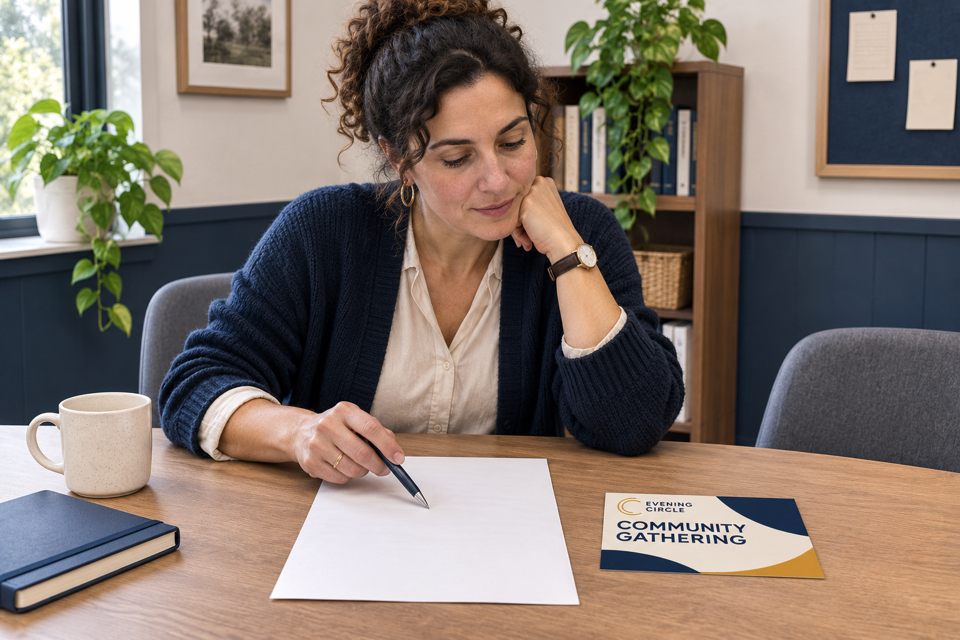
Fictional example: Evening Circle's coordinator receives a draft headed “Hanukkah begins December 5.” The draft is meant to promote a particular community discussion, so that heading does not tell guests when to attend.
The coordinator holds the proof, checks the current calendar and distinguishes the December 4 first evening from the December 5 daytime label. The responsible host confirms that its discussion is actually on Sunday, December 6. The coordinator makes that program date prominent and retains the host's already-confirmed start time, venue and participation instructions in the revised notice.
The host approves the corrected digital version. Existing accurate group cards can still identify Evening Circle, so the coordinator places no additional print order. This example completes a date correction without announcing a real event or inventing a public lighting time.
An optional card for a checked invitation
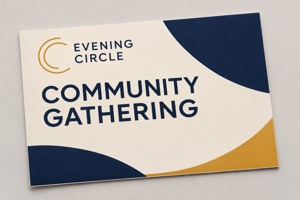
Flat printed postcard
These postcards for a checked community invitation offer size and orientation routes including a 6 × 4 inch horizontal format. The page lists default 16pt stock, a glossy front finish and purchasing increments of 50. Check the selected configuration against the actual message and distribution need.
Compare custom postcards after the host approves the details. Bring the artwork and requirements to DecentCustom for proof review. Eight nights do not automatically require eight print versions or gifts.
Reviewed November 18, 2026. These calendar and education sources answer published questions; they do not measure customer question frequency or confirm a local event. Community practices and program arrangements need their own review. No attendance, ritual suitability, print-arrival date or campaign result is verified here.