Deli packaging selection guide
Choose the package for the actual food and handling conditions first. Add a branded outer bag only after the wrapped portion and the handoff fit.
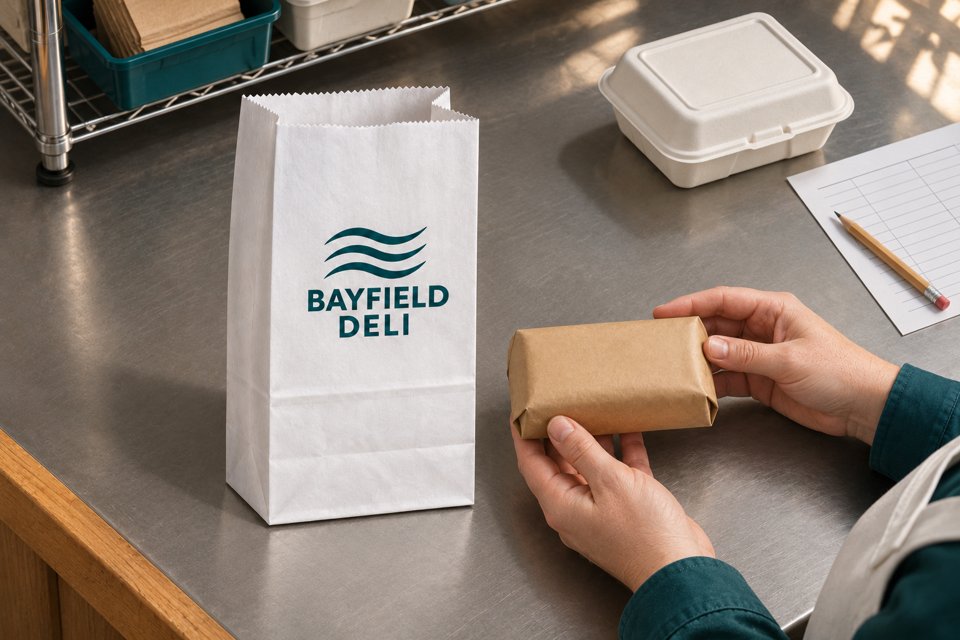
The food container and the branded outer bag have different jobs
Check deli packaging against the actual food, its condition when packed, the fully wrapped portion and the way it will be carried or delivered. Decide which material touches the food and which item only carries the finished package. A logo on the outside does not establish either item’s suitability.
A deli can sell dry wrapped goods, chilled moist portions, hot dishes and gift assortments. Those products do not become one packaging task because they leave the same counter. Start with a brief for each use rather than searching for one bag to handle the entire menu.
The original shop research also separates ready-to-serve catering from shipped gifts. For an operating example, Zabar’s shipping page describes insulated packaging for its perishable shipments. That does not make a retail paper bag a shipping package. Coordinate the actual route through the gift delivery and recipient instructions.
Ask about the exact material and intended conditions
The FDA’s explanation of food-contact materials distinguishes substance identity, specifications and conditions of use. It also says a buyer may ask the manufacturer for confirmation that a particular product is acceptable for its intended food-contact use. That explanation does not approve the bag or container shown here.
Give the packaging supplier the actual item and use: whether contact is direct or through another package; whether the contents are dry, moist or oily; conditions during filling and holding; and whether reheating in that container is intended. Ask for information covering the exact material and configuration being supplied.
Keep the material question separate from the physical packing question. A container’s external dimensions do not establish its food-contact suitability. Equally, relevant material documentation does not show that the selected portion, lid, card and serving item fit together.
Three completed packing decisions
Fictional examples: Bayfield Deli’s coordinator, Nia, reviews three proposed uses. These are purchasing decisions based on stated needs, not completed food tests or observations of a real deli.
1. A dry, individually wrapped counter item
Job: carry one separately wrapped item at collection. Its existing inner wrapping remains responsible for the food’s actual packaging requirements.
Decision: consider a small paper outer bag only for that dry, fully wrapped item. Nia first needs the packed item’s external dimensions and the intended top closure. She does not approve fit from the unwrapped food size or the scene photograph.
Next step: compare the actual wrapped item and any insert against a sample’s usable space. Keep the current suitable outer packaging if the new bag crowds the item, prevents the intended closure or lacks a justified quantity need.
2. A chilled, moist salad portion
Job: hold the actual portion in a suitable primary container with its matching closure, then support the intended collection or delivery process.
Decision: do not replace that container with an unlined retail paper bag. Confirm the container configuration and its intended-use information. Check the external closed container, including its lid, before choosing an outer carrier.
Next step: resolve moisture exposure and handling with the packaging supplier and the deli’s responsible food-operation team. Nia keeps the existing appropriate container and carrier while the proposed replacement is unresolved. No condensation or leak test has been completed in this example.
3. A hot broth order
Job: package a liquid under the deli’s actual filling and handoff conditions.
Decision: exclude the unlined paper bag as the primary liquid container. Review an exact container-and-lid combination intended for this job with its supplier; do not infer suitability from a similar-looking cup or the word “takeout.”
Next step: retain the deli’s current appropriate packaging and operating process until the proposed alternative has been checked. A branded outer bag does not replace that work or establish heat retention, a secure closure or protection during transport.
The useful outcome is a decision for each item. The dry wrapped item has a conditional outer-bag candidate; the moist portion keeps its separate primary container; the broth is excluded from the unlined bag’s direct use. None is recorded as physically tested or approved through this article.
A complete supplier request before changing the container
Example request for the moist-portion job
We are reviewing packaging for a chilled moist deli salad portion. We need the exact container and matching lid configuration for our actual portion and collection process. We will provide the food description, portion specification and filling/holding conditions from our operating brief.
Please identify the supplied material and configuration, provide the relevant intended food-contact use information and describe any limitations. Please also confirm the usable container capacity and the external dimensions with the lid fitted. We need to check the packed portion and any separate serving item before selecting an outer carrier.
We have not approved a replacement or placed an order. A proposed material or lid change should be identified separately so we can review it against the same brief.
This is example wording, not an inquiry sent to a supplier. It deliberately leaves actual food-process measurements to the responsible business rather than inventing a temperature, holding period or portion specification.
Use a dry mockup to check geometry, not food safety
After receiving the exact format, compare the fully wrapped item or closed container with the intended outer bag. Include the lid overhang, any insert and room for the intended top fold. Check whether packing and removal work without forcing or distorting the package. Record the actual configuration and what still needs resolution.
An empty or dry mockup can reveal a size or access problem. It does not establish resistance to hot contents, grease, liquid, condensation or carrying loads. Those questions need evidence appropriate to the exact material and use.
A small paper bag is a conditional dry outer layer
Compare custom paper bags after the inner package and packing job are defined. Existing plain bags or other suitable carriers may already do the job.
4.75W × 8.75H white paper lunch bag
The current listing describes unlined white paper, a serrated top and bottom gussets, with dimensions of 4.75W × 8.75H × 3 inches. It is for dry contents and has no laminated poly liner.
The minimum/default order is 200 bags; the case pack is 500. One-sided full-color printing is included. The listing says to use suitable inner packaging and does not present the bag as a protective shipping carton.
AI concept with Bayfield Deli’s fictional teal identity, matching the scene. Click the small image for the exact product. The artwork does not prove packed-item fit, carrying capacity or a heat, grease or moisture barrier.
Finish the packing decision before the artwork decision
Keep the selected primary container, outer carrier and actual handoff together in the brief. When a dry outer-bag need and quantity are justified, take the packed-item details and artwork to DecentCustom for current configuration and quote review. Keep the existing appropriate packaging while a proposed replacement remains unresolved.
Prepared by DecentCustom, reviewed November 7, 2026. Bayfield Deli, Nia and the three decisions are fictional editorial examples. No supplier inquiry, actual food pack, material authorization review, thermal test, leak test or customer result has been completed. Follow the responsible supplier’s and food business’s instructions for the actual use. Source organizations do not endorse the product.