Deli purchasing calendar guide
Food ordering, printed production and event preparation run on different clocks. Plan around the date the supplies must be received and checked, not only the event date.
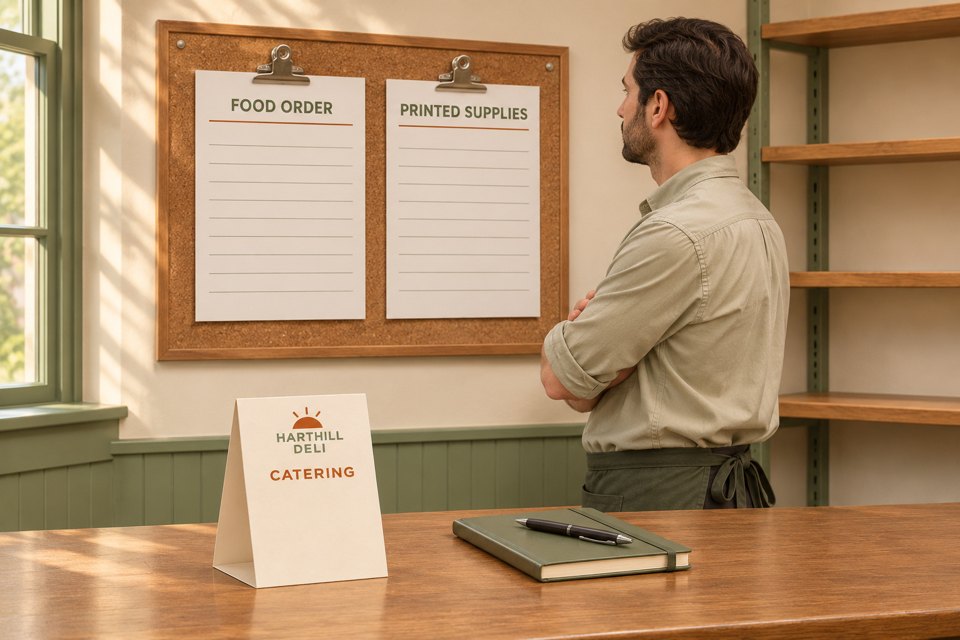
A food order cutoff does not tell you when to order printed supplies
Set separate dates for the food order and the printed materials. For print, identify when artwork and configuration must be approved, when production starts, what dispatch and arrival dates mean, and when staff must receive, check and assemble the materials. The date of the event is only the final point in that sequence.
For example, Zabar’s catering page asks customers to submit food orders 48 hours ahead. That is one retailer’s food-service policy. It is not a production or delivery commitment for custom printing.
Start with the actual job. A gift basket sold to a customer is not evidence that the deli needs a bulk giveaway campaign. A catering order is not automatically a reason to buy new branded packaging. First check the actual food packaging, current supplies and information that needs updating.
Then identify the earliest task that requires the new material to be physically available. If staff assemble order packs before the event, their assembly date matters. Artwork approved on a screen and a parcel marked dispatched do not satisfy that need.
A complete calendar that exposes a missed preparation date
Fictional example: Harthill Deli is preparing a Saturday group order. All dates and times below are the example shop’s local time in November 2026. These are invented planning inputs, not DecentCustom lead times or a real supplier quote.
Tuesday, November 10, 2:00 p.m. — proposed artwork cutoff
The fictional print proposal asks for final artwork, quantity and configuration by this time. Meeting that cutoff would only allow the proposed print schedule to proceed; it would not establish that the materials arrive in time for the deli’s preparation.
Monday, November 16, 10:00 a.m. — required on-hand date
The deli chooses this receiving deadline so its assigned staff can check quantity, spelling, configuration and condition before assembly. It is a requirement of this example’s work plan, not a standard buffer every deli should use.
Tuesday, November 17, 9:00 a.m. — scheduled pack assembly
This is when the assigned staff need the approved materials available. The event is later, but this preparation slot is earlier. A different receiving or staffing arrangement would need its own review.
Wednesday, November 18 — estimated print arrival
The fictional proposal gives this as an estimate. Even if that estimate is met, arrival is after the Monday receiving deadline and Tuesday assembly. An estimate before the event is therefore still insufficient for the stated plan.
Thursday, November 19, noon — example food cutoff
The deli’s fictional food-order brief uses a 48-hour cutoff before the Saturday noon event. This belongs to the food order. Waiting until this date to begin the printed-material decision would ignore all earlier preparation tasks.
Saturday, November 21, noon — event service
The group receives its agreed food service. The earlier receiving and assembly requirements are part of getting ready for that service; they cannot be removed by looking only at the event date.
The date arithmetic is simply Thursday noon to Saturday noon = 48 hours. The example does not calculate production or transit from a generic number of working days, and it makes no holiday or carrier-service assumption.
Keep the existing materials when the proposal misses the work plan
In the example, coordinator Sam does not treat the Wednesday arrival estimate as meeting Monday’s on-hand requirement. He keeps the new print proposal out of this order’s assembly plan. The team uses existing appropriate supplies and a current plain printout where that meets the information need.
Sam does not authorize a rush charge, change the material or promise a different arrival date. If an alternative is proposed, he checks its exact configuration, artwork requirements and timing against the same on-hand date before changing the decision.
Completed internal handoff — fictional example
Sam owns the printed-material decision and the Monday receiving check. Nina owns the food-order confirmation and Thursday cutoff. Tuesday assembly uses existing suitable supplies and the current information sheet; the proposed new print is not assumed available.
If the food order changes, Nina updates the current order record and tells the packing team which version applies. Sam checks whether any printed or plain information is affected. Neither person treats the other schedule as automatic approval.
This record assigns responsibility within the example. It does not say that an actual food order, print order, parcel or receiving inspection has occurred.
Ask the print supplier about the actual on-hand requirement
Complete example request
We need the selected printed materials physically received and checked at our shop by Monday, November 16, at 10:00 a.m. for Tuesday assembly. The event is Saturday, November 21; the event date is not our receiving deadline.
Please review the exact quantity, paper/finish configuration and artwork requirements for that need. What must be finalized, and by when, before production can start? Please distinguish production completion, dispatch and expected delivery, and identify which dates are estimates and any commitment you can actually make.
The proposed Wednesday, November 18 arrival estimate does not meet our current preparation plan. We will use existing materials unless a reviewed alternative meets the actual requirement. Please identify any changed configuration or additional cost separately for review.
This is fictional wording, not a message sent or an agreement reached. For a real order, replace the example dates and confirm the actual delivery address, configuration and responsible approver through the supplier’s process.
Keep recurring counter information separate from one event’s dates
Stable information can sometimes be printed for repeated use while the current menu, guest count, dates and order details remain in an editable record. Compare suitable custom marketing materials only if the recurring need and quantity justify it.
Example of stable counter wording
Ask us about catering
Speak with the counter team about the current menu, quantities and available collection or delivery arrangements. Your order confirmation records the agreed details. Please confirm changes with the team before relying on a revised arrangement.
Use this only where it describes the deli’s actual service and staffed contact route. Keep a changing cutoff date or unconfirmed delivery promise out of a long-lived display.
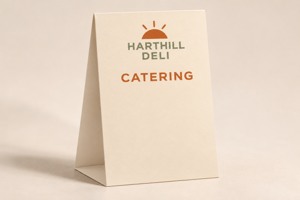
5 × 7 inch paper table tent
The current listing specifies 14pt stock, glossy finish as the default and matte as an option. Its minimum/default quantity is 25 table tents.
One counter display does not by itself justify that quantity. Check the actual placement, readable copy and recurring use before ordering. The format does not establish a print turnaround, delivery date or resistance to a wet cleaning environment.
AI paper-table-tent concept with Harthill Deli’s fictional sage-and-orange identity, matching the scene. Click the small image for the exact product. The lower artwork is blank; the example wording is real text above. This is not a physical finish, stability or placement test.
Give every deadline a meaning and an owner
Record food confirmation, print approval, receiving and assembly separately. When a justified print job has a workable schedule, bring its exact on-hand requirement, approved copy and configuration to DecentCustom for current review and quotation. Continue with existing suitable materials when a proposed schedule does not meet the job.
Prepared by DecentCustom, reviewed November 7, 2026. Harthill Deli, Sam, Nina and every date in the worked calendar are fictional. The cited food cutoff belongs to one retailer. No supplier contact, quote, print order, rush expenditure, carrier arrival or customer outcome has been verified. Source organizations do not endorse the product.