A customer appreciation invitation should tell people which location to visit, when the relevant activity runs and what participation actually includes. Store opening hours, a demonstration window and a limited offer can be different. Resolve those differences before turning the message into a banner, printed notice or online post.
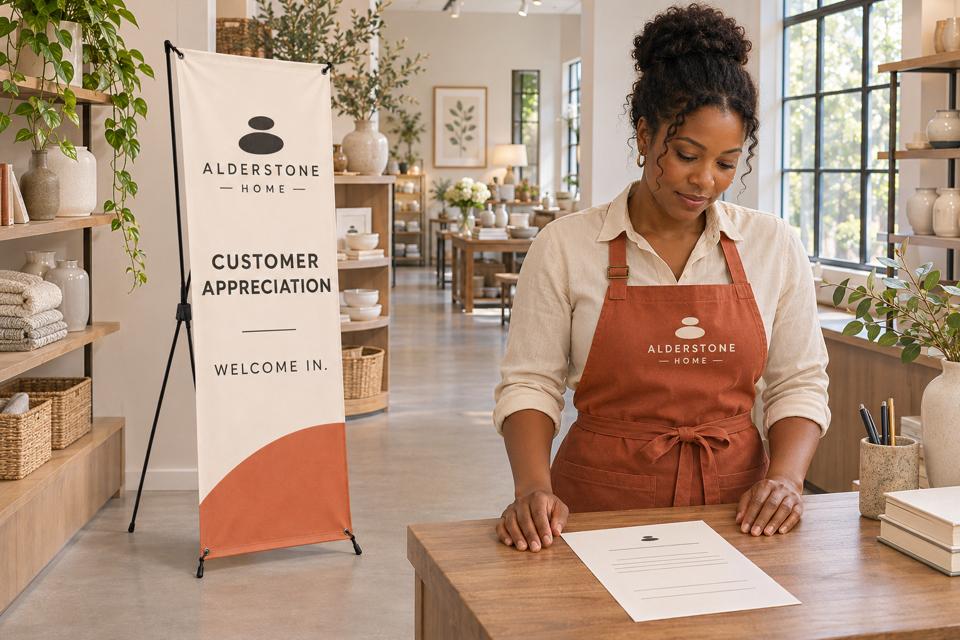
Check what each time and condition applies to
Start with the approved activity, not the largest headline. “Customer Appreciation Day” alone does not tell a customer whether they can drop in, need a booking, must use a particular location or will find the same activity throughout the day.
Real operator announcements illustrate the distinction. Yard Stop's expired April 2026 appreciation event separated its event hours from a shorter food-service window and stated exclusions for its sale. That is a record of that operator's announced arrangement, not an offer currently available through this article.
IFA Country Store's 2026 appreciation page likewise lists location-specific sale dates and meal times. These examples show why the location and activity matter; they do not establish a universal Customer Appreciation Day, required promotion or successful sales outcome.
- Visit: the named location and full public address, with the relevant date and time zone.
- Activity: what the customer can actually do, with its own start and end times.
- Participation: who can take part and whether booking, a purchase or another approved condition applies.
- Separate offers: any distinct sale, gift or limited service, with the conditions that belong to it.
- Questions and changes: the current information source and the person who can resolve an uncertainty.
Fill only the fields your shop has decided. A thank-you conversation or demonstration does not need an invented giveaway. If an essential activity or location is still unconfirmed, settle it before publishing a specific invitation.
A complete invitation with three different time windows
Fictional example: the following shop, address and activity are invented to show the message structure. They are not an invitation to a real event.
Alderstone Home Customer Appreciation Afternoon
Saturday, November 21, 2026
Alderstone Home, 10 Example Lane, Sampletown — fictional address
All times Central Time.
Thank you for making our shop part of your year. Visit our team from noon to 3 p.m. to ask questions about gift presentation and share requests for future demonstrations.
Our wrapping demonstration runs from 1 to 2 p.m. Everyone is welcome to watch; no purchase or booking is needed. This is a demonstration, rather than a wrapping service for visitors' own items.
The store's regular shopping hours that day are 10 a.m. to 6 p.m. The appreciation conversation and demonstration run only during their stated windows.
Ask the Alderstone Home counter team to confirm activity details before planning a special trip. If the plan changes, the team will update the shop's current event notice and invitation.
This example separates the reason to visit from the service being offered. It names the location, date and time zone, gives the demonstration its own window and explains participation. It does not leave staff to decide at the counter whether “wrapping demonstration” meant a free wrapping service.
The fictional date is a Saturday, chosen by the fictional shop. It is not presented as a nationally fixed observance or a required date for another business.
Test the invitation with the questions a customer might ask
“Can I watch at 2:30?”
In this example, the demonstration has ended. The appreciation conversation continues until 3 p.m. Give both facts rather than answering only that the store is open.
“Can I join at 3:30?”
The shop remains open for ordinary shopping, but the stated appreciation activity has finished. Opening hours do not extend the activity.
“Can you wrap my own gift?”
The advertised activity is a demonstration. Staff should explain any separate service from its actual current arrangements, without treating the invitation as a service booking.
“Do I need to buy or reserve?”
The fictional invitation says no purchase or booking is needed to watch. That answer applies to this example's demonstration, not every possible appreciation event.
Also ask whether the message could be mistaken for another branch's event. A business with several locations should publish the approved location-specific details, rather than assuming a shared brand name makes every offer available everywhere.
Keep the approved invitation and staff answer together
Before release, have the responsible shop person read the complete message and confirm the activity, staffing, place and conditions. Keep the approved version where staff can refer to it.
For the fictional example, a change from a 1–2 p.m. demonstration to 1–1:30 p.m. affects the invitation, the current notice and the answer to “Can I come at 1:45?” Update the relevant customer-facing places and check the visible result. Saving a revised file is not the same as replacing an old printed notice.
Identify the change clearly when communicating with people who already received the earlier arrangement. If a customer has made a separate booking or received a personal confirmation, review that commitment through the shop's normal process instead of assuming a general post has resolved it.
Use a welcome sign alongside the actual details
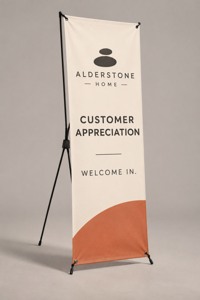
An indoor headline, with details kept current
The illustrated Alderstone Home banner identifies the activity and welcomes visitors. The separate notice carries the full arrangement. A large welcome headline should not be treated as a replacement for the participation details.
DecentCustom's custom X-frame banners list several graphic sizes, including 24 × 63 inches, with the frame, banner and carrying bag described in the package. Confirm the selected configuration and placement before ordering.
The illustration uses the X-frame form indoors. Check the real display footprint and keep customer access clear; this scene is not an installation approval or a wind, weather or stability test.
Compare marketing materials according to where the customer will read the information. An existing suitable sign, an accurate paper notice or a current online invitation may be enough. If requesting a new display from DecentCustom, provide the approved message, actual dimensions and the information that must remain readable.
The invitation is ready when a customer can identify the right place and activity window, understand participation and get a consistent answer from the shop.
Reviewed November 8, 2026. Alderstone Home and its sample invitation are fictional. The cited operators' announcements are specific examples, not evidence of attendance, sales or the effect of printed displays.