For a business Christmas card, choose words that fit the actual relationship and what the recipient has shared. A known preference can support a Christmas-specific greeting. For a mixed list or a contact you do not know well, a broader message of thanks can express the purpose without assuming a particular celebration.

Decide what you are trying to say before choosing the picture
Is this a Christmas wish to someone you know celebrates, a year-end acknowledgment of working together, or thanks for a specific purchase or project? Those purposes can share a brand identity while needing different words.
The Emily Post Institute's holiday-card advice suggests a broader sentiment for a business contact whose preferences are unknown and respecting preferences you do know. It also treats sending cards as optional. This is etiquette guidance, not a measurement of which wording will produce sales.
Gallup's December 2025 Christmas research describes both social and religious forms of observance. That historical population context does not tell you how a particular customer wants to be addressed in 2026. A purchase, surname, appearance or workplace is not a reliable substitute for their expressed preference.
- Known and appropriate: use the greeting the recipient has welcomed, with a message suited to the business relationship.
- Unknown or mixed: use a broader thank-you or year-end message that accurately describes your purpose.
- No card wanted: respect that choice. Do not automatically replace it with another promotional item.
If a choice is useful in an existing conversation, ask about the message rather than religious identity: “Would you prefer a Christmas greeting or a simple thank-you note?” Nobody needs to explain their beliefs to receive courteous service.
Two complete messages for different circumstances
The following names, shop and project are fictional. They show how to combine a suitable greeting, a truthful detail and a clear sender. Replace the detail only with something you can actually substantiate.
The second version does not need a religious image or a seasonal claim. It is also more specific than “Thanks for being our best customer” when you have no basis for ranking the person that way. Avoid inventing a successful event, a long friendship or a recipient's family plans simply to make the note sound personal.
If the purpose is appreciation, check whether an added discount, review request or sales pitch changes that purpose. Keep an optional commercial message separate and accurately described. A card should not suggest the recipient owes a reply, purchase or public endorsement.
A mixed-list example without a religion column
Fictional planning example: Harbor & Thread is reviewing 12 established business contacts for an optional card:
- Three have expressly welcomed a Christmas greeting: 3 Christmas messages.
- Seven have no recorded greeting preference: 7 broader thank-you messages, after confirming the communication is appropriate.
- One has requested a year-round thank-you only: 1 broader thank-you message.
- One has asked not to receive a card: no card.
The resulting plan is 3 Christmas cards + 8 broader thank-you cards + 1 no-card contact = 12 contacts reviewed. It is a worked example, not a recommended audience split or a print order.
The operational record needs the approved message version and the relevant communication preference, not a guessed religious category. Review whether old preferences and contact details remain suitable. Keep the working recipient information within the shop's appropriate private process; do not put the mailing list into artwork shared for a general design review.
A repeat order or a card received last year does not automatically confirm that the same message, destination or frequency is welcome now. When an uncertainty affects whether to send, leave the item pending while it is resolved rather than filling the gap with an assumption.
Read the whole card, not just the greeting in your spreadsheet
A neutral message can still sit beside an incompatible picture or an old printed headline. Check the actual front and back of every version together.
- Version: does the file contain the approved Christmas or broader message, rather than an earlier draft?
- Artwork: do the pictures and symbols fit that version's purpose? Inspect the actual design instead of assuming a file labeled “neutral” is suitable.
- Names and sender: are spelling, business name and signature accurate and appropriate?
- Truthful detail: can the sender stand behind the project or purchase mentioned?
- Distribution: does the prepared card match the intended message version, with no-card requests excluded?
Keep the versions separately identified through approval and preparation. If you personalize individual names or text, confirm the supplier's actual process and check the resulting proof; a design concept does not establish that individual variation is included in a standard print quote.
Choose a format that supports the actual message
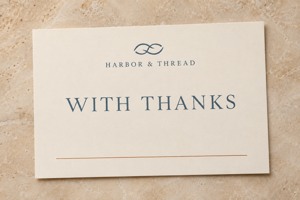
A flat postcard with room for approved words
DecentCustom's custom postcards list several sizes, including 4 × 6 inches, and single- or double-sided printing options. Review the selected stock and finish if you intend to add handwriting.
The product notes increments of 50. The fictional 3-and-8 split above does not establish that a small mixed-version order is available or that one minimum covers several artworks. Confirm the current configuration and quantities per version.
Compare postcard formats if the message needs a different layout. A request to DecentCustom should include each approved artwork version, its quantity and whether individual personalization is required. Existing suitable blank cards, a personal message through an appropriate channel or no additional card can also meet the need.
The useful outcome is an accurate, considerate message delivered in the form that suits the relationship. More elaborate holiday printing is not a requirement for expressing thanks.
Reviewed November 8, 2026. Harbor & Thread, the sample notes and all 12 contacts are fictional. No recipient beliefs, campaign response, sales improvement or customer result was inferred or measured.