Convenience-store catering instructions
A useful catering notice names the service, gives an exact deadline and explains what happens when the requested time is unavailable.
Write catering cutoffs for the actual store, menu and fulfillment service. “Order ahead” leaves customers guessing. “24 hours ahead” and “by 11 a.m. the previous day” describe different rules. Neither guarantees that a particular item or pickup slot is available.
Build the notice from your existing booking process. Tell customers which service they are choosing, when an order must be completed, where or how it will be received, and what to do if their request falls outside the offered options.
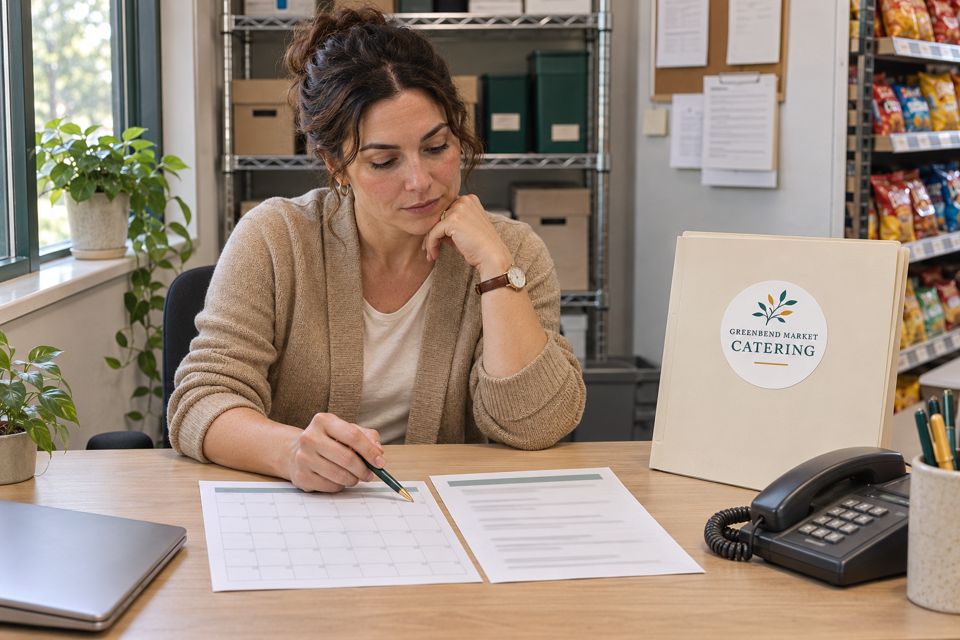
Identify the catering service before borrowing its rules
A familiar brand name does not mean every catering program has the same conditions. The Wawa store-catering FAQ saved during our November 2, 2026 research described store and item differences in advance notice, with the relevant cutoff shown during date-and-time selection. That archived page also described store pickup and third-party delivery. We could not recheck its live text on November 4; confirm current conditions in the selected store’s ordering flow.
A separate Wawa Large Event Catering FAQ, reviewed November 4, describes a program based outside Philadelphia. It lists delivery rather than customer pickup, a deadline of 11 a.m. the day before an event, and a contact route for later requests. Its conditions belong to that program. They cannot be pasted into ordinary store-catering instructions.
Customer questions reveal another gap. In a July 2024 discussion about when to use catering, one person asked about six to eight sandwiches when the need was known only two to three hours ahead. Commenters offered different thresholds and suggestions. This is an old, unverified account of confusion, not evidence for a universal order-size or notice rule.
Your customer-facing page should answer the relevant local question: which ordering path should someone use for these items, this quantity and this requested time? A regular meal-ordering page and a catering inquiry form may lead to different next steps. Once the booking is settled, matching and completing a pickup order is a separate handoff task.
Compare “24 hours ahead” with “the previous day”
Illustrative comparison: a customer wants an order for Thursday, April 8, 2027 at noon. They ask on Wednesday, April 7 at 11:30 a.m. All times below refer to the same fictional store’s local clock; the example does not cross a daylight-saving change. These are two hypothetical policies, not two verified Wawa offerings.
Policy A: at least 24 hours ahead
Calculated deadline: Wednesday, April 7 at noon.
The request at 11:30 a.m. is 24 hours and 30 minutes before the requested pickup. It meets this notice interval. Menu availability, capacity and successful order acceptance still need to be checked.
Policy B: by 11 a.m. the day before
Calculated deadline: Wednesday, April 7 at 11 a.m.
The same request arrives 30 minutes after this cutoff. It needs the store’s exception process or another available option. Having more than 24 hours until pickup does not make it timely under Policy B.
For Policy A, subtract 24 hours from the requested pickup timestamp. For Policy B, use the previous calendar date at the stated local cutoff. A generic “next day” label cannot communicate that difference.
Also check whether an item needs longer notice, the date is unavailable, or that fulfillment service is closed at the requested hour. Do not advertise a slot just because it passes the clock calculation. Near a clock change or for an out-of-area organizer, confirm the full local date, time and time zone through the store’s actual system.
Turn the verified rule into a usable notice
Before publishing, have the person responsible for the service verify the participating location, applicable menu, notice rule, available pickup or delivery windows, and the event that makes an order accepted. Verify the contact route and modification process too. A request form submission may be an inquiry; a completed checkout may produce a different status. Use the wording that matches your system.
Fictional example: Greenbend Market, pickup catering only
Planning a group pickup?
For the menu covered by this notice, complete your order by 11 a.m. store local time on the day before pickup. Choose an available pickup time during ordering. Items with a different notice requirement will need to be checked separately.
For a Thursday, April 8, 2027 pickup, the usual cutoff is Wednesday, April 7 at 11 a.m.
If the time you need is unavailable or you have missed the cutoff, ask our catering team before making plans around the order. A request is not an accepted exception. We will confirm whether we can provide the requested items and time.
After acceptance, use the pickup location and instructions in your confirmation. Contact the catering team to request a change to an accepted order.
This example intentionally covers one menu and pickup service. Replace it with your verified conditions, genuine contact details and actual acceptance language. If you offer delivery, publish its available area, timing and any additional charges before commitment through the appropriate service path. Do not let “pickup or delivery” imply that every date, address and item works for both.
Keep a late request separate from a confirmed order
Return to the 11:30 a.m. request under Policy B. The useful response is not “Try ordering anyway” or an automatic promise for the next day. The employee responsible for catering checks the requested items, quantity, location and time against actual capacity.
- While the check is pending: keep the original requested time visible and describe it as awaiting confirmation. Do not tell the organizer the exception is accepted.
- If the store can accommodate it: record the specific approved items, quantity, fulfillment method and time using the existing order process. Communicate that accepted arrangement to the customer.
- If it cannot: offer only alternatives the store has actually checked, such as an available menu or later slot. Let the customer choose; do not silently move the order.
Use the same discipline for a change after acceptance. An email asking to move noon pickup to 10 a.m. does not itself change the accepted time. The team needs to check the request and communicate the outcome through its normal process.
Before releasing the notice, walk through a timely request, an after-cutoff request, an unavailable item and a pickup-to-delivery change. Ask a colleague to identify the next action from the text alone. Record where they need to guess, fix that wording and repeat that case. This is an internal editorial check, not a measured customer or sales result.
Keep changing service information easy to replace
A current web page and ordinary replaceable notice may be enough. Put dates, hours, exceptions and contact details where your team can maintain them. Consider custom labels and stickers for stable identification, such as the catering mark on a dry indoor information folder, once the actual message is settled.
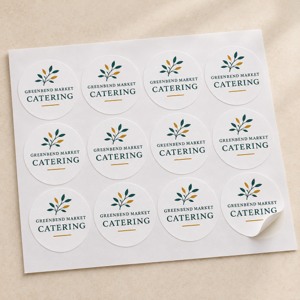
custom product labels
The current SKU decentcustom-st-000009 page lists circle shapes, material and finish choices, and customizable sizes. Its white-paper description is for indoor, dry use. Confirm the selected configuration for the intended surface; this illustration does not establish suitability for food contact or a wet container.
Quantity starts at 1 ordering unit; the package refers to sheets without establishing labels per sheet. Confirm the finished-label quantity before ordering. A printed brand label is not an editable service notice or a guaranteed removable label.
AI artwork concept with a fictional Greenbend Market mark. The pictured sheet count and dimensions are illustrative. Click the small image for the actual product page.
At DecentCustom, review the artwork and selected configuration before ordering. Keep the operational rule in the maintained service information. The practical result to check is whether a customer can identify the correct service, calculate the relevant deadline and understand the status of an exception request.