Convenience-store catering preparation
Start with what each menu line needs and what the accepted order already includes. Guest count alone cannot tell you what to pack or buy.
Check cups and utensils against the menu, confirmed package contents and usable stock before ordering extras. Twenty-four guests do not automatically require twenty-four new cups, forks and spoons. Some drinks arrive in their own containers; some meals include their utensils; existing suitable supplies may cover the remainder.
The useful record connects each accessory to the item it serves. Keep “included but quantity unknown” separate from “not included.” A generic catering FAQ is a starting point for questions, not a completed packing list.
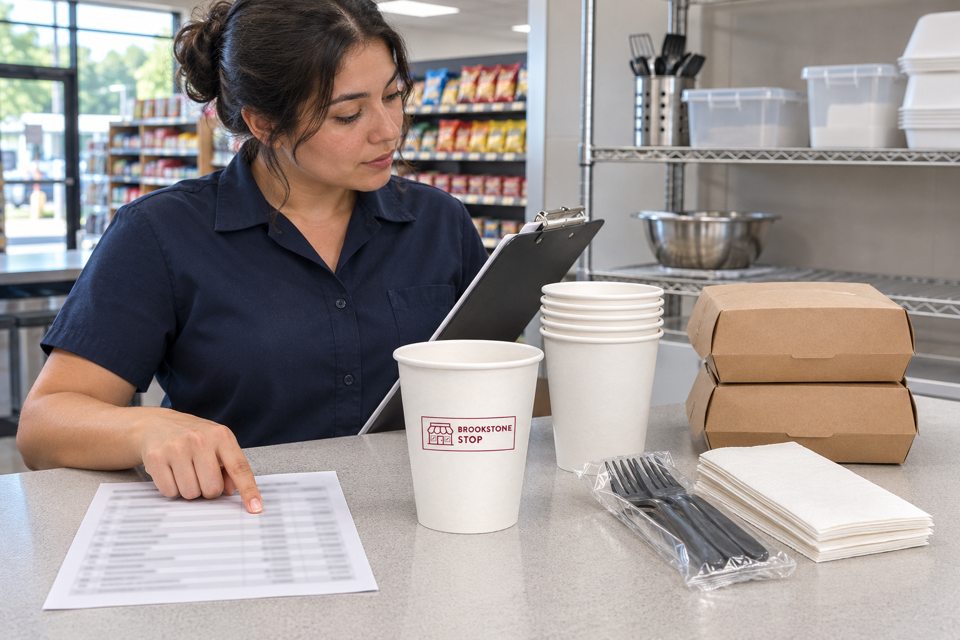
Write down what each ordered item actually needs
Begin with the accepted menu, quantities and serving arrangement. Individual salads and a shared salad platter create different accessory questions. A bottled drink and a bulk coffee container do too. Resolve catering cutoffs and pickup options first, then work from the arrangement the store has accepted.
The Wawa store-catering FAQ saved in our November 2, 2026 research described utensils and napkins as included. We could not recheck the live text on November 4. That archived statement does not establish a cup count, lid fit or every serving utensil for a particular menu. Ask about the actual order rather than assuming that “utensils included” answers all of those questions.
Two other operators show why detail matters. Joe Coffee’s boxed-coffee page lists a 96 oz container serving 10–12 people and complimentary 12 oz cups. Katz’s coffee-box description lists a 96 oz box, a sleeve of cups and napkins. The latter description does not state how many cups are in that sleeve. These are examples of package descriptions, not accessory policies for your convenience store.
For each menu line, establish the required accessory, the confirmed included quantity and any unresolved detail. If a customer wants cups with bottled drinks, that is a separate request to record. If the agreed arrangement is to drink from the bottles, do not add another cup merely because those guests are in the headcount.
A 24-person order that needs no new accessory purchase
Fictional worked example: Brookstone Stop has accepted 16 individually boxed sandwiches and eight individually boxed salads. The customer has requested 12 single coffee servings and 12 bottled waters, with no refills planned. The agreed service calls for one cup per coffee, one fork per salad and one napkin per meal. This is a planning example, not a recommended portion or a real retailer’s package.
The employee checks the actual order and confirms ten suitable cups with the coffee, eight forks with the salads and 24 napkins with the meals. The store also has four suitable cups of the approved service model, unallocated to any other job.
| Accessory and requirement | Confirmed included | Allocate from suitable stock | New quantity needed |
|---|---|---|---|
| Coffee cups: 12 | 10 | 2 of the 4 available cups | 0 |
| Salad forks: 8 | 8 | 0 | 0 |
| Meal napkins: 24 | 24 | 0 | 0 |
Follow the cup calculation
12 required − 10 confirmed included = 2 cups still to cover.
Allocate 2 of the 4 suitable, unallocated cups already held: 0 new cups needed, with 2 existing cups still unallocated.
Every number is an invented input for this example. The four existing cups count only because their condition, compatibility and availability have been checked. This is not a stock or demand forecast.
The 16 sandwich meals do not add 16 forks under this agreed service. The bottled waters do not add 12 cups. Any extra utensils, second drinks or spare allowance would need their own stated reason and quantity. Do not hide an unexplained percentage inside the total.
Change one input and update the record. If the coffee package only says “cups included,” leave that quantity unresolved and obtain the count before declaring a shortage. If the four stored cups belong to another order, they are unavailable here. If the customer adds six coffee servings, required cups rise from 12 to 18; confirm the extra drink supply and any accessories it includes before recalculating what to add.
Cup capacity is not the same as a planned pour
A cup marked 8 oz describes a nominal capacity; it does not establish a suitable fill level, allowance for additions or matching lid. A supplier’s estimated servings also need to be understood in the context of its own service.
For example, dividing the 96 oz container in Joe Coffee’s description into 12 equal portions gives 8 oz per portion. Its listed 12 oz cups do not turn that container into twelve 12 oz drinks. The calculation is simply 96 ÷ 12; it does not account for spills, refills or a customer’s chosen pour.
For your own order, confirm beverage volume, planned portion and refill expectations together. Use the cup model and operating instructions approved for that service. Do not adopt a competitor’s serving estimate as a test of a cup you plan to buy.
Check the whole arrangement, including what the menu does not specify
- Cup and lid: verify the specific models and supplier fit information when a lid is needed. Equal nominal capacity is not evidence of equal rim diameter. A photograph of a lid sitting on a cup is not a compatibility result.
- Food and utensil: distinguish an individual eating utensil from the tool needed to serve a shared platter. Do not treat a count of guest forks as confirmation of serving spoons or tongs.
- Existing stock: confirm condition, suitability and reservations before allocating it. An unidentified sleeve is not automatically usable stock for this service.
- Customer arrangement: confirm whether accessories are already supplied at the venue or declined. Keep that decision with the order so the next employee does not add them again.
Before packing, another employee should be able to follow the accepted menu through the accessory record without guessing what “one set” contains. Expand that phrase into its actual components. Check the packed quantities against the record; record substitutions or unresolved fit questions through the store’s normal process.
Separate a small shortage from a supplier’s minimum
Compare custom paper cups only after the format and genuine remaining need are clear. In the worked example, the new quantity is zero. Branding alone does not make the existing suitable cups unusable.
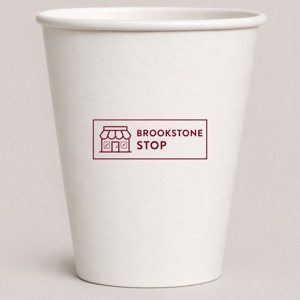
custom 8oz paper cups
The current SKU decentcustom-dr-000024 page lists paper construction, a rolled rim, nominal 8 oz capacity and a 2 W × 1.13 H inch imprint area. The quantity field starts at 100 and its minimum validation is 100; the separately listed case pack is 1,000.
The page does not establish an exact rim diameter or a compatible lid model. Confirm those requirements for the intended service. The AI artwork is not evidence of usable fill level, temperature performance or a manufactured proof.
AI artwork concept based on the listed cup form, with a fictional Brookstone Stop mark matching the scene. Illustration proportions are not measurements. Click the small image for the actual product.
If you truly needed only two new cups, that would still be a two-cup requirement; it would not lower this product’s minimum to two. A 100-cup order would leave 98 beyond that immediate gap. Decide whether a supported future need, storage and the confirmed configuration justify that quantity. Do not mistake the 1,000 case-pack listing for a required order of 1,000.
At DecentCustom, review the selected configuration and artwork before ordering. Keep the menu-based coverage record with the order. Its useful outcome is a clear decision about what is already covered, what needs confirmation and what genuinely remains to be supplied.