Before printing an energy-learning handout, check whether every number identifies its unit, time period and source. A simple example can teach a concept without implying a real project result. A large number with a missing label may leave a reader with the wrong understanding even when the artwork looks finished.
First define the scope of a Clean Energy Day activity. For a public introduction, choose one concept the facilitator can explain and review. Keep individual equipment recommendations and property assessments with the appropriate provider.
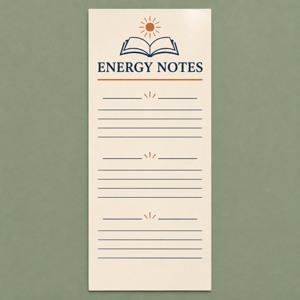
AI illustration of worksheet preparation. The educator, worksheet and Energy Notes artwork are illustrative; no real readings or learning results are shown.
Keep power and energy labels distinct
The EIA’s Measuring electricity explanation distinguishes power at a particular moment from electricity used over time. Kilowatts, written kW, describe power; kilowatthours, written kWh, describe an amount of electrical energy. One kilowatt sustained for one hour corresponds to one kilowatthour.
In a learning example, explain what the value describes before choosing the headline. Is it a stated power rating, an assumed operating level, a measured energy total or an estimate? Preserve that distinction in the caption and the worksheet answer. A rated value alone does not establish how much electricity a device actually used during an event.
Worked example: repair an incomplete worksheet statement
Invented teaching example: a draft says, “Our display used 2 kW.” The organizer has no meter record. The intended exercise assumes one load draws a constant 2 kW for two hours. That assumption belongs in the question; it is not an observation about a real display.
Revised exercise: assume one load draws a constant 2 kW for 2 hours. How much electrical energy would it use over that interval? Calculation: 2 kW × 2 h = 4 kWh. Answer label: 4 kWh in this hypothetical two-hour example. Boundary: one assumed constant load only. Other equipment and losses are outside the example. Evidence status: calculated from invented inputs; not metered use, generation or savings. Concept source: EIA, Measuring electricity; reviewed November 14, 2026.
The correction makes the question answerable while limiting what the result means. It does not show that a real appliance runs at constant power, that a site saved 4 kWh or that the activity reduced emissions. If the organizer wants an actual energy-use statement, someone must supply the relevant measurement and its scope.
Keep the answer and its assumptions together when reformatting the exercise. A shortened slide that retains “4 kWh” but drops “hypothetical two-hour example” changes the meaning. Review the slide, facilitator notes and take-home version against the same approved explanation.
Give the source date and the example period different jobs
The EIA’s Units and calculators guide explains why different fuels need common units for comparison and notes that conversion factors are updated annually. A source review date tells the editor when a reference was checked. It does not identify when an energy observation occurred or make an old factor current.
For each real figure proposed for a handout, record the original source location, definition, unit, geography, observation period and whether it is measured, estimated or modelled. Record the editor’s review date and version separately. Leave a missing field unresolved until its owner supplies it; do not replace unknown information with zero or an attractive graphic.
Then review the proof in two passes. Read the words and numbers for meaning first: can a reader identify what the figure covers and what it leaves out? Next inspect the actual-size layout: do units remain beside values, are footnotes legible, and does a line break separate an assumption from its result? A visually tidy proof still needs the first pass.
Use the existing worksheet or maintained resource page when it already serves the activity. Keep frequently changing figures there. An additional printed item earns its place only if it helps a visitor return to information they otherwise could not easily find.
Use a card for a stable resource address
If visitors need a durable reference to the maintained learning page, custom rack cards for a stable energy-resource reference are one possible paper format. Keep the full exercise, changing data and corrections in the maintained resource.
The linked SKU is 3.74 × 8.27 inches, with a default 14pt glossy option and a starting quantity of 50. A holder is separate. Check an actual-size proof and rack card formats and options when preparing approved artwork with DecentCustom.
The pictured Energy Notes design is an AI concept for ordinary paper. It is not an official education item, an environmental certification or evidence of improved understanding. Check whether the selected paper and finish suit the intended use before ordering; the illustration is not a writing-surface test.
Sources and linked SKU reviewed November 14, 2026. Both technical references are from EIA, not independent studies. The exercise is fictional and the editing method is editorial guidance. No real energy, cost, emissions, reader or sales outcome is established.