Decide whether your Clean Energy Day activity explains a topic, introduces a place or connects someone with project advice before preparing the visitor materials. Each purpose needs a different next step. A public information table should not imply that it provides a building assessment or a confirmed facility visit.
For a community organizer or local business host, a useful starting question is: what can a visitor reasonably leave knowing or knowing how to do? Define that task, the person responsible for it and the information already available before choosing a printed piece.
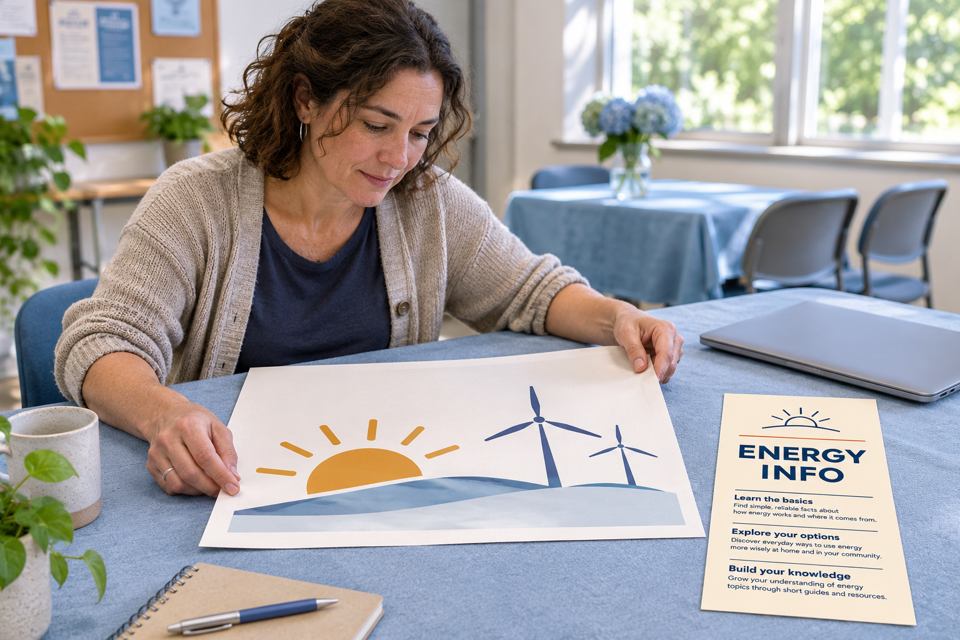
AI illustration of information planning. The person, paper display and Energy Info artwork are illustrative; no equipment performance or real event is shown.
Use the observance as context, then confirm the local offer
The UN’s International Day of Clean Energy page identifies January 26 as a day for awareness and action toward a just and inclusive clean-energy transition. It also identifies that date as IRENA’s founding date. The annual observance provides context; it does not confirm your organization’s event, access arrangements or speakers.
State the actual local activity date separately. Before using an edition-specific programme or an official event time, verify its year and relevance. An undated “join us” block on an observance page is not enough to announce a future local session or suggest that your host is part of an official UN event.
Choose a manageable public-learning question instead of promising to cover every energy issue. Confirm that the intended audience wants that introduction and that the host can provide the agreed explanation or resource route.
Match the visitor’s question to the available response
The U.S. Energy Information Administration’s Energy Explained guide organizes public information into topics such as energy sources, units, energy use and the environment. That gives an organizer a way to select an educational topic. It does not assess a particular building or establish the suitability of an individual project.
Visitor question
Suitable activity scope
What needs separate confirmation
Where can I learn the basic terms?
An introduction to a checked public resource and its relevant section.
The selected topic, explanation and facilitator’s preparation.
Can our group visit an energy site?
Information about a host-approved visit, if one is actually offered.
The site host, date, booking, route and participant requirements.
What would a project mean for my property?
A clear route to the appropriate project provider or adviser.
The provider’s own assessment process, scope and any individual proposal.
The same visitor may have more than one question. Give each a clear route instead of extending a general explanation into an answer the event has not established. A brochure title, a model or a speaker’s presence does not by itself confirm an individual project’s cost, suitability or expected results.
Worked example: an energy-resource information table
Fictional planning example: a neighborhood organization wants to host an adult introduction to public energy information around January 26. It has not arranged project assessments or a facility tour. The following brief describes an invented activity, not a real booking or partner announcement.
Visitor task: find a reliable starting resource for a general energy question. Format: a facilitated introduction to selected public information, with time to identify a relevant resource section. Content: the facilitator checks the chosen pages and explains what each page covers. Keep source addresses and review dates in the working notes. Project questions: explain that the session does not provide an individual property assessment. Offer only a verified provider contact route that the organizer is authorized to share. Visit questions: do not advertise a site visit unless the site host confirms one and provides its participation instructions. Local arrangements: the organizer confirms the activity date, venue, joining step and question contact before promotion. Takeaway: a maintained resource address and a clear next question to explore.
For this activity, an invitation can describe a public-resource introduction. It should not promise that attendees will receive installation recommendations, an energy quote or a place on a future tour.
If the host later arranges a separate project-advice appointment, publish its own confirmed scope and joining process. If a facility offers a visit, use that host’s current instructions. The original information table need not take on those additional tasks to be useful.
Prepare the information that supports the next step
Start with existing resources: the maintained activity page, selected public education pages and any approved host information. Confirm that the person staffing the table knows which questions the material answers and which questions need another owner.
A simple display can identify the topic and current source. A resource guide can help a visitor return to the relevant page. Keep explanations and source references legible; decoration should not be the only way a reader identifies the subject or next step.
Review each proposed extra item against the task. If an email or existing digital guide already gives people the needed route, an additional printed pack may not solve a remaining problem. If printing is useful, confirm the content owner, artwork, actual quantity, proof approval and receiving arrangements before ordering.
Keep the topic and the product facts separate. An energy-themed design does not establish the environmental attributes of the paper, a carbon reduction or a visitor’s energy savings. Describe the actual selected product rather than extending the event’s purpose into a performance claim.
Consider paper for a stable general-resource route
If reception or an information table repeatedly shares the same checked resources, custom rack cards for a general energy-resource guide are one possible format. Keep changing event details and individual project information in the maintained system.
The linked paper SKU is 3.74 × 8.27 inches, with a default 14pt glossy option and a starting quantity of 50. A holder is separate. Review an actual-size proof and rack card formats and options when preparing approved artwork with DecentCustom.
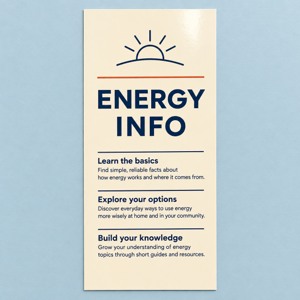
The image is an AI design concept for ordinary information paper, not an official campaign item, environmental certification or real customer order. Keep using an existing resource page or email when it already serves the visitor’s task.
Sources and the linked SKU were reviewed November 14, 2026. The activity brief and visitor-question framework are editorial examples. They do not confirm a local event, a 2027 official programme, a technical assessment, project savings or measured environmental or sales results.