Christmas packaging does not need every message printed on the main bag or box. When the underlying packaging suits year-round use, keep its stable brand identity separate from dates, limited offers and temporary instructions. Then check the quantity, handling and actual layout before deciding whether that approach serves your shop.
Review the words before choosing festive artwork
Start with a list of everything the proposed packaging says. Ask when each statement stops being accurate. A shop logo and a current store name may suit a longer use period. “Christmas 2026,” a dated promotion or a December pickup instruction has a different life.
- Potential base artwork: the approved store identity, a logo and a general message that remains appropriate outside the holiday. Check that the identity itself is still current.
- Seasonal message: Christmas wording, a year, a limited collection or event information. Put an end date or review point in the internal artwork record.
- Short-lived service information: particular opening hours, booking instructions or an offer deadline. A current counter notice or order message may be more suitable than a bag expected to remain in stock.
- Required product information: keep the product's own necessary information intact. This exercise does not authorize covering, removing or replacing it with decorative copy.
For a qualitative example of the underlying concern, an anonymous seasonal-business discussion raises minimum quantities, packaging costs and leftovers before demand is known. The question concerns a Diwali experiment, not a verified US Christmas sample. It is a useful planning question, not evidence of how many bags your shop will use or that a separate insert is automatically cheaper.
One purchase quantity, three possible remaining quantities
Fictional example: Pine & Post is considering 200 bags for a holiday use period. The following numbers are deliberately chosen scenarios, not a sales forecast or a recommended order quantity:
- If 120 bags are used, 200 − 120 = 80 bags remain.
- If 150 bags are used, 200 − 150 = 50 bags remain.
- If 180 bags are used, 200 − 180 = 20 bags remain.
Now compare the artwork under the same scenarios. If every bag carries an expired offer or “Christmas 2026,” the remaining units retain that dated message. If the bags carry only a still-current Pine & Post identity, the remaining units may be usable for later appropriate orders after inspection and a fit check.
Neither design changes the arithmetic. Nor does it guarantee future use, good storage condition or customer demand. The distinction is whether the message itself limits an otherwise suitable bag. A leftover unit is not automatically waste, and a generic logo does not automatically make an unsuitable bag useful.
Make the purchase decision from your own observed use, usable stock, intended period and current supplier requirements. The figures above do not determine the quantities of inserts, labels or shipping packages; each component has its own purpose and minimum.
Treat the seasonal insert as a separate, current item
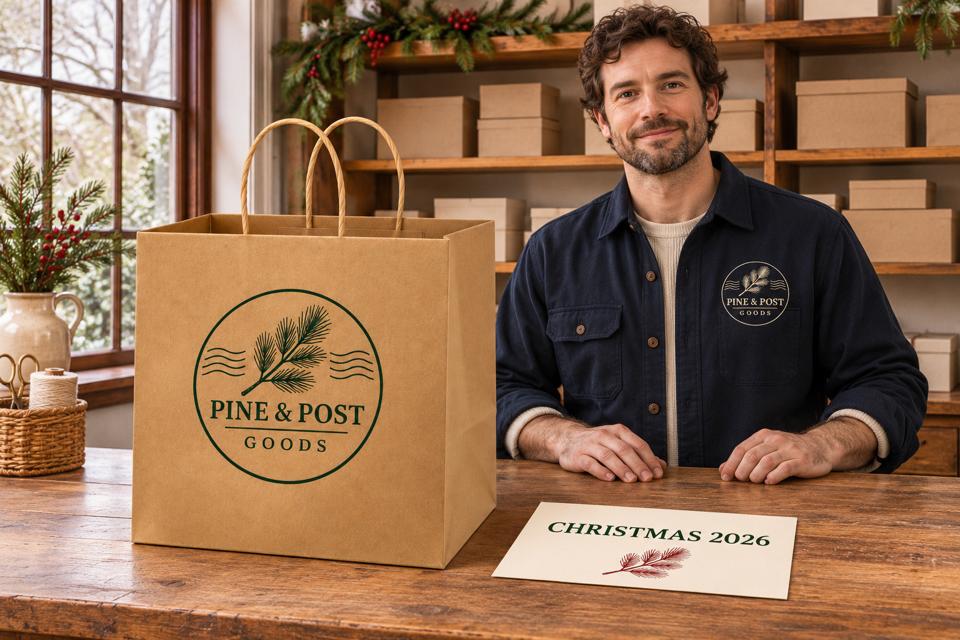
In the fictional design, the kraft bag carries the Pine & Post name and pine-postmark logo. A loose card carries “Christmas 2026.” The separate card is an illustration of the copy split, not a claim that all orders need another piece of packaging.
Before commissioning a separate component, check what customers actually need to read and how staff will handle it. Consider whether it stays legible, fits the selected presentation and avoids hiding necessary product information. Do not assume an adhesive label can be removed cleanly from a bag; that needs the actual materials and an appropriate test.
Keep the two artwork records distinct. For example:
Fictional Pine & Post artwork brief
Base bag: current store name and pine-postmark logo; no holiday year, offer or pickup date.
Seasonal card: Christmas 2026 message only; review before any later use period.
Approval check: verify each component's actual quantity, layout and final copy before ordering.
After the holiday: keep remaining bags and dated cards separately identified; do not distribute outdated messages with a later order.
If a temporary offer or service instruction is added, confirm its precise terms with the shop's responsible person and include a review point. A new date on the bag does not confirm that the underlying promotion or service is available.
Compare complete current quotes for the proposed components, including relevant setup, handling, production and delivery conditions. Splitting the artwork can add work or another minimum quantity. Choose it for a defined operational benefit, rather than assuming that two components always cost less than one.
A fully seasonal bag can still be an intentional choice
A retailer may want the whole presentation to be Christmas-specific for a limited collection, a confirmed event or a deliberately seasonal gift. That is a different design goal. Keep the use period and quantity clear, then decide what the store will do if some units remain.
Leaving the year off does not necessarily make a Christmas design suitable for every later occasion. A named event, expired offer, changed logo or very specific seasonal artwork can still restrict its use. Review the actual words and design, rather than labeling the entire stock “evergreen.”
Check the bag's physical job as well as its message
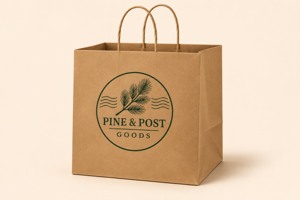
One kraft base-bag candidate
DecentCustom's brown kraft retail bags list 120 GSM natural kraft, twisted paper handles and dimensions of 12 W × 12 H × 9 D inches. Compare the actual packed item and handling needs before choosing this form.
At review, the ordering quantity validation starts at 60; the stated case pack is 200. Those figures do not establish this fictional shop's requirement. The AI logo bag is a design concept, with no carrying-capacity, food-contact or transit-protection test supplied here.
Compare paper bag formats if a different size or structure fits better. A request to DecentCustom should distinguish stable base artwork from any time-limited component, with the required quantities and current proof versions for each.
The decision is ready when the selected packaging fits its job, each message has an appropriate use period, the complete configuration has been reviewed and someone owns the remaining-stock check. Existing suitable packaging, with no additional seasonal component, can also be the right outcome.
Reviewed November 8, 2026. Pine & Post, its artwork brief and quantity scenarios are fictional. No actual demand, savings, stock reuse, recycling outcome or customer result was measured.