Workplace training planning • Reviewed November 28, 2026
A safety training day can give each worker a chance to find and use the site’s approved reporting route. Use a fictional case and an isolated practice channel so the team can check the process before anyone needs it on shift.
What should a hazard reporting exercise test?
Have a worker find the reporting route available on their shift, describe what they observed and identify the person or team that will receive the report. Ask the receiver to acknowledge it in the exercise and show where a follow-up would go. Use a training account, a marked paper simulation or a facilitator role-play approved by the site.
OSHA’s recommended practices for education and training include explaining how to report hazards and close calls, using language workers can understand and allowing questions and feedback. The practical exercise below applies those recommendations to one training task. Have the site's safety lead review the scenario, language and routes before running it.
Use an invented observation and location that everyone can discuss safely in a training room. A photo mockup or drawing can supply the prompt without staging a hazard. Explain how to leave the exercise and reach the site’s actual reporting or emergency process if someone raises a real concern.
How do you run the exercise?
- Assign a reporter and a receiver. Give the reporter the scenario. Give the receiver the approved practice route and an agreed way to acknowledge the submission.
- Watch the reporter choose a route. Let the worker use the tools and language available on their shift. Ask where they would get help if the route is missing, locked or unfamiliar.
- Check what arrives. Can the receiver identify where the observation occurred and understand what the worker saw? Can the reporter tell who received it and how to ask for an update?
- Record a barrier and assign follow-up. When someone needs help to find the route, note which step failed. Fix the access or wording and arrange another attempt.
Give each person a turn as reporter rather than asking the group whether they understood the demonstration. Offer a way to practice in the language and format they ordinarily use. A person who watched the session may still need a turn. Record attendance and observed practice in separate fields.
What if the reporting route needs a login the worker lacks?
Fictional exercise: At the start of a shift, the facilitator presents a drawing of a curled mat edge at a fictional staff-room door. The worker’s task is to describe the observation and location using the simulated route. The practice portal asks for a type of login the worker does not have on the shared shift device.
First attempt. The worker finds the portal link but cannot get through the login screen. Record “route found, access blocked.” The coordinator asks the site’s reporting owner to confirm the alternate route available on this shift.
Second attempt. The coordinator adds the approved route to the practice sheet. In the simulation the worker tells the designated receiver, “The edge of the mat curls up just inside the staff-room north door.” The receiver repeats the location and provides the exercise follow-up path. Record “alternate route practiced, receipt observed.”
Still open. Give the login issue to the named owner with a check date. A successful rehearsal through the alternate route leaves the original access issue open. Confirm the fix on a shift device before closing it.
Review the wording with the worker. A note such as “could not get past the sign-in page on a shared device” tells the organizer what to fix. A broad mark such as “needs more training” hides the access problem. Keep the practice record limited to the exercise and the follow-up it requires.
When does a practice station need a printed label?

Mark the table clearly during the exercise
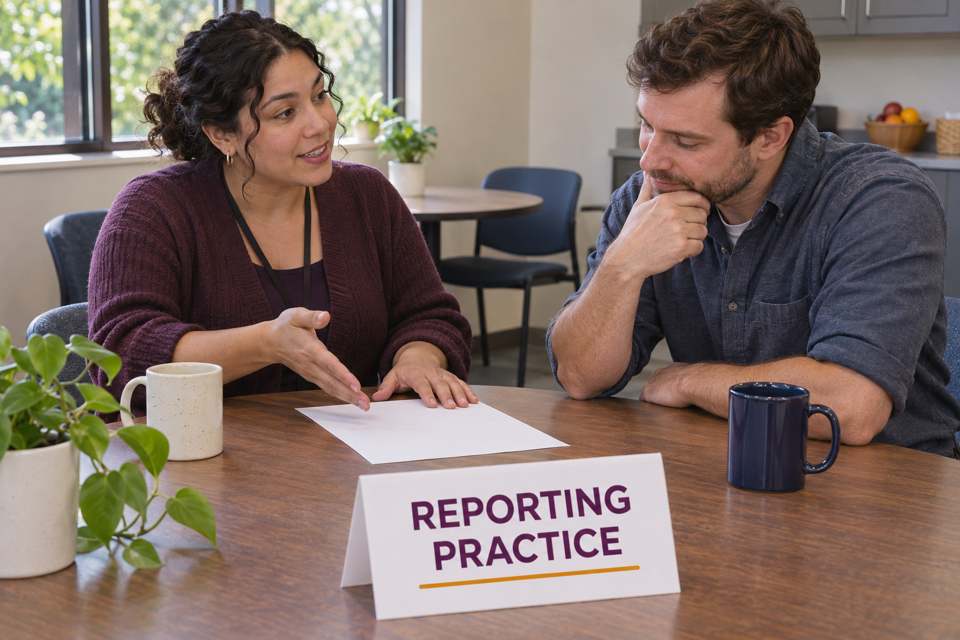
A card with “Reporting Practice” can identify a tabletop during repeated sessions. Explain the practice boundary during the briefing and remove the card when the exercise finishes. A reusable holder and a paper insert can do the same job for a one-off session.
DecentCustom’s custom paper table tents for a practice station are listed at 5 × 7 inches on 14pt cardstock and use a folded format. Confirm how the intended wording fits at actual size and check that readers can see it from the approach. Compare custom marketing materials when a different format is useful. Share the approved wording and placement with DecentCustom for a print proof.
The pictured table tent is AI concept artwork for a tabletop exercise.
Safety training day practice questions
Can participants send a fictional report to the live system?
Use a separate approved training channel or role-play. Send real workplace concerns through the site’s actual process.
What if workers use different reporting routes on different shifts?
Confirm the route and the receiver for each shift. Let workers rehearse with the devices, language and alternatives available to them.
What should the organizer record when practice is incomplete?
Record the last observed step, the specific barrier, the person responsible for removing it and the next practice date.
Does this rehearsal document completion of required training?
It documents the reporting steps observed in the exercise. Ask the site’s safety lead to track any required training and evaluations under its own approved process.