The woman on the “We Can Do It!” poster and Norman Rockwell’s Rosie are often grouped together. Their makers, original settings and paths to recognition are different.
Rosie is a broader symbol; the two artworks have different makers
Norman Rockwell’s Rosie and J. Howard Miller’s “We Can Do It!” are different images. The Library of Congress’s Rosie the Riveter guide describes Rosie as a symbol of women’s wartime industrial work.
Rockwell: a magazine cover
Rockwell’s Rosie appeared on the May 29, 1943, cover of The Saturday Evening Post. It is not the Miller poster under another title.
Miller: a Westinghouse poster
Miller made “We Can Do It!” for Westinghouse. The National Archives’ description explains that Westinghouse hired him to create a poster series and initially used this one internally. The familiar association with Rosie developed later.
This distinction does not require choosing one image as the only “real Rosie.” A symbolic character, a named artwork and the many women who actually worked during the war are different subjects.
Present-day recognition is not evidence of wartime circulation
A picture can be widely recognizable now without having reached a broad public when it first appeared. The Library of Congress describes limited wartime circulation and links later popularity to a 1982 magazine article about National Archives posters.
That changes the historical question. Instead of asking only “What does this image mean to us?”, also ask “Who was meant to see it then?” An internal workplace poster and a national magazine cover entered different settings. Treating them as one nationwide wartime campaign erases information the sources provide.
The National Archives supplies another useful detail: its caption dates the poster approximately 1942–1943 and gives National Archives Identifier 535413. Retain that approximate range when citing that record. A catalog date range is not an invitation to invent an exact printing day.
A caption can name the work without overstating its reach
Too broad: “This Rosie poster recruited women across the country during World War II.”
Source-bound: “J. Howard Miller created ‘We Can Do It!’ for Westinghouse. The National Archives describes its original internal use and its later association with Rosie the Riveter. The archive’s record dates the poster approximately 1942–1943.”
The second version tells readers which artwork is being discussed and separates its first setting from its later identity. It leaves room to investigate further. It does not claim that the image alone caused anyone to take a job, or that every woman war worker had the same experience.
Use the image as an opening, then follow the evidence
A Women’s History Month reading table or community workshop can place two questions beside its source links:
- Which work are we looking at? Find the maker, title, original publication or commissioner, and catalog identifier where supplied.
- Which claim does the source support? Separate original audience from later recognition, and a symbolic worker from a particular person’s documented life.
For a complete short introduction, try:
Keep direct source addresses available. The Library of Congress guide links to photographs for further reading. For the calendar background, read why Women’s History Month is in March.
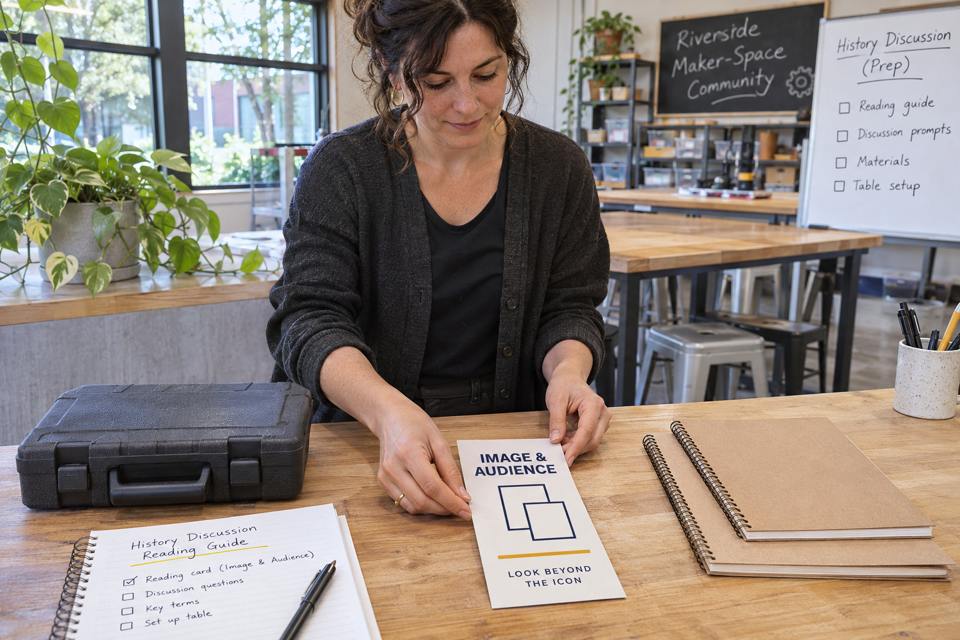
These institutional descriptions support the distinctions above; they are not a complete account of women’s wartime labor. This article does not identify a definitive model for the poster or reproduce either historical artwork. Its AI image is a modern reading scene, not evidence of the period.
A short source guide may be enough
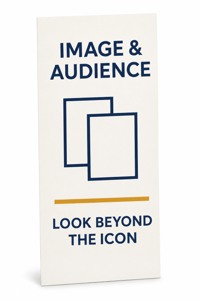
Use an existing handout or the digital sources when they serve readers well. If a take-away guide is needed, custom rack cards for a source-reading guide offer a narrow flat-paper format. The linked SKU currently lists 3.74 × 8.27-inch cards, default 14pt stock, a 16pt option and a 50-card minimum. A display holder is not established as included.
Compare custom marketing materials and confirm layout and configuration with DecentCustom. The fictional artwork shown here is a new source-guide design, not licensed museum merchandise or a reproduction of a historical poster.