A number on a Nutrition Facts label only makes sense with its stated amount. Check the serving size and the column heading before treating calories per serving as calories for the whole package.

Serving size and servings per container answer different questions
Serving size tells you the amount used for a serving-based label calculation. Servings per container tells you how many such servings the package contains. Read those together with the heading above the nutrient figures.
The FDA’s serving-size guide explains that labels usually report nutrition per serving, while some also provide information for the package. It also makes a crucial distinction: the label’s serving size reflects typical consumption, rather than a recommendation of how much an individual should eat.
In other words, “one serving” is a basis for reading these numbers. It does not tell a workshop host what every participant should put on a plate.
A 45-gram amount is not automatically one serving
This is an invented arithmetic exercise, not a real food’s label or a dietary recommendation. Suppose a package contains 90 grams, with a stated serving size of 30 grams and 150 calories per serving. It therefore contains three servings.
| Amount in this exercise | Servings represented | Calculated calories |
|---|---|---|
| 30 g | 30 ÷ 30 = 1 | 1 × 150 = 150 |
| 45 g | 45 ÷ 30 = 1.5 | 1.5 × 150 = 225 |
| 90 g, the whole package | 90 ÷ 30 = 3 | 3 × 150 = 450 |
Formula: amount used ÷ stated serving amount = number of servings; then multiply that number by the per-serving figure. Keep the units consistent: grams divided by grams, not grams divided by an unconverted cup measure.
For the 45-gram amount, writing “150 calories” would carry over the figure for 30 grams. Writing “450 calories” would use the whole-package amount. The calculation gives 225 for this fictional exercise. The lesson is to match the number to its denominator before making a comparison.
If a column already says per package, do not multiply it again
The FDA describes dual-column labels that show figures both per serving and for the whole package. Read the heading before choosing which figure to use.
Using the fictional example: a per-serving column shows 150 calories, and a per-package column shows 450.
For the whole package: use the 450 figure directly. Multiplying 450 by three again would give 1,350 and count the package three times.
Also check whether a label describes the food as packaged or as prepared. Keep any stated basis with the number you copy. A remembered calorie figure without its amount or column heading is an incomplete comparison note.
A good note preserves the amount and the source
For a community label-reading activity, one completed exercise note could be:
With a real package, write its exact name or version, the label’s stated serving amount, the chosen column and the amount being compared. If that information is missing, return to the package rather than asking an AI tool to guess the label.
This is a reading-and-arithmetic exercise, not a way to rank someone’s diet from one nutrient or one food. Label figures can be rounded; a scaled result is a calculation from those figures, not a new laboratory measurement. Individual nutrition questions belong with an appropriately qualified professional.
An existing notebook may be all the activity needs
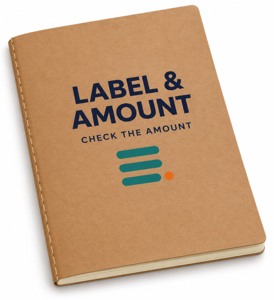
If a group genuinely needs a consistent place for its worksheets, kraft-cover A5 notebooks for a label-reading worksheet are one option. The linked product currently lists blank pages, 80 sheets and an 8.26 × 5.83-inch format. Its minimum is 12 notebooks; the listed 500-piece case pack is a separate figure. A pen is not included.
Use existing paper or the FDA guide when sufficient. For a justified order, compare custom padfolios and notebooks and confirm the selected format and artwork with DecentCustom. A notebook organizes notes; it does not measure food or provide nutrition advice. The pictured design is fictional and carries no official campaign artwork.